Exposition Medals
1915 Panama-Pacific So-Called Dollars: Reading HK Numbers and Rarity Ratings
10 min read
The Panama-Pacific International Exposition opened in San Francisco in 1915 to mark the completion of the Panama Canal, and unofficially to show the world that the city had rebuilt after the 1906 earthquake. It produced the deepest and best-cataloged run of so-called dollars of any American fair, including a series of state-sponsored issues. For collectors it is the ideal field in which to learn HK numbering, rarity ratings and the way metal multiplies a single design into several distinct collectibles.
Why Was There a Fair in San Francisco in 1915?
Officially, to celebrate the opening of the Panama Canal, completed in 1914 and one of the largest engineering achievements attempted to that date. The canal transformed the economics of Pacific shipping, and a Pacific-coast city had an obvious claim to mark it.
Unofficially, and more importantly to the people who built it, to demonstrate that San Francisco had come back. The 1906 earthquake and the fire that followed destroyed a large part of the city and killed thousands. Nine years later the exposition was a deliberate statement of recovery, staged on reclaimed ground at the northern edge of the city.
That double purpose gives the material a particular character. It is celebratory in an assertive, slightly defiant register, and it was produced by a city with something to prove.
The Palace of Fine Arts, built for the fair, still stands, the only major structure to survive, and the reason the exposition remains physically present in San Francisco rather than only in its souvenirs.
How Do HK Numbers Work?
HK refers to Harold Hibler and Charles Kappen, whose 1963 reference *So-Called Dollars* cataloged dollar-sized commemorative medals and tokens and assigned the numbering the field still uses.
An HK number identifies a design. It does not identify a metal, a grade or a specific specimen. This is the single most common source of confusion in listings, and it works exactly as DeWitt numbers do for campaign medals, a point we cover in why one campaign medal exists in several metals.
Alongside the number, Hibler and Kappen assigned a rarity rating on a scale from R1 to R10:
R1 to R2 indicates common material you can find whenever you want it. R3 to R4 indicates moderate scarcity. R5 and above indicates genuine scarcity, a piece that requires waiting for. R8 to R10 covers the extremely rare through to unique.
Our archive spans this range: the Oregon HK 411 at R3 sits in the moderate band, while HK 404 in bronze and HK 414 in gilt brass are both R5.
| Rating | Meaning | What it means for buying |
|---|---|---|
| R1–R2 | Common | Buy the best example you see; there will be others |
| R3–R4 | Moderately scarce | Available with patience; condition still negotiable |
| R5–R7 | Scarce to very scarce | Take a good example when it appears |
| R8–R10 | Extremely rare to unique | Availability governs, not condition |
What Are the State Issues?
Several US states sponsored buildings and exhibits at the exposition, and a number issued their own so-called dollars, pieces identifying a specific state's participation rather than the fair generally.
This creates one of the most satisfying sub-collections in the field: a run of state issues from a single exposition. The unifying element is the fair; the variable is the state, and each piece carries its own iconography.
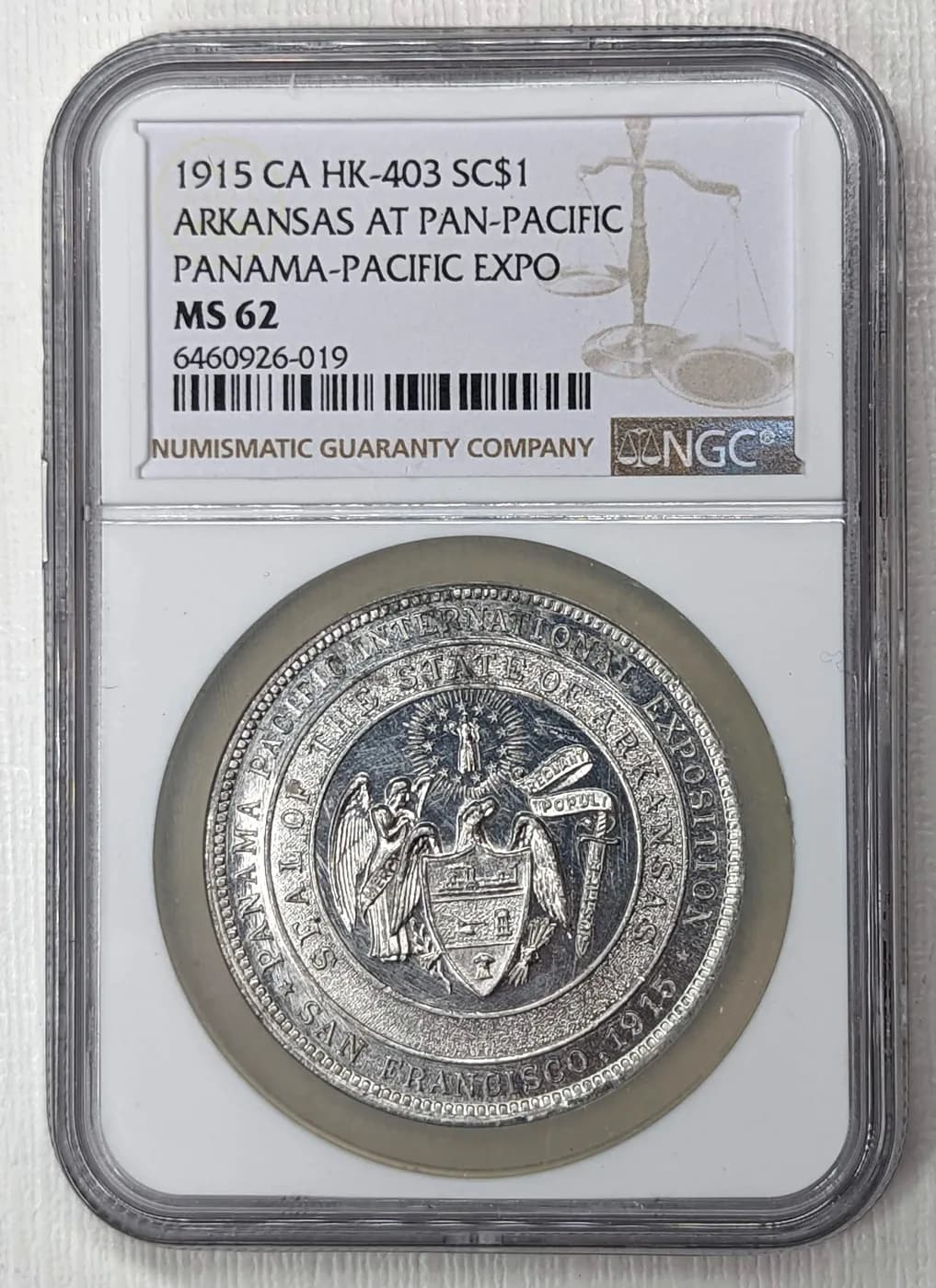
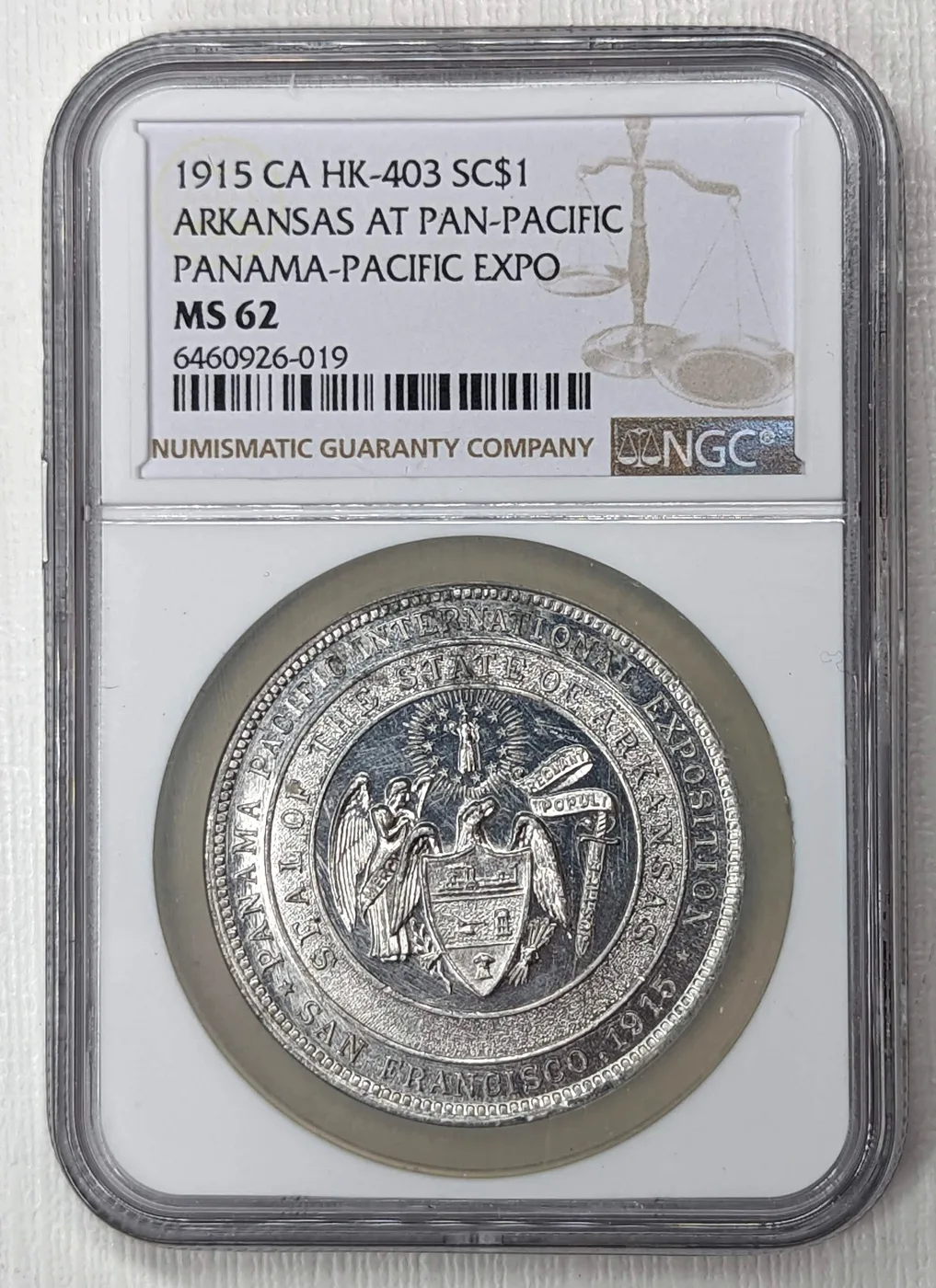
Our archive includes the Arkansas issue, HK 403, at NGC MS62 and the Oregon issue, HK 411, at MS63.
State issues also tend to attract regional collectors, someone in Arkansas who collects Arkansas, which supports prices independently of the exposition collector base. That is a genuine structural advantage over generic souvenir material.
How Much Does Metal Change Things?
Enough that metal should always be established before price is discussed.
The 1915 series was struck across bronze, gilt brass, silver and other alloys depending on the issue. A single HK number can therefore describe several genuinely different collectibles with different survival rates and different prices.
Gilt brass is the metal that causes the most trouble. Gilding is a thin gold wash over a brass core, and it wears through on high points with handling. A gilt piece with most of its gilding intact is considerably more desirable than one worn down to the brass, and photographs disguise the difference easily, which is a strong argument for buying gilt material certified.
Bronze is more forgiving and ages predictably, developing a stable patina. As always, an original bronze surface beats a cleaned one regardless of technical grade.
What Does an AU Details Grade Tell You?
It tells you two separate things, and collectors routinely conflate them.
AU, About Uncirculated, describes the amount of wear: a piece with light friction on high points but most original surface intact.
Details means the grading service declined to assign a straight numerical grade because of a problem outside the wear scale, cleaning, damage, a repair, environmental effects, mounting. The service is saying: this is genuine, here is roughly its wear level, and here is why it does not get a number.
So a piece graded AU Details is authenticated, lightly worn, and carries a disclosed issue. On an R5 piece that combination is often the sensible buy, because scarcity governs at that rarity level and waiting for a problem-free example may mean waiting years.
The same logic applies across this cataloge, and we cover it in more depth in what a 'Details' grade means. The principle: on common material, buy the grade. On scarce material, buy the piece.
What Official Coins Did the Fair Produce?
The most ambitious commemorative coin program the United States has ever issued, and it sits directly alongside the so-called dollars.
The 1915 Panama-Pacific issue ran to five coins struck at the San Francisco mint: a silver half dollar, a gold dollar, a gold quarter eagle, and two fifty dollar gold pieces, one round and one octagonal. The fifty dollar coins are the largest United States coins ever issued for circulation as legal tender, the octagonal format is unique to this issue, and both were produced in tiny numbers because almost nobody could afford them at the time.
They are relevant to a so-called dollar collector for two reasons. First, they set the visual vocabulary the unofficial pieces borrowed from, so a medal echoing the coinage is usually deliberate rather than coincidental. Second, they explain the price structure of the whole 1915 field: the official coins absorbed the collector money at the top, leaving the medals and so-called dollars to develop as a separate and much cheaper market.
For most collectors the half dollar is the realistic point of contact with the official program, and the two gold fifties belong to a different budget entirely.
What Did the Fair Look Like?
Deliberately spectacular, and built to say San Francisco had recovered.
The exposition marked the opening of the Panama Canal, but its local purpose was to demonstrate that the city rebuilt after the 1906 earthquake and fire was functioning and confident. The centerpiece was the Tower of Jewels, hung with tens of thousands of cut glass pieces that moved in the wind and threw light during the day and under searchlights at night.
Bernard Maybeck's Palace of Fine Arts survives, rebuilt in permanent materials, and is the reason the fair remains visible in the city rather than existing only in photographs.
The design program shows up throughout the medallic material. Towers, canal imagery, the state seals of the participating states and allegories of the two oceans joined are the recurring motifs, and they are worth learning because the state issues in particular are frequently listed by sellers who describe the design without recognizing the series it belongs to.
How Should You Use Population Reports?
As a floor on scarcity, never as a count.
A population report tells you how many examples a grading service has graded at each level, which is a different question from how many exist. Pieces get resubmitted in the hope of a higher grade, which inflates counts. Pieces get crossed between services. And an entire category of material has never been submitted at all, because the coins are worth less than the fee.
That last point bites hardest in exactly this series. So-called dollars in the lower price tiers are frequently uncertified, so a report showing a handful graded may reflect submission economics rather than rarity. The HK rarity ratings, built from decades of specialist observation, remain the better guide to how many pieces are actually out there.
Where population data does earn its keep is at the top of a grade run. If a type shows a substantial population through MS64 and almost nothing above it, that is a real signal about how the issue was made and stored, and it tells you what a jump of one grade point is likely to cost. Read the shape of the distribution rather than the headline number.
Why Is 1915 the Best Series to Learn On?
Because it has depth, documentation and a full range of difficulty in one place.
Depth: enough distinct designs that you can collect for years without exhausting it.
Documentation: the HK cataloge covers it thoroughly, so you can always establish what you are looking at.
Range: pieces at R1 through to genuine rarities, which means you can build a real collection at modest cost while learning what scarcity actually feels like in practice.
Certification: enough material has been submitted to NGC and PCGS that population data is meaningful, unlike thinner exposition fields.
A collector who works through the 1915 series properly comes out understanding HK numbering, rarity ratings, metal variation and details grading, which is most of what is needed to buy confidently anywhere else in exposition material. The wider map is in collecting American world's fair medals and tokens.
One last practical point in its favor: the 1915 material is documented well enough that you can check yourself. The HK catalog covers it thoroughly, auction records for the common types are plentiful, and the state issues give you a structured set to work through rather than an open field. A new collector can form an opinion about a piece, test it against the record, and find out within minutes whether the opinion was any good. Very few areas of exonumia offer that.
Frequently asked questions
What does HK stand for on a so-called dollar?
Hibler and Kappen, the authors of the 1963 reference So-Called Dollars, which cataloged this material and assigned the numbering still used universally. An HK number identifies a design, not a metal or a specific piece.
How rare is an R5 rating?
Genuinely scarce. On the Hibler and Kappen scale of R1 to R10, R5 sits in the band where you take a good example when one appears rather than holding out for a better one, because opportunities are infrequent.
Should I avoid a Details grade?
Not on scarce material. Details means the piece is genuine but has a disclosed problem outside the wear scale. On common pieces, hold out for a straight grade; on an R5 piece, a Details example is often the sensible purchase.
What was the Panama-Pacific Exposition celebrating?
Officially the opening of the Panama Canal, completed in 1914. Unofficially, San Francisco's recovery from the 1906 earthquake and fire, which is why the fair had such an assertive character.
What are the state issues?
So-called dollars sponsored by individual US states that participated in the exposition, identifying that state rather than the fair generally. They make a natural sub-collection and attract regional collectors as well as exposition specialists.
Why does gilt brass need extra care?
Because gilding is a thin gold wash over brass that wears through on high points, and photographs hide the difference between a fully gilt piece and a worn one. It is the metal where independent certification most repays the cost.
Pieces from the collection
Examples handled here, cataloged with photographs and, where the piece was certified, its grading label. Sold pieces stay listed as a reference record.
 Sold
SoldMedals · 1915
1915 Panama Pacific Exposition Arkansas HK 403 MS62 NGC So Called Dollar
Sold
Medals · 1915
1915 Panama Pacific Exposition Oregon HK 411 MS63 NGC So Called Dollar R3
Sold
Medals · 1915
1915 Panama Pacific Exposition HK 404 NGC AU Det So Called Dollar R5 Bronze
Sold
Medals · 1915
1915 Panama Pacific Exposition HK 414 MS61 NGC So Called Dollar R5 Gilt Brass
Sold
More guides
Have one of these?
We buy outright, and we will value a piece for you whether or not you sell. Photographs and whatever paperwork you have are enough to start.