
Provenance
What 'Ex DeWitt' Means on a Campaign Medal
7 min read
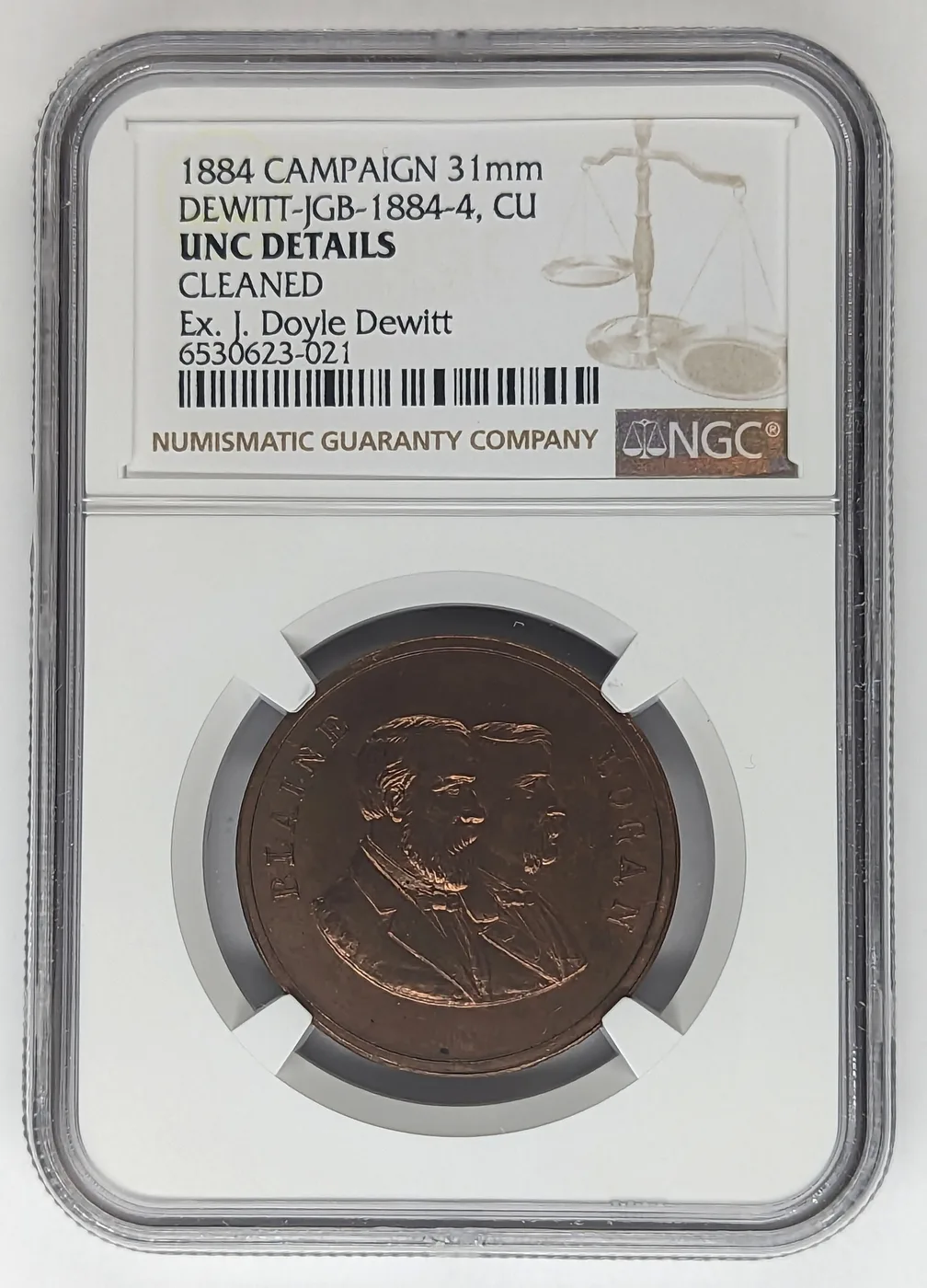
A line reading Ex. J. Doyle DeWitt on a certification label means the medal in the holder traces back to the collection of the man who wrote the catalog those medals are numbered by. DeWitt assembled more than 25,000 pieces of American political material, published the descriptive list collectors still cite, and left the collection to the University of Hartford. Understanding that line tells you where a piece has been, why its catalog number exists, and why it reached the market when it did.
Who Was J. Doyle DeWitt?
DeWitt was a Hartford, Connecticut insurance executive who became the leading authority on American political numismatics. His interest went well past accumulation: he cataloged what he owned and what he saw, and in 1959 he published **A Century of Campaign Buttons 1789-1889**, subtitled a descriptive list of medalets, tokens, buttons, ferrotypes and other lapel devices relating to the national political campaigns in the United States.
That subtitle matters more than it looks. DeWitt was not writing about coins. He was writing about the things people pinned to a coat or carried in a pocket during a campaign season, a category that federal coin references ignore entirely. He also produced work on American political badges and medalets covering 1789 to 1892.
The collection behind the book grew to more than 25,000 individual pieces, which is why his numbering could be so granular. He was describing objects he could put on the desk in front of him.
Why Does His Name Appear on Modern Holders?
Two separate reasons converge on the same label, and collectors often conflate them.
The first is cataloging. When a holder reads DEWITT-GC-1888-12, that is DeWitt's classification system: the candidate's initials, the campaign year, and the number he assigned that design. It tells you what the piece is.
The second is provenance. When the label also reads Ex. J. Doyle DeWitt, it is saying this particular specimen came out of his collection. It tells you where the piece has been.
A medal can carry a DeWitt number without ever having been near DeWitt's collection, because the number describes a type that anyone can own. Only the provenance line makes the ownership claim, and only some pieces earn it.
| Label element | What it asserts | Applies to |
|---|---|---|
| DEWITT-GC-1888-12 | The design's catalog number in DeWitt's descriptive list | Every specimen of that design |
| WM, BRASS, CU, AR, GILT | The metal this specimen was struck in | This specimen only |
| MS 64, AU Details | The grading service assessment of condition | This specimen only |
| Ex. J. Doyle DeWitt | Ownership history traced to DeWitt's collection | This specimen only |
How Did a 1950s Collection Reach the Market Now?
DeWitt arranged for his collection to go to the University of Hartford, in his home city. The university raised funds for a Museum of American Political Life to display it alongside other holdings of political Americana.
The museum closed in 2004. The collection went into storage, where it remained for more than a decade while the university looked for a buyer and a new home for material that few institutions are equipped to house. Heritage Auctions acquired the collection and has been dispersing it at auction since 2022.
That timeline explains something collectors notice and misread: a sudden availability of ex-DeWitt material after decades of near-total absence. It is not a hoard surfacing or a fake provenance spreading. It is one very large institutional collection being sold in sequence.
What Is Ex DeWitt Provenance Actually Worth?
Honestly, it depends on what else the piece has going for it, and the effect is easy to overstate.
Provenance does not improve a medal's condition, and a bent, cleaned specimen with a famous prior owner is still a bent, cleaned specimen. What provenance does is remove doubt. For a category where reproductions and later restrikes exist, knowing a piece sat in a documented reference collection since well before the modern market is genuine assurance.
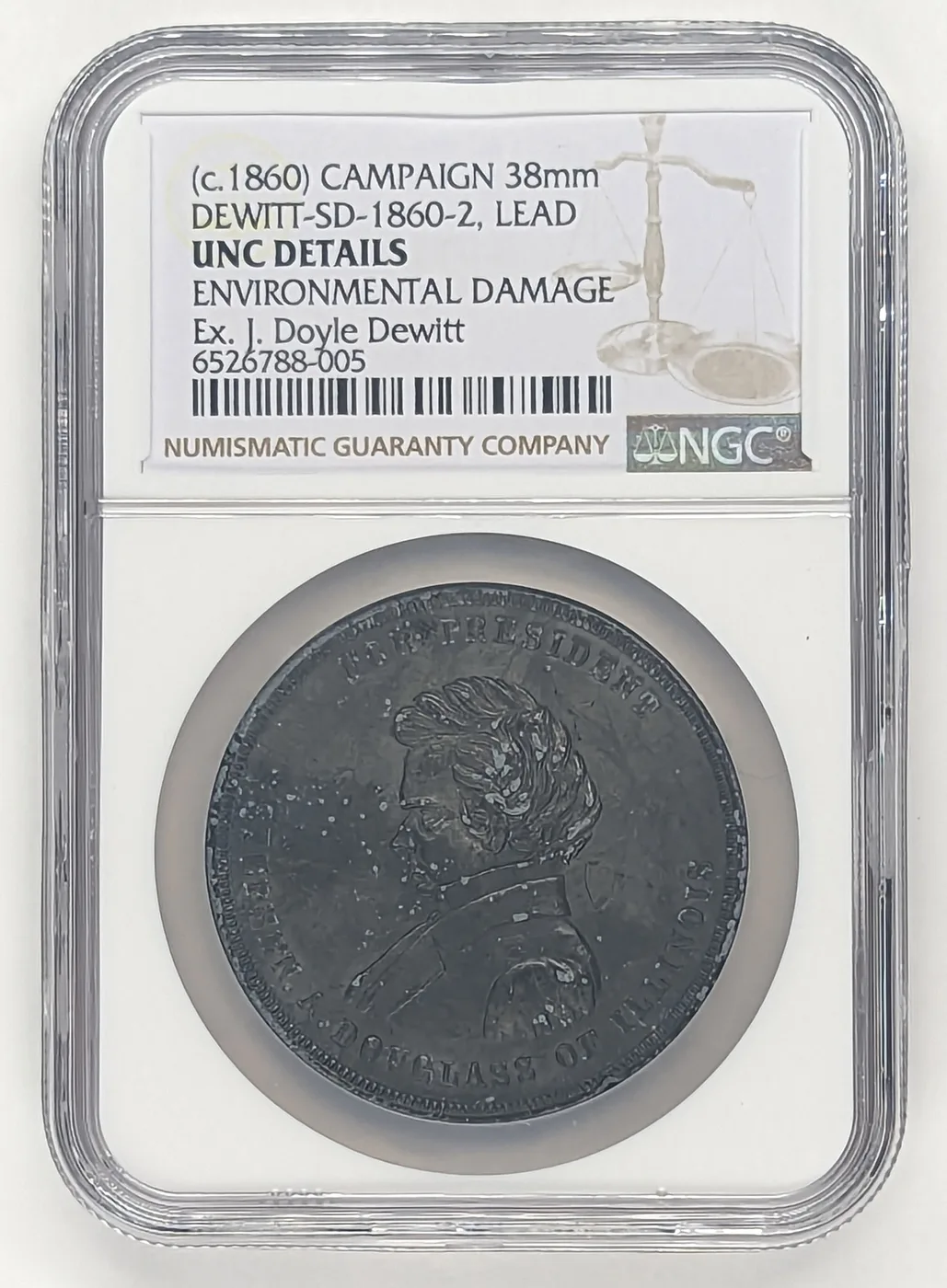
It also carries a collecting appeal of its own. Some buyers assemble by provenance rather than by candidate or date, and for them the line on the label is the point. A lead striking of a Douglas medal with environmental damage is a good illustration: undesirable on condition alone, but a documented survivor in a soft metal that rarely lasts.
The practical rule: treat it as a tiebreaker between comparable specimens rather than a multiplier on a poor one.
A Worked Example: Reading One Label End to End
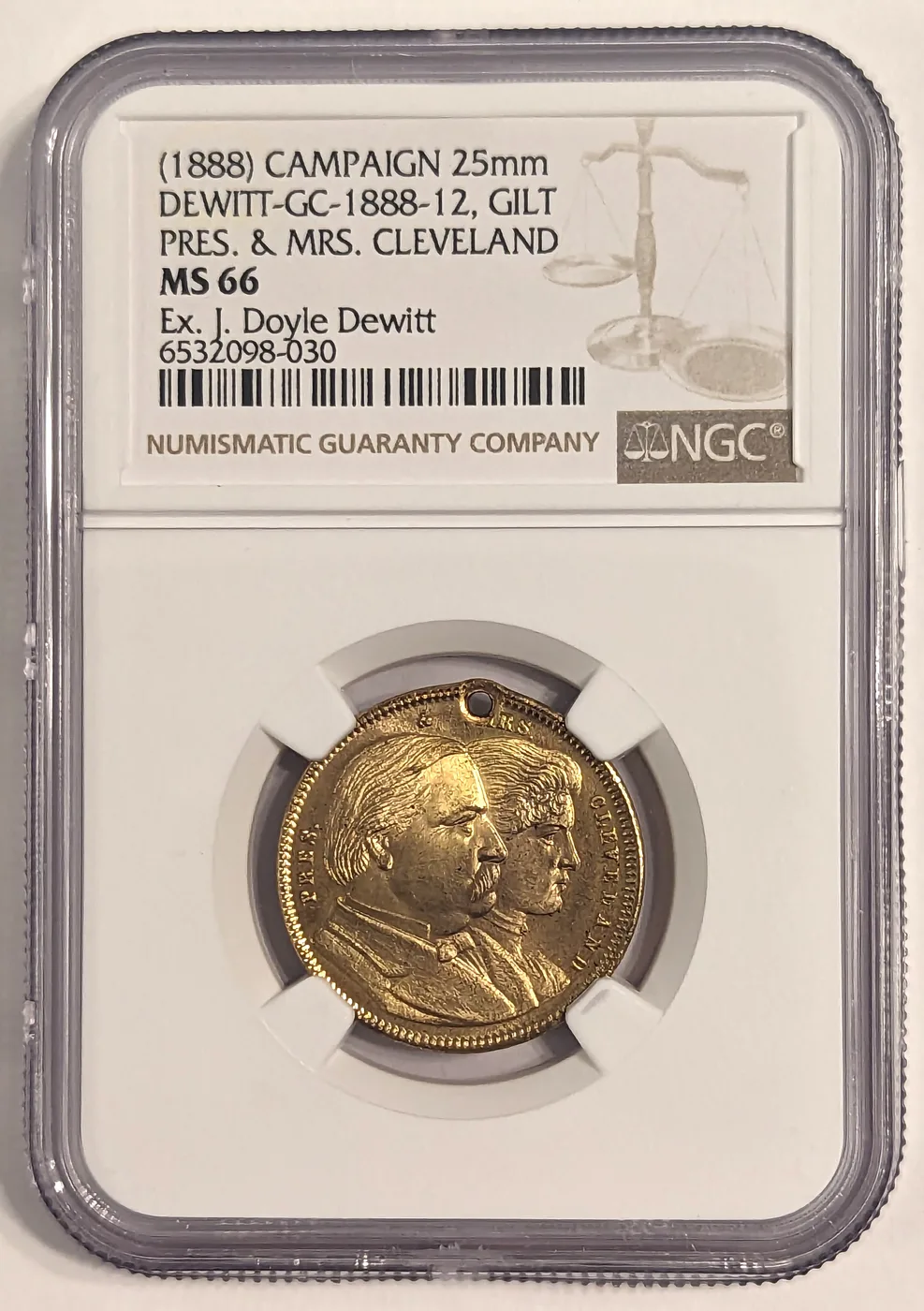
Take the holder on this 1888 Cleveland medal, which reads: 1888 CAMPAIGN 25mm / DEWITT-GC-1888-12, GILT / PRES. & MRS. CLEVELAND / MS 66 / Ex. J. Doyle DeWitt.
Read left to right, that is a campaign piece from the 1888 canvass, 25 millimeters across, cataloged by DeWitt as Grover Cleveland number 12 for that year, struck in gilt, showing the ticket of the President and Mrs. Cleveland rather than Cleveland alone, graded Mint State 66, and traced to DeWitt's collection.
Every one of those is a separate, checkable fact. The diameter can be measured. The catalog number can be looked up. The ticket can be confirmed against the design. The grade belongs to the grading service. The provenance can be traced to an auction record.
The one that trips people up is metal. GILT is not a grade and not a design variant, it is what this specimen is made of - and the same GC 1888-12 design also exists in other metals as genuinely different pieces. You can see that split directly in the available campaign medals, where one catalog number appears more than once with different metals and different grades.
How Do You Verify a Provenance Claim?
Provenance printed on a label is an assertion by whoever submitted the piece, accepted by the grading service. It is usually right and occasionally repeated carelessly, so verify rather than assume.
Check that the certification number on the holder resolves on the grading service's own verification lookup and returns the same description. Check that the catalog number matches the design in front of you rather than a similar one. Where the piece came through auction, the lot record should describe the same metal, diameter and grade.
Be sceptical of a provenance line with no paper behind it, on a piece whose catalog number and metal do not agree with the holder. Those three things disagreeing is the signal worth acting on.
Where DeWitt Numbers Stop Being Useful
DeWitt's list covers 1789 to 1889, extended in his badges and medalets work to 1892. Material after that is outside it, which is why later political items are cataloged under other systems entirely.
The list is also a description of designs, not a rarity guide or a price guide. It will tell you that a design exists and what it looks like. It will not tell you how many survive, what condition they are usually found in, or what one is worth today. Those questions are answered by auction records and population data, not by the number on the holder.
For pieces from the Civil War era that are tokens rather than campaign devices, a different reference applies, and the two are easy to confuse when a piece carries political imagery but circulated as money. The medals in the collection and the Civil War tokens are cataloged under those separate systems for exactly that reason.
Frequently asked questions
Does Ex DeWitt mean the medal is rare?
No. It is a statement about ownership history, not scarcity. Common designs were in the collection alongside rare ones, because DeWitt was building a comprehensive reference rather than a set of highlights.
Is a DeWitt number the same as a Fuld number?
No. DeWitt numbers catalog political campaign devices from 1789 onward. Fuld numbers catalog Civil War tokens, which are a different category of object that circulated as emergency money during a coin shortage.
Why does the same DeWitt number appear on medals in different metals?
Because the number identifies a design, not a specimen. A design struck in brass, copper, white metal and gilt produces four separate collectible pieces sharing one catalog number, and they can differ widely in scarcity and value.
Where is the DeWitt collection now?
It was donated to the University of Hartford, stored after the museum built to display it closed in 2004, and acquired by Heritage Auctions, which has been selling it at auction since 2022.
Can I look up a DeWitt number online?
Partly. Auction archives and specialist references cite the numbers heavily, so searching a number usually surfaces comparable examples. The original descriptive list itself is a 1959 book and remains the authoritative source.
Does a grading service verify provenance?
The service records the provenance the submitter asserts and prints it on the label. It authenticates and grades the piece itself, so treat the provenance line as a claim supported by the surrounding paperwork rather than an independently proven fact.
Pieces from the collection
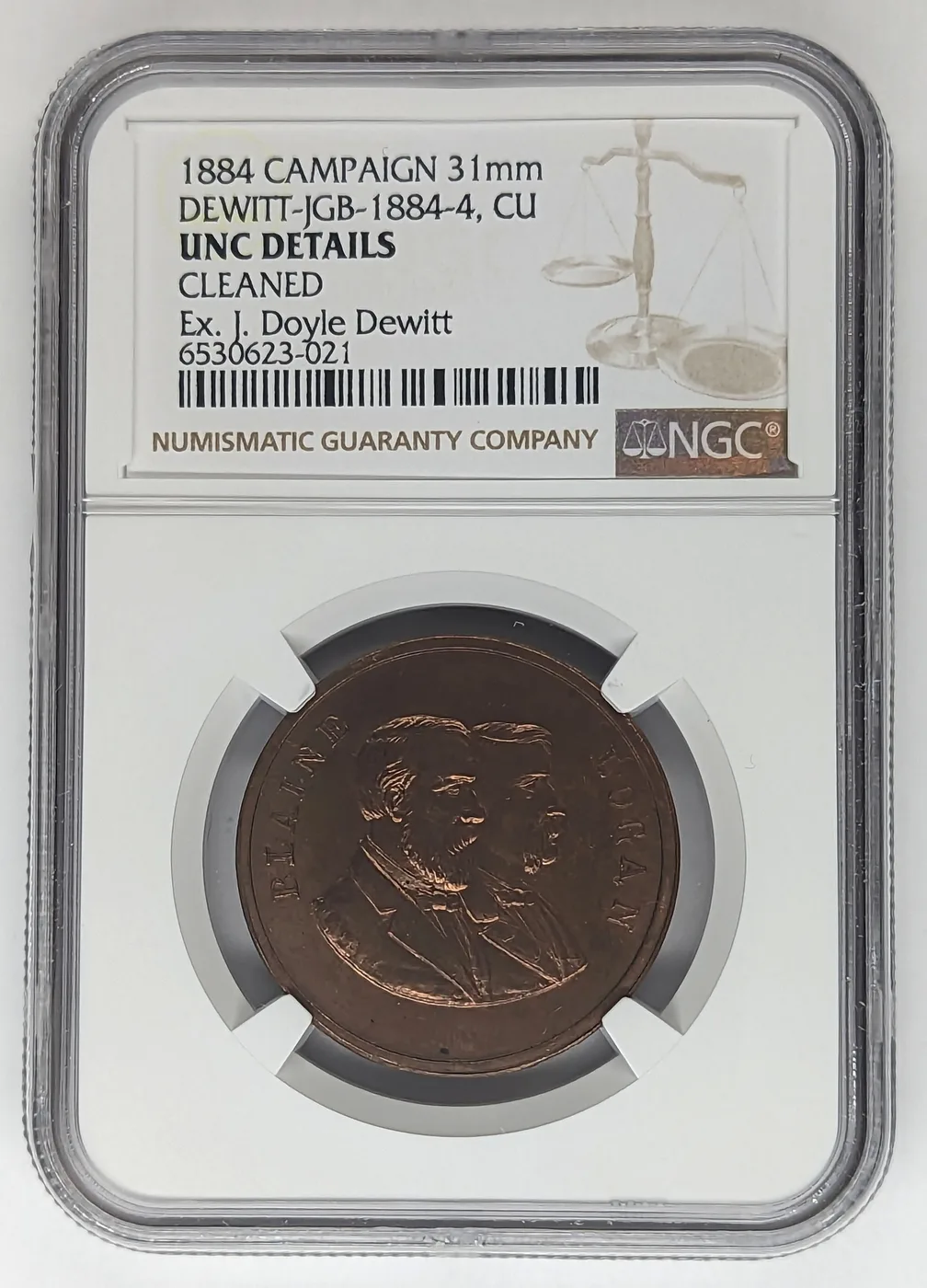
Examples handled here, cataloged with photographs and, where the piece was certified, its grading label. Sold pieces stay listed as a reference record.
More guides
Have one of these?
We buy outright, and we will value a piece for you whether or not you sell. Photographs and whatever paperwork you have are enough to start.