
World Coins
The 1908 Austria 100 Corona: Scarcity, Restrikes and What Sets the Price
9 min read
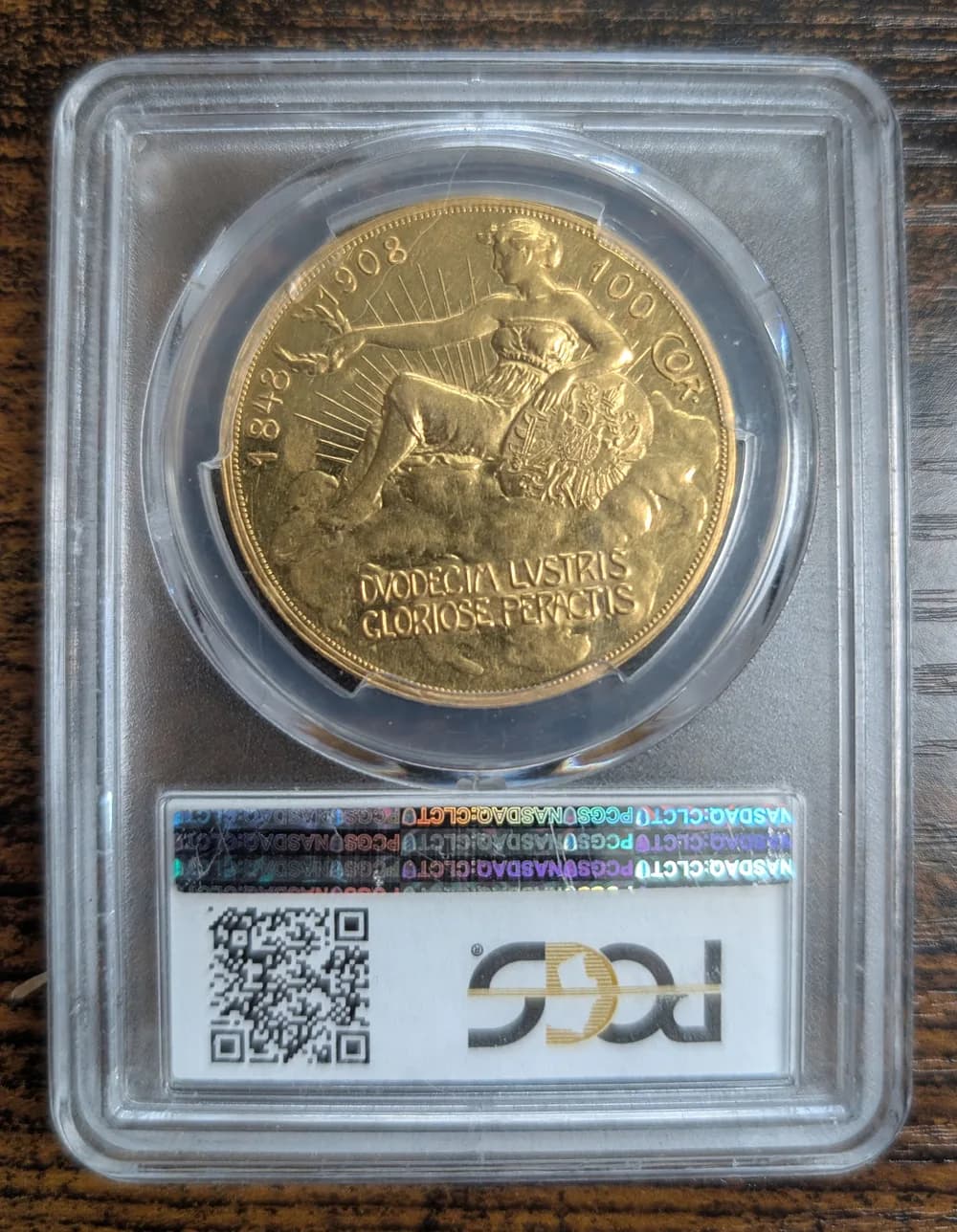
The 1908 Austrian 100 corona, known to collectors as Lady in the Clouds, is a one-year gold commemorative struck for the sixtieth anniversary of Franz Joseph I's reign. It carries 0.9802 troy ounces of fine gold and was designed by the Vienna medalist Rudolf Marschall. The decisive fact for a buyer is not the design but the striking: Austria restruck the type officially for the bullion market long afterwards, so most 1908-dated examples in existence were not made in 1908. Separating an original from a restrike is what determines the price, and it is not something a photograph can settle.
What Is the 1908 Austria 100 Corona?
The 100 corona was the largest gold denomination of the Austro-Hungarian corona system, introduced when Austria-Hungary moved from the gulden to a gold-standard currency in 1892. For most of its life it carried a conventional portrait obverse and a standing allegorical figure on the reverse, and it functioned less as circulating money than as a store of value and a trade coin.
1908 is the exception. In that year the Vienna mint struck a distinct commemorative design marking the sixtieth anniversary of Franz Joseph I's accession, which had taken place on 2 December 1848 during the revolutionary upheaval that swept the empire. A reign of sixty years was, by any measure, worth marking: he had been on the throne since before the American Civil War.
The result is a one-year type. It shares the denomination, the weight and the fineness of the ordinary 100 corona, and nothing else. For a collector that matters, because it means the coin can be bought as gold and sold as a design.
The nickname comes from the reverse, where a draped allegorical figure floats on a bank of cloud instead of standing on a ground line as she does on the standard type. Lady in the Clouds appears nowhere on the coin, it is a dealer and cataloge shorthand, and the same piece is also sold as the jubilee or sixtieth-anniversary 100 corona.
How Scarce Is It?
Scarcity here is not one number, and treating it as one is how buyers overpay.
Original 1908 strikes are the scarce part. The jubilee issue was struck for a single year, in a quantity appropriate to a commemorative rather than to a circulating trade coin, a small fraction of the tens of millions of gold coins Austria-Hungary produced across the corona period. Against that, Austria's later official restrikes of the type were produced for the bullion market in quantities that dwarf the original issue.
So the population of 1908-dated 100 corona pieces in existence today is dominated by coins that were not struck in 1908. The date on the coin is not a statement about when it was made, and any scarcity claim that ignores that is describing the wrong population.
The practical measure is the certified population report. PCGS and NGC both publish how many examples they have graded and at what grades, and both distinguish originals from restrikes in their attributions. That data is the closest thing to a survival estimate available, it is free to consult, and it updates continuously, which is more than can be said for any mintage figure quoted in a dealer listing.
Read it for shape rather than for a single total. The question that matters is not how many exist but how many exist above the grade you are buying, because that is what determines whether the next one is a month away or a year.
What Do Examples Actually Sell For?
Three things set the price, and they act in this order.
The gold floor. At 0.9802 troy ounces of fine gold, the coin has a hard bottom that moves with the bullion market. Nothing sells below it. On a restrike in ordinary condition, the price is the floor plus a modest margin, because that is essentially what the coin is.
The original premium. A verified original 1908 strike trades above a restrike of identical weight, fineness and design. This is the single largest swing in the market for the type, and it is why certification is worth its cost here rather than being a nicety.
The grade premium, which only bites near the top. Circulated and About Uncirculated originals are the normal state of the type; genuinely choice mint state examples are where the numbers climb steeply.
Where to check current levels: Heritage Auctions' archive records realized prices with images and grades, going back years, and is searchable without an account. NGC and PCGS publish price guides by grade. Use realized auction prices over guide values where both exist, a guide is an opinion, a hammer price is a transaction.
One caution on comparables: confirm the piece you are comparing against is the same thing you are buying. A restrike sale and an original sale sit side by side in search results, look identical in photographs, and are not comparable at all.
| Factor | Effect | How to verify it |
|---|---|---|
| Gold content | Sets the floor; identical on originals and restrikes | Weight and fineness are fixed by the corona standard |
| Original vs restrike | The largest single swing in the type | Certification, the attribution states which it is |
| Grade | Modest below AU, steep at the top of mint state | The label, plus the population report above that grade |
| Surface originality | Cleaning costs more than a grade point or two | Examine in hand or from good images before bidding |
Who Was Rudolf Marschall?
Rudolf Marschall was an Austrian medalist and engraver who spent his career in Vienna and directed the engraving school there. His background matters to how the coin looks: he came to coinage from the medallic tradition, where the designer has a wider field, deeper relief and no obligation to make a design stack neatly in a bank drawer.
That inheritance is visible in the jubilee 100 corona. The reverse composition is medallic, an allegorical figure in an open field, without the tight framing devices that circulating coinage usually demands. It is a medal designed to coin tolerances, which is precisely the quality that makes the type attractive to collectors who otherwise ignore world gold.
For anyone building a collection around the people who cut the dies rather than the countries that issued them, Marschall is a name worth knowing alongside Augustus Saint-Gaudens in America, both were medalists whose work crossed into coinage, and both produced designs that outlived the currency systems they served.
How Much Gold Is in It?
The specifications are fixed by the corona standard and are the first thing to check on any piece offered to you.
The practical implication: the coin has a hard floor. Whatever happens to collector demand, it contains just under an ounce of fine gold, and that sets the price below which it will never trade. The premium above that floor is what you are actually assessing when you look at grade, eye appeal and originality.
| Property | Value |
|---|---|
| Denomination | 100 corona |
| Gross weight | 33.875 g |
| Fineness | .900 gold |
| Fine gold content | 30.49 g / 0.9802 troy oz |
| Diameter | 37 mm |
| Designer | Rudolf Marschall |
| Type | One-year commemorative (60th jubilee) |
What Is the Difference Between an Original and a Restrike?
This is the question that decides the price, and it is the one most casually written listings avoid.
Austria has a long and openly acknowledged history of restriking its gold coinage, including corona-system pieces, using original or reworked dies long after the nominal date. These restrikes are official products of the mint, not counterfeits, and they are struck to the same weight and fineness. As bullion they are identical. As collectibles they are not.
An original 1908 strike is a survivor of the jubilee year. A later restrike is a gold product bearing an 1908 date. Both are legitimate; only one has a hundred and twenty years of history behind it, and the market prices them accordingly.
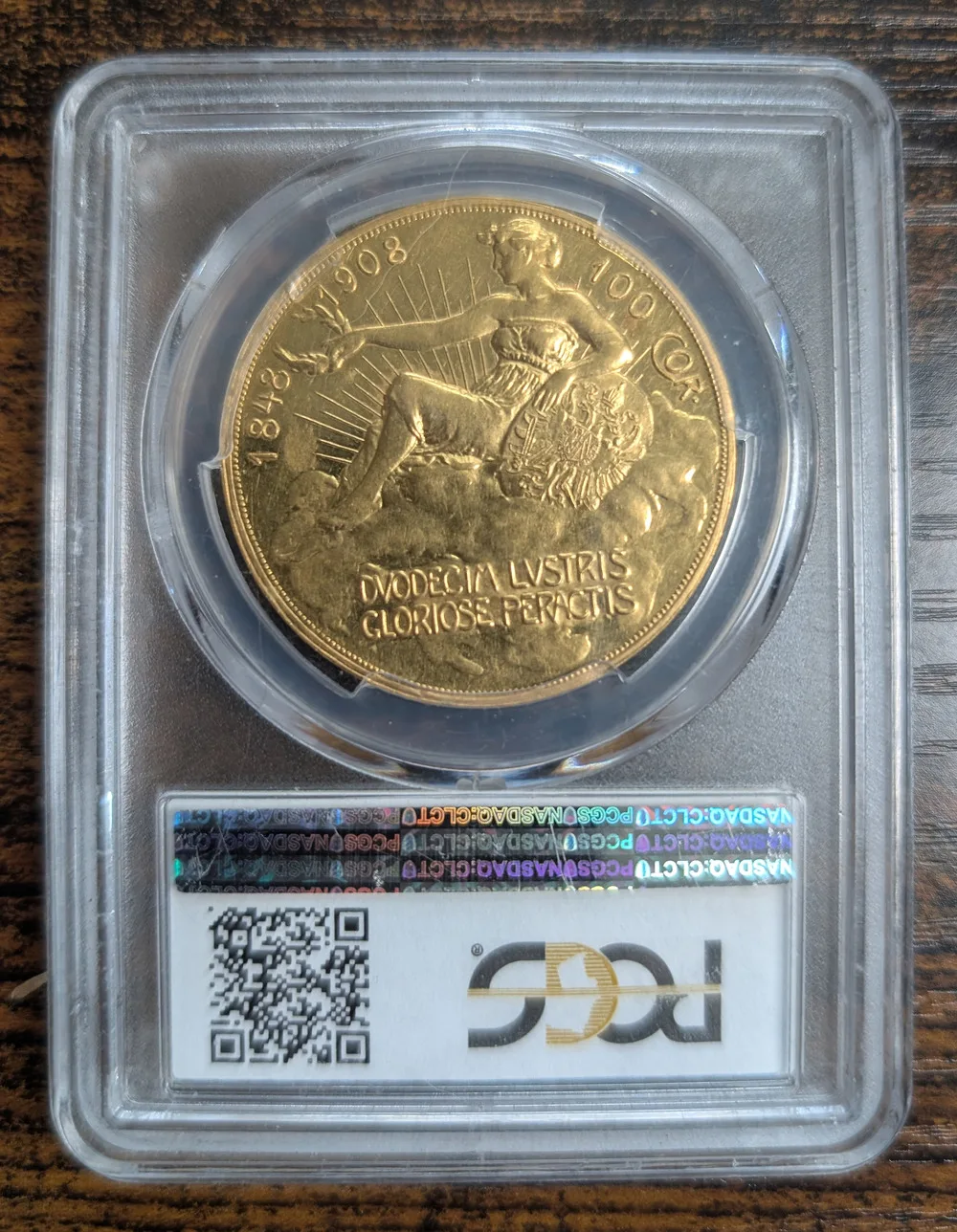
This is the single strongest argument for buying the type certified. PCGS and NGC both assess originality as part of grading, and a holdered coin removes the question from the negotiation. The piece we cataloged as PCGS AU55 is an example of the type in circulated-but-honest condition, which is where a lot of the genuinely old strikes sit.
How Should You Grade and Buy One?
Large gold coins take marks. At 37 millimetres and nearly an ounce, a 100 corona is heavy enough that contact with other coins leaves visible evidence, and most surviving pieces show it. About Uncirculated grades, AU50 through AU58, describe a coin with light friction on the high points and most of its original surface intact, and for this type that is a normal, unembarrassing state.
What to look for, in order: originality of surface before technical grade, because a cleaned or polished 100 corona is worth substantially less than a naturally toned one two grades lower. Then the reverse figure, since the floating allegory carries the highest relief on the coin and wears first. Then the rim and edge, where mount marks from jewellery use are common on large European gold and often disguised.
Buy the coin, not the label, but on a type with an active restrike history, buy the label too.
Why Is the 1915 Restrike the Coin Most People Have Seen?
Because Austria kept striking 100 corona pieces dated 1915 long after 1915, and sold them as gold rather than as coins.
The 1915-dated 100 corona is one of the standard European gold trade pieces, produced in quantity by the Austrian mint for the bullion market well into the modern era. It is a legitimate official product, not a counterfeit, and it carries a design of Franz Joseph in profile that has nothing to do with the Lady in the Clouds composition. Dealers stock it by weight, the premium over melt is small, and the date on it tells you nothing about when it was made.
This matters here for one reason: it is the coin a newcomer finds first when searching for an Austrian 100 corona, and it sets a price expectation that is completely wrong for the 1908 jubilee type. One is a bullion instrument valued at roughly its gold content. The other is a one-year commemorative whose value rests on being a specific, dated, collectible issue, and whose originals carry a real premium over metal.
If a listing shows a 100 corona at a thin premium to spot, it is almost certainly a 1915 restrike, whatever the seller has called it. Check the date and check the design before anything else.
Where Does It Fit in a Collection?
The jubilee 100 corona sits at an unusual intersection. It is world gold, so it appeals to bullion-adjacent buyers. It is a one-year commemorative type, so it appeals to type collectors. And it is medallic in design and by a named medalist, so it appeals to people who collect the work of engravers rather than the coinage of nations.
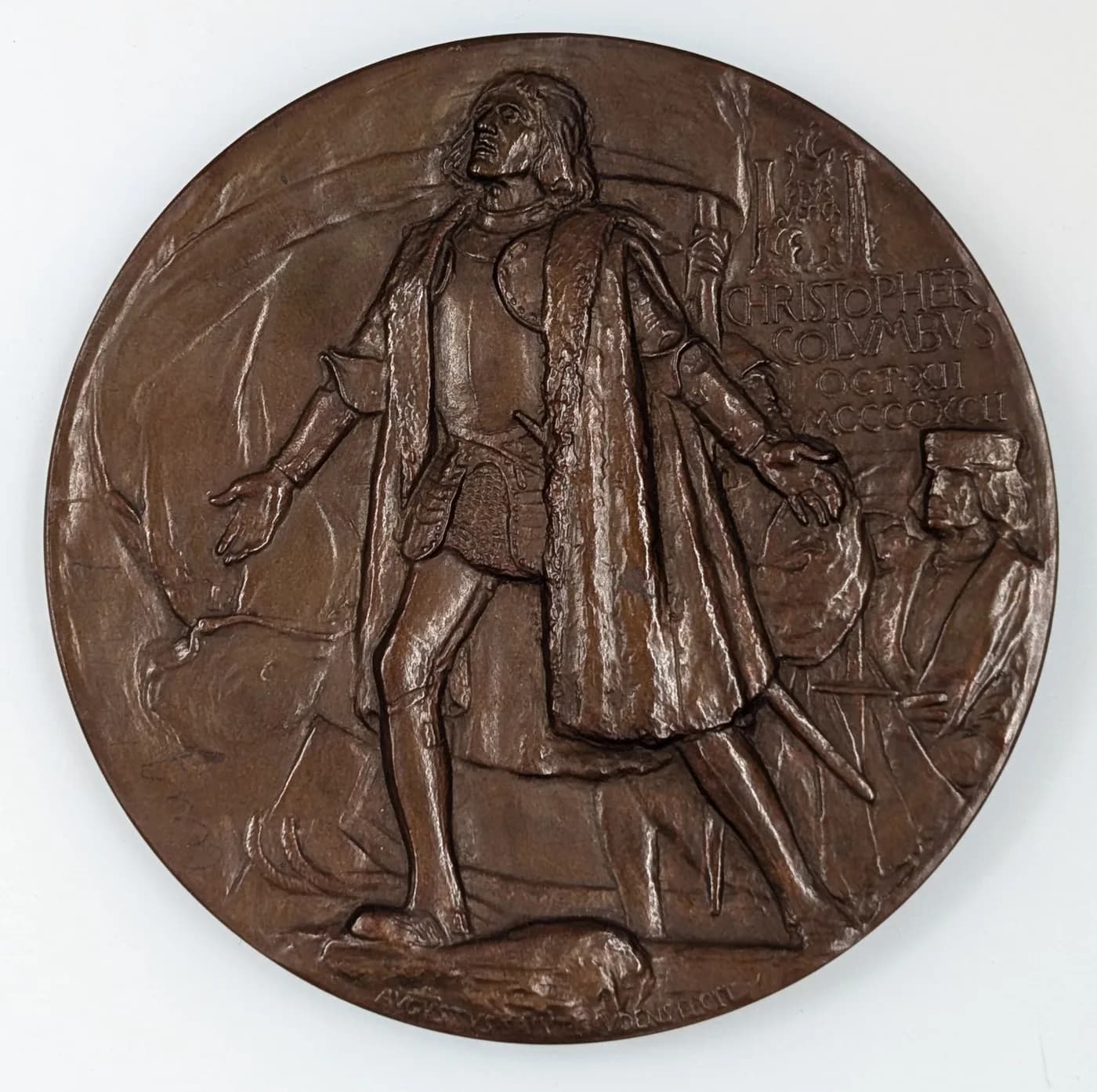
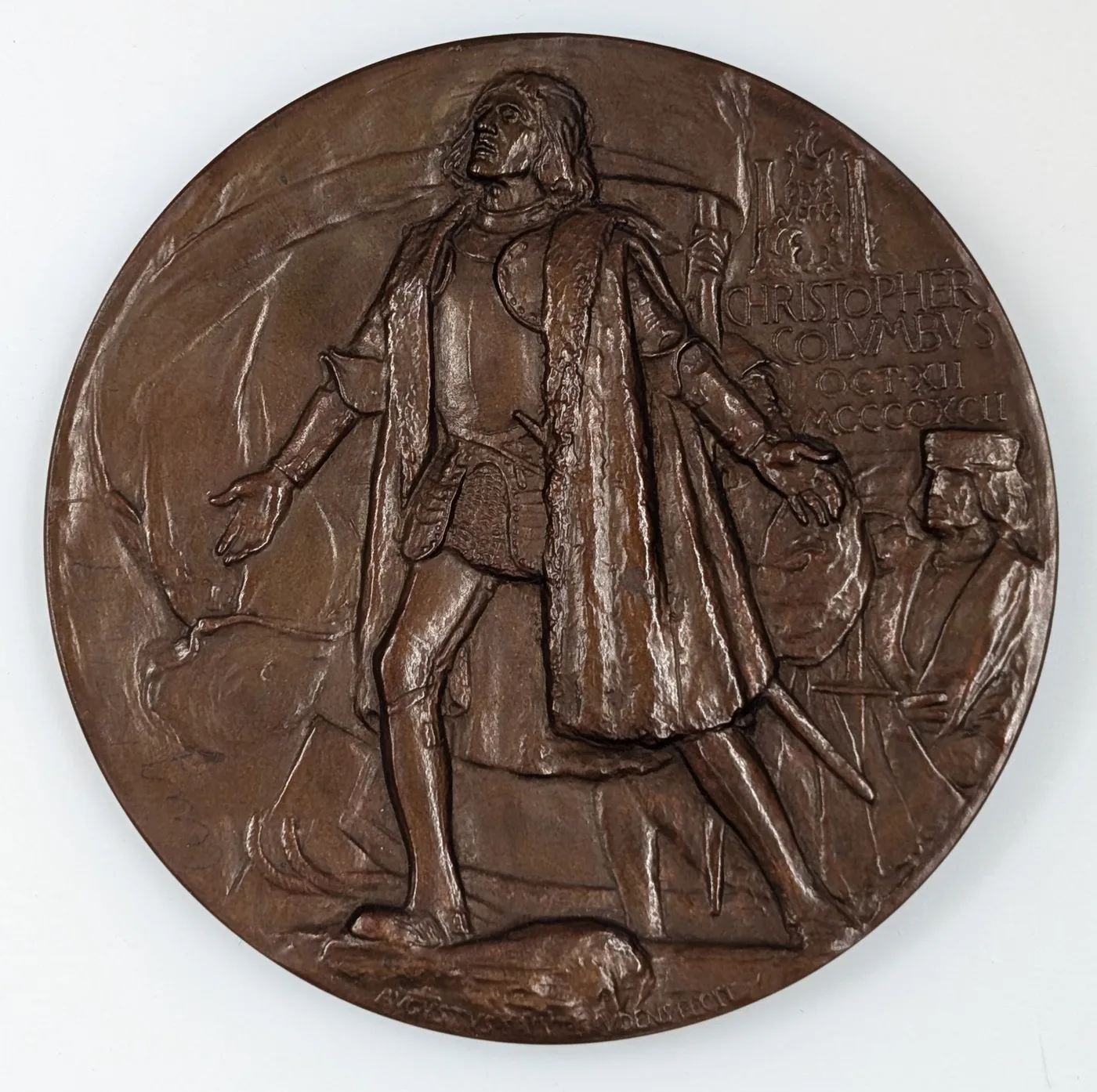
That third group is the one this cataloge is built for. If you collect by the hand that cut the die, Marschall's jubilee piece belongs next to American medallic work of the same generation, the Saint-Gaudens Columbian Exposition medal of 1893 is the obvious companion, struck fifteen years earlier by a sculptor making the same crossing from medal to coin.
Both answer the same question from opposite sides of the Atlantic: what happens when you give a medalist a coin to design.
Frequently asked questions
Is the 1908 Austria 100 corona a real gold coin or a bullion round?
It is a real coin. It was legal tender of Austria-Hungary at a face value of 100 corona and was struck by the Vienna mint to the official corona gold standard. Its bullion content is incidental to that, not the reason it was made.
How can I tell a restrike from an original 1908 strike?
Reliably, you cannot do it from a photograph. Restrikes were struck from original or reworked dies to the same specifications, so the differences are in surface, strike character and die state rather than design. Certification by PCGS or NGC is the practical answer, since originality is part of what they assess.
What does AU55 mean on this coin?
About Uncirculated 55 means the coin has light friction on its highest points from brief handling but retains most of its original mint surface. On a coin this large and heavy, AU is a common and perfectly respectable grade for a genuinely old strike.
Why is it worth more than its gold value?
Because it is a one-year commemorative design by a named medalist, rather than a generic trade coin. The gold sets a floor; the design, the jubilee occasion and the condition set the premium above it.
How many 1908 100 corona were struck?
The original jubilee issue was a single year's commemorative striking, small against the tens of millions of gold coins Austria-Hungary produced across the corona period. But official restrikes made later for the bullion market far outnumber it, so a raw mintage figure describes only part of what exists. The certified population reports at PCGS and NGC are the more useful measure.
What does one of these actually sell for?
The example cataloged here sold for $5,000 in April 2025: an original 1908 striking, certified PCGS AU55. That is the figure to reason from, because it separates the two things that set the price. Roughly 0.98 troy ounces of gold sets the floor, and being a genuine jubilee-year strike rather than a later restrike sets everything above it. Restrikes change hands at a thin premium to spot, so a restrike sale tells you almost nothing about what an original is worth. Every piece we handle stays listed here with what it brought, so the comparables are on this site rather than somewhere you have to go and register for.
Is Franz Joseph I the same emperor connected to the start of the First World War?
Yes. He reigned from 1848 until his death in 1916, and it was his heir presumptive, Archduke Franz Ferdinand, whose assassination in 1914 triggered the July Crisis. This coin was struck six years before that, at the high-water mark of the reign.
Pieces from the collection
Examples handled here, cataloged with photographs and, where the piece was certified, its grading label. Sold pieces stay listed as a reference record.
More guides
Have one of these?
We buy outright, and we will value a piece for you whether or not you sell. Photographs and whatever paperwork you have are enough to start.