Exposition Medals
Collecting American World's Fair Medals and Tokens: A Field Guide
11 min read
Between 1876 and 1939 the United States staged a series of world's fairs that each produced their own currency of souvenirs, official award medals, privately struck so-called dollars, exhibitor tokens, ribbons and badges. Collecting them means learning two cataloges, Hibler and Kappen for the dollar-sized pieces and the exposition literature for everything else, and understanding that an official medal and a concessionaire's token are very different objects that sat side by side on the same fairground.
Which American Expositions Matter to Collectors?
Six produced material substantial enough to sustain a collection, and they run in a chain across sixty-three years.
1876 Philadelphia, Centennial Exhibition. The first major American world's fair, marking a hundred years of independence.
1893 Chicago, World's Columbian Exposition. The largest and most influential, nominally marking four hundred years since Columbus. Dedicated in October 1892 and opened to the public in May 1893, which is why both dates appear on material.
1901 Buffalo, Pan-American Exposition. Remembered less for the fair than for what happened at it.
1904 St Louis, Louisiana Purchase Exposition. The fair of the popular imagination, and a vast producer of souvenirs of every kind, including complete boxed sets of playing cards.
1915 San Francisco, Panama-Pacific International Exposition. Marking the opening of the Panama Canal and, unofficially, the city's recovery from the 1906 earthquake.
1939 New York, World's Fair. The last of the line before the war, and the one that produced gold Lincoln tokens.
What Is a So-Called Dollar?
It is a cataloge category rather than a type of object, and understanding that prevents a lot of confusion.
So-called dollars are dollar-sized medals and tokens, struck privately rather than by the US Mint, commemorating events, expositions and anniversaries. They are not coins, were never legal tender, and were never intended to be. The name acknowledges that they look like dollars and are not.
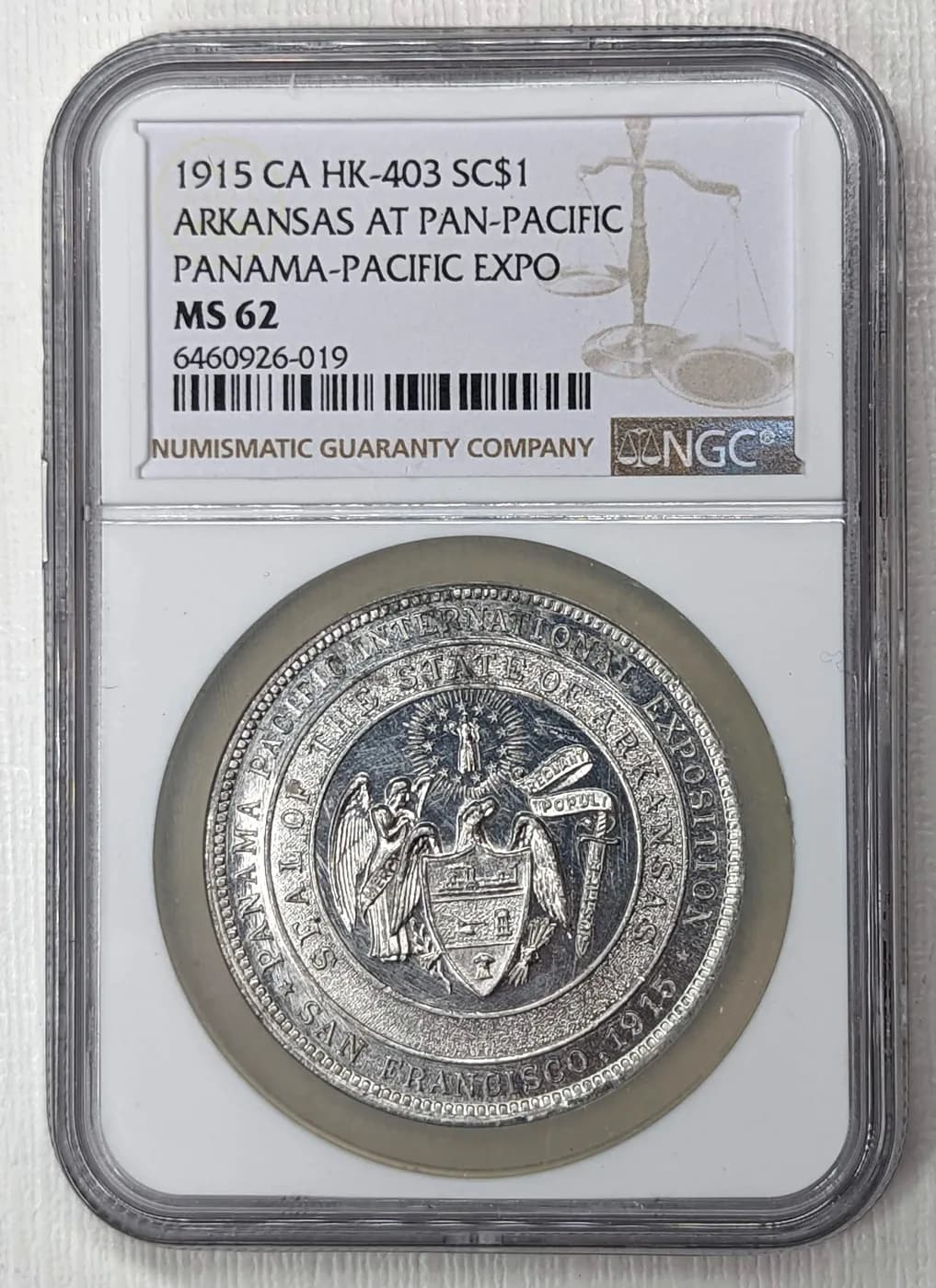
The standard reference is *So-Called Dollars* by Harold Hibler and Charles Kappen, published in 1963, which assigned the HK numbers still used universally. An HK number identifies a design; the metal is a separate attribute.
The cataloge also assigns rarity ratings from R1 to R10, where R1 is common and R10 is unique or nearly so. An R5 rating, which appears on several pieces in our archive, indicates genuine scarcity, see the 1915 Panama-Pacific HK 404 in bronze and HK 414 in gilt brass, both rated R5.
| Element | Example | What it tells you |
|---|---|---|
| HK number | HK 403 | The design, per Hibler & Kappen |
| Rarity | R3, R5 | Scarcity on a 1-10 scale; R5 is genuinely scarce |
| Metal | Bronze, gilt brass, silver | A separate attribute; same HK can exist in several |
| Grade | NGC MS62 | Condition, independently assessed |
| Exposition | Panama-Pacific 1915 | The event it commemorates |
What Is the Difference Between Official and Private Issues?
This is the distinction most commonly lost in dealer listings, and it materially affects value.
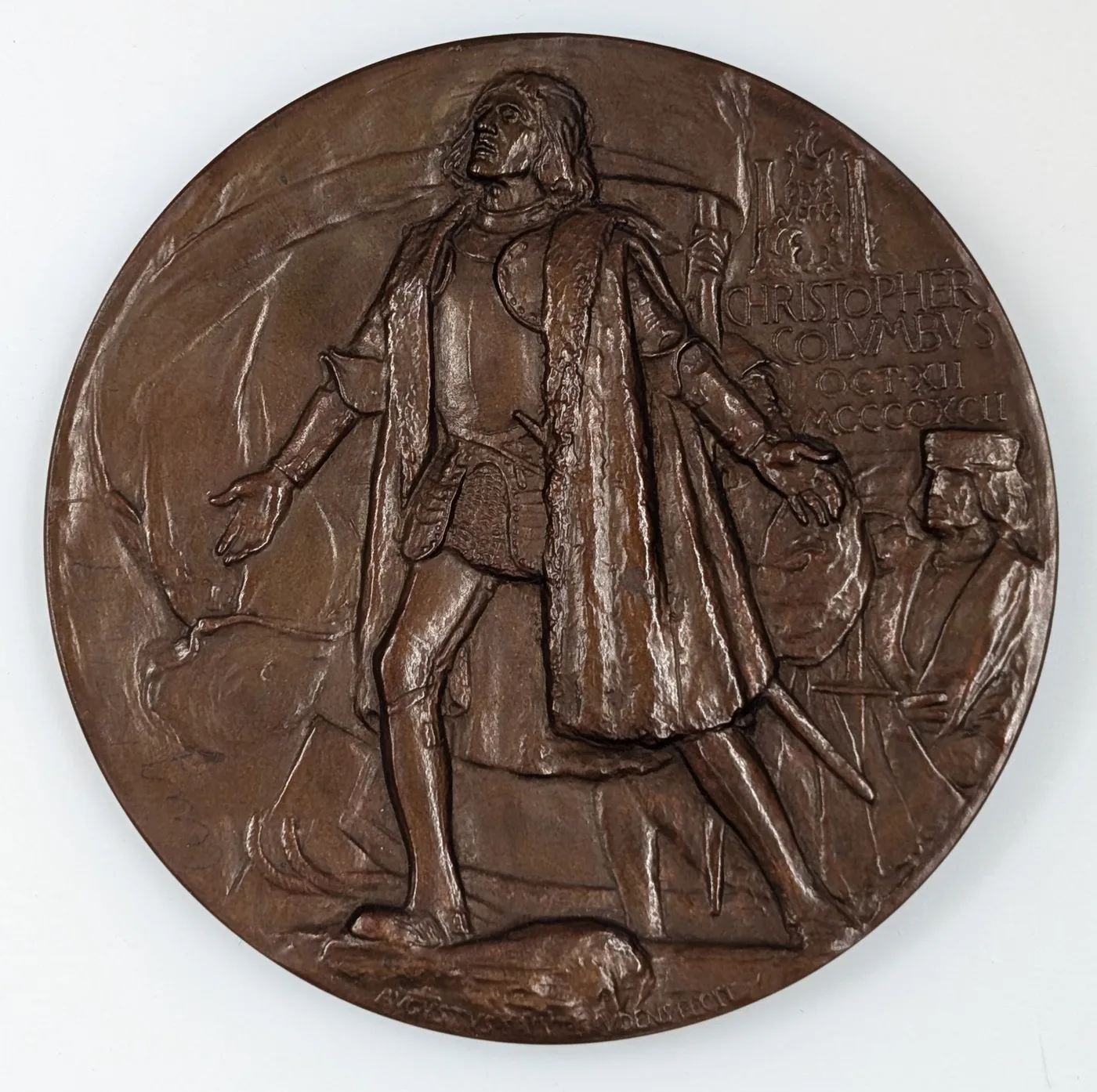
An official award medal was commissioned by the exposition itself and given to exhibitors as a prize, gold, silver or bronze awards for merit. These have documented designers, controlled mintages, and often survive with their original cases and award documents. The Saint-Gaudens Columbian medal with its case is the archetype.
A private souvenir was struck by a commercial producer to sell to visitors. Anyone could make one; many did. These are the bulk of surviving exposition material and the bulk of the so-called dollar cataloge.
An exhibitor or concessionaire token was issued by a specific business exhibiting at the fair, advertising itself. Our archive holds two good Buffalo examples: the Murray Iron Works so-called dollar and the Kleinhans Co token.
All three are legitimate exposition collectibles. Only the first is an award, and a listing that calls a souvenir an award medal is either careless or hoping you will not check.
How Much Does Metal Matter?
As much as it does anywhere in medallic collecting, and often more, because exposition pieces were deliberately produced across a price ladder.
The same design might be sold in gilt brass for a quarter, bronze for less, and silver for a premium, with gold reserved for presentation or for tiny numbers. That ladder survives into today's market as a scarcity ladder.
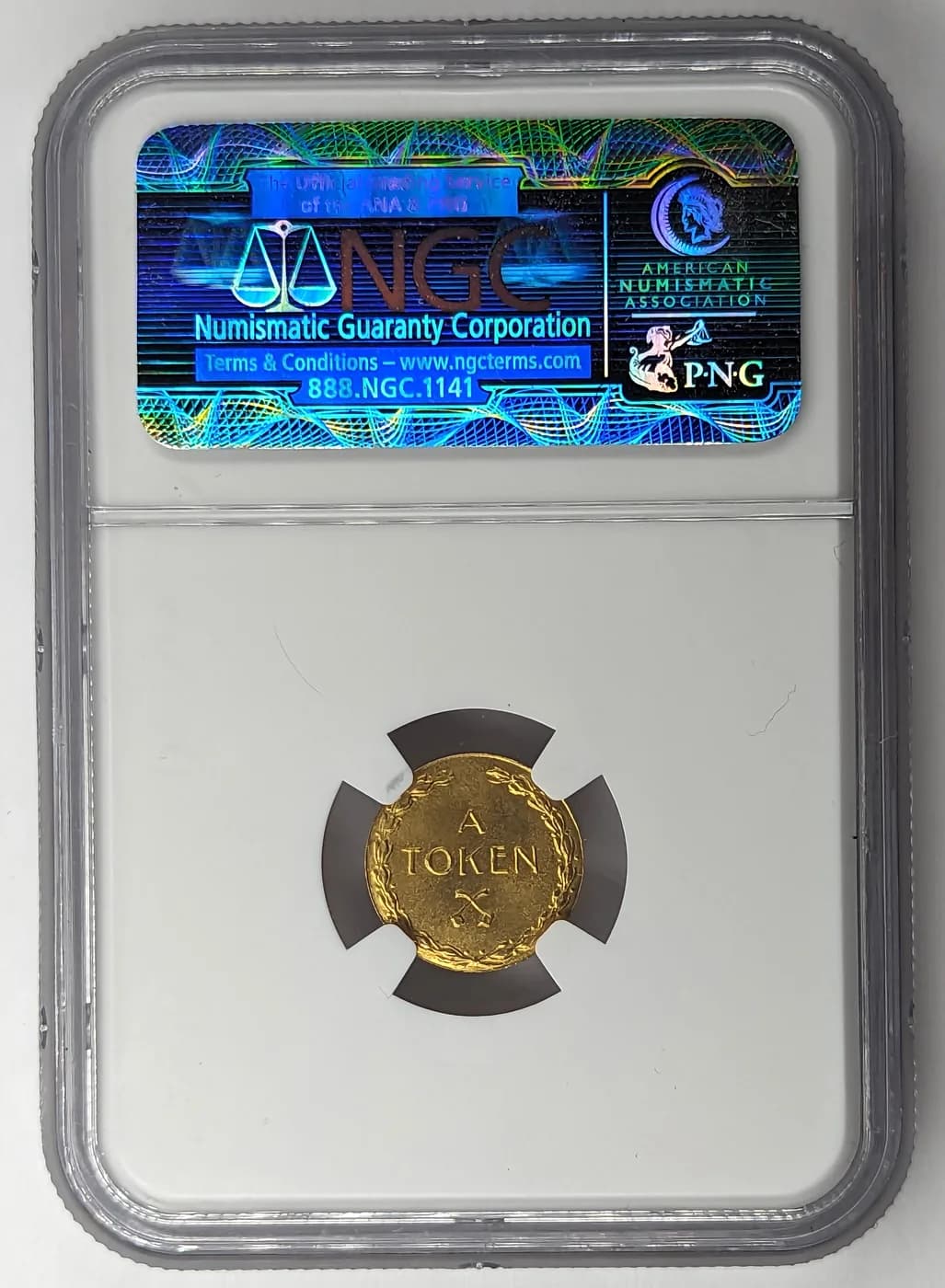
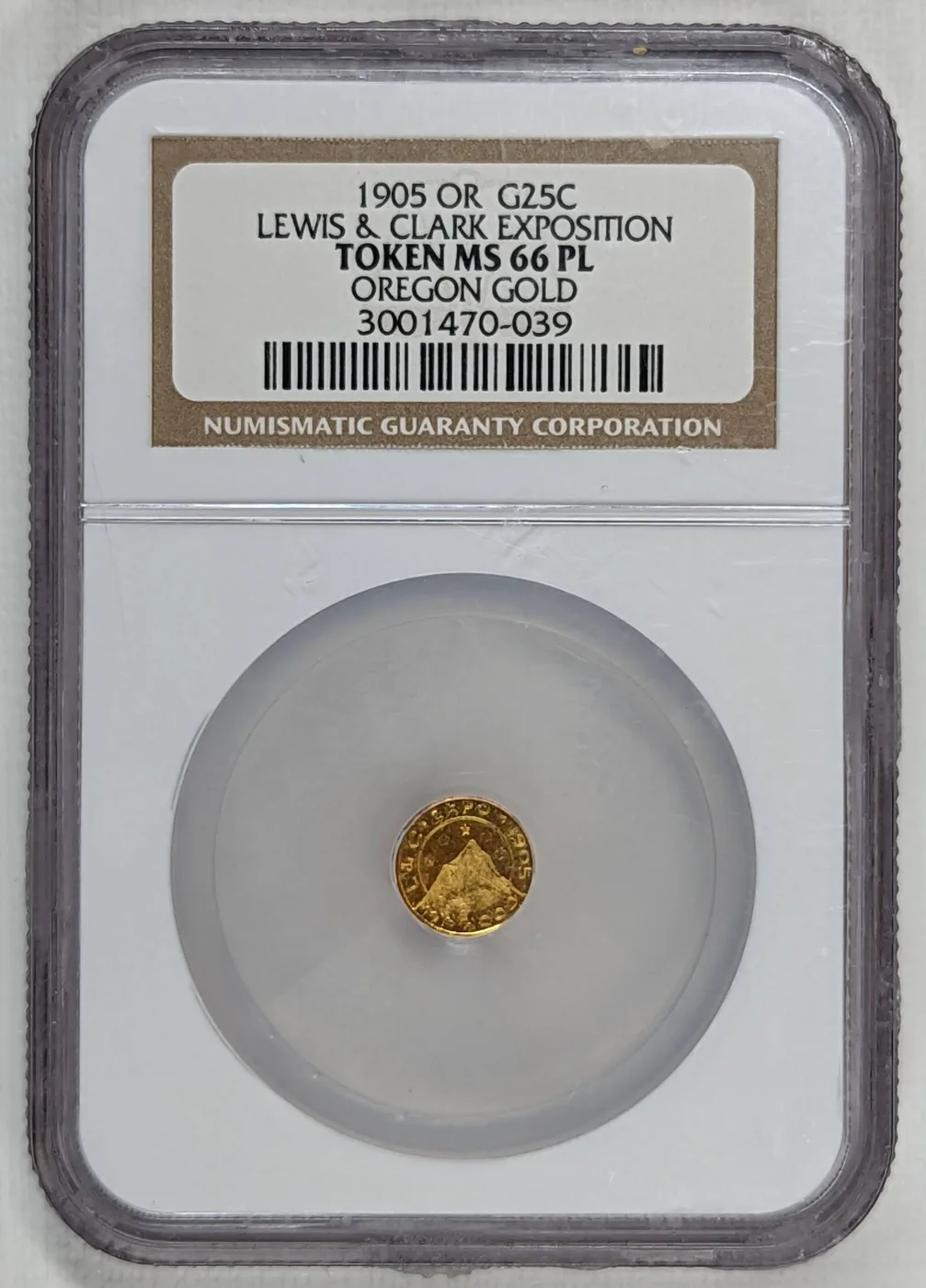
Gold exposition pieces are the top of it. Our 1905 Lewis and Clark Exposition gold piece at NGC MS66 PL and the 1939 New York World's Fair Lincoln gold token are both examples of small gold strikings that survive in far smaller numbers than their base-metal equivalents.
Always establish the metal before comparing prices. Two listings quoting the same HK number can be describing objects that differ in value by an order of magnitude.
Who Were the Named Producers Worth Knowing?
Exposition material is more interesting when you know whose hand is behind it.
Augustus Saint-Gaudens designed the official award medal for the 1893 Columbian Exposition, the most artistically significant American medal of the century, and the subject of a controversy we cover separately in the Saint-Gaudens Columbian Exposition medal.
Charles E. Barber, Chief Engraver of the US Mint, produced the reverse that eventually replaced Saint-Gaudens's on that medal, and his hand appears across official American medallic work of the period.
Thomas L. Elder was a New York coin dealer and prolific issuer of privately struck tokens and medals in the early twentieth century, including the 1939 World's Fair Lincoln pieces. Elder issues are a collecting speciality in their own right.
Collecting by producer rather than by fair is a legitimate and rewarding alternative organising principle, and it tends to produce a more coherent collection than sweeping up everything from one exposition.
What About the Fairs Between 1904 and 1915?
They are the quiet middle of the series, and they are where the value is.
Four expositions fill the decade. St. Louis held the Louisiana Purchase Exposition in 1904, the largest of them and the one with the deepest medallic output. Portland followed with the Lewis and Clark Centennial in 1905. Jamestown marked its tercentennial in 1907, and Seattle held the Alaska-Yukon-Pacific Exposition in 1909.
None of them carries the name recognition of Chicago in 1893 or San Francisco in 1915, and that shows in prices rather than in scarcity. A collector who wants an exposition run without competing for the famous issues can assemble these four in reasonable grade for a fraction of what the bookend fairs cost.
The Portland fair also produced one of the more attractive small gold issues of the period, of the kind represented by our 1905 Lewis and Clark quarter in prooflike MS66. Small commemorative gold from these fairs is a distinct collecting area with its own literature, and it rewards patience: examples with genuine prooflike surfaces are much scarcer than the population figures alone suggest.
What Changed at the Fairs of the 1930s?
The fairs got bigger and the medals got more commercial.
Chicago's Century of Progress ran in 1933 and 1934, New York held its World of Tomorrow in 1939 and 1940, and San Francisco ran the Golden Gate International Exposition on Treasure Island across the same two years. All three produced souvenir medals in quantity, and much of it was frankly manufactured for the souvenir trade rather than issued by the fair.
That is not a reason to dismiss the period. It is a reason to be selective. The pieces that hold up are the ones with a real issuer behind them: an exhibiting company, an official concession, or a numismatist producing a limited striking for collectors rather than for the midway.
Thomas Elder's work is the best example of the last category, and it connects the 1930s fairs back to the collector market that had grown up around so-called dollars. Our 1939 New York World's Fair Lincoln token in gold is exactly that kind of piece: small, deliberately limited, aimed at people who already collected, and cataloged as HK-493.
How Do You Judge Condition on These?
By the fields first, and the high points second, which is the reverse of how most people look at a coin.
Exposition medals were struck in soft alloys, kept as souvenirs rather than spent, and then handled for a century by people who were not collectors. The result is that genuine wear is often light while surface damage is common: rim knocks from being dropped, hairlines from a wipe with a cloth, and the flat gray of a piece that was cleaned once in 1950.
Original surface is the thing to protect. A white metal piece with its natural gray patina intact is worth substantially more than a brighter example that got there by polishing, and the difference is permanent. On bronze, look for even color across the fields; a mottled or spotty appearance usually means a cleaning that has begun to retone unevenly.
Certification helps most here. Grading services see enough of these to recognize a cleaned surface reliably, and a Details grade that names the problem is more useful than an optimistic raw description. It is also why buying certified is the default recommendation for anything above a modest price in this series.
How Should You Start?
Pick one exposition and learn it properly before spreading out. The literature is deep and the material is abundant; breadth without knowledge produces an expensive miscellany.
1893 Chicago is the best starting point for most collectors. It produced the widest range of material, it is the best documented, and it includes genuine artistic significance at the top end.
1915 Panama-Pacific is the best starting point for so-called dollar collectors specifically, because the HK series for that fair is deep, well cataloged and includes pieces at every rarity level, from the readily available Oregon HK 411 at R3 up to the R5 issues.
Buy certified where the piece is expensive or where the metal is the whole argument. Gilt brass and bronze can be difficult to distinguish in photographs, and gilt wears; an independent opinion on both metal and grade is worth having when either determines the price.
Frequently asked questions
Are so-called dollars real coins?
No. They are dollar-sized medals and tokens struck privately rather than by the US Mint, and they were never legal tender. The name acknowledges that they resemble dollars without being them.
What does an R5 rarity rating mean?
It comes from the Hibler and Kappen cataloge, which rates so-called dollars from R1 (common) to R10 (unique or nearly so). R5 indicates genuine scarcity, a piece you will not simply find whenever you want one.
What is the difference between an award medal and a souvenir?
An award medal was commissioned by the exposition and presented to exhibitors as a prize, with a documented designer and controlled mintage. A souvenir was struck commercially to sell to visitors. Both are collectible; only one is an award.
Why do 1892 and 1893 both appear on Columbian Exposition material?
Because the fair was dedicated in October 1892, on the four hundredth anniversary of the landing, but did not open to the public until May 1893. Material was produced around both events.
Which exposition should a new collector start with?
Chicago 1893 for breadth, documentation and artistic significance, or Panama-Pacific 1915 if your interest is specifically so-called dollars, since its HK series is deep and spans every rarity level.
Is exposition gold worth the premium?
Usually yes, because gold strikings were made in very small numbers relative to base metal versions of the same design. But confirm the piece against its cataloge entry first, the premium is for genuine scarcity, not for the metal alone.
Pieces from the collection
Examples handled here, cataloged with photographs and, where the piece was certified, its grading label. Sold pieces stay listed as a reference record.
 Sold
SoldMedals · 1893
1893 Columbus Saint-Gaudens Bronze Medal World's Columbian Exposition with Case
$185
 Sold
SoldMedals · 1915
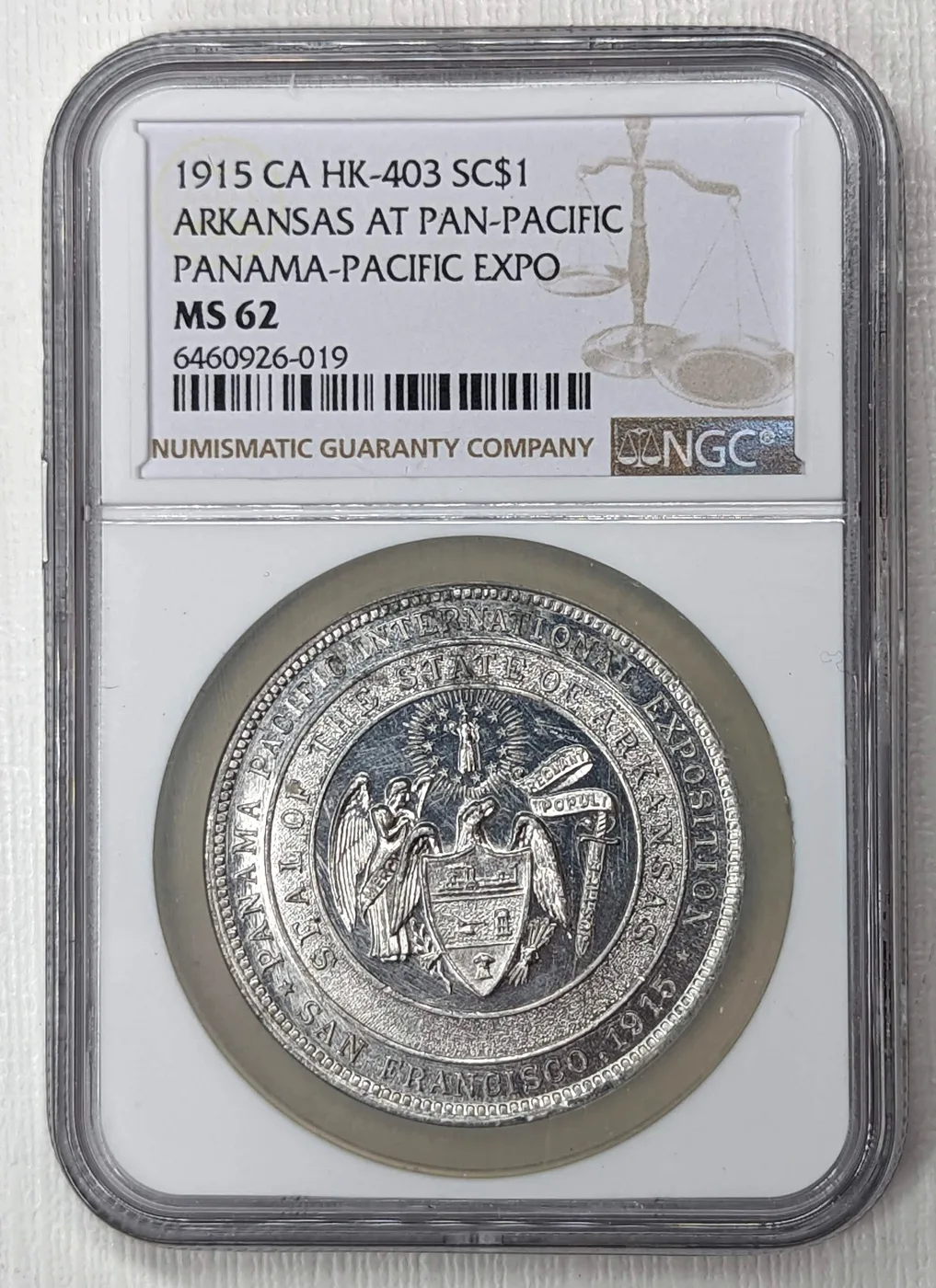
1915 Panama Pacific Exposition Arkansas HK 403 MS62 NGC So Called Dollar
Sold
 Sold
SoldTokens · 1939
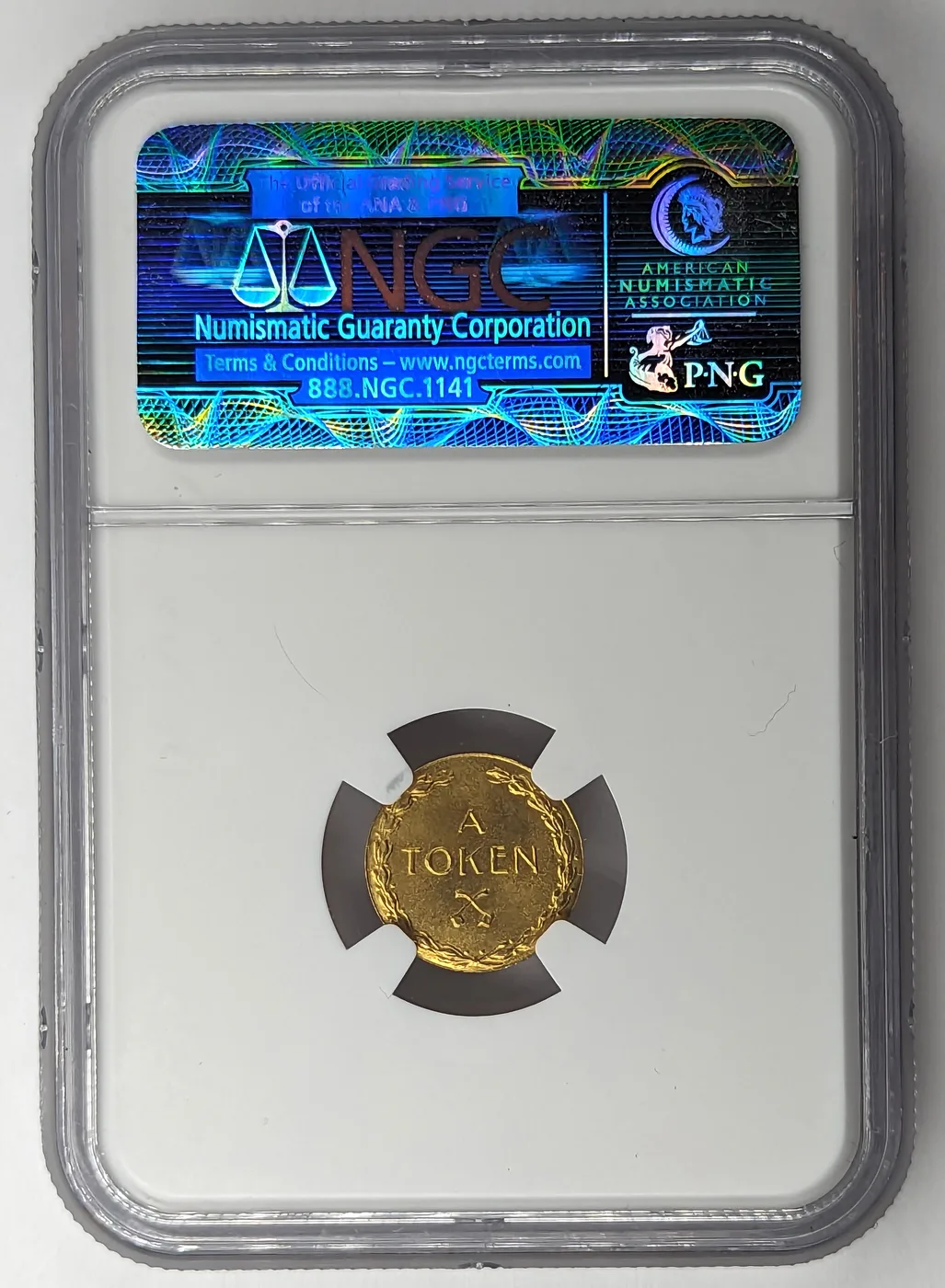
1939 New York World's Fair Abraham Lincoln Gold a Token NGC MS63 Thomas Elder HK 493
Sold
 Sold
SoldMedals · 1905
1905 Oregon Gold Lewis Clark Exposition 1 4 NGC MS66 PL Prooflike Mt Hood
Sold
More guides
Have one of these?
We buy outright, and we will value a piece for you whether or not you sell. Photographs and whatever paperwork you have are enough to start.