
Exposition Medals
Collecting the World's Columbian Exposition: HK Numbers, Eglit Numbers and What They Mean
11 min read
Two catalogs cover the medals of the 1893 Chicago fair, and a single piece can carry a number in both. What HK and Eglit each measure, why a missing HK number is usually a ruler rather than a warning, and why prooflike surfaces move the price here more than a grade point does.
What Was the World's Columbian Exposition?
Chicago built a temporary white city on the lakefront to mark four hundred years since Columbus reached the Americas. It was dedicated in October 1892, opened to the public on May 1, 1893, and closed on October 30 of that year.
The fair matters to American numismatics out of all proportion to its six months. It produced the first United States commemorative coins, the Columbian half dollar and the Isabella quarter, and it produced souvenir medals in a volume no earlier American event had approached. A great deal of what a collector meets today was struck on the grounds and sold to visitors as they walked between the buildings.
Why Are Some Pieces Dated 1892 and Others 1893?
Because the fair straddled two years, and the anniversary it marked fell in the first of them.
Columbus reached the Americas in 1492, so the quadricentennial was 1892, and a great deal of souvenir material is dated accordingly, often as the paired legend 1492-1892. The exposition was dedicated in October of that year with a full ceremony, and medals, ribbons and invitations were produced for it.
The grounds did not open to the public until May 1, 1893, and the fair then ran until October 30. Souvenirs sold to the people who actually walked through it are dated 1893, and a number of pieces carry both years together.
None of this indicates a reproduction or a later striking, which is the conclusion buyers most often jump to. A piece dated 1892 is not early or wrong; it belongs to the anniversary and the dedication. A piece dated 1893 belongs to the fair as visitors experienced it.
Where it does matter is in comparing prices. A dedication-year piece and a fair-year piece can look nearly identical, sit under different numbers, and have quite different survival rates, so check the date before you treat one sale as a comparable for the other.
Why Are There Two Numbering Systems?
Because two different books were written for two different purposes, and this fair falls inside both.
Hibler and Kappen's So-Called Dollars, published in 1963, catalogs American medals of roughly dollar size struck for expositions, monuments and public events from the 1850s onward. Its scope is a size band and an occasion type, running across the whole country and a century of them.
Nathan N. Eglit's Columbiana, published in 1965, catalogs the medallic record of Christopher Columbus and this exposition specifically, at any size. Its scope is a subject.
So a dollar-sized souvenir struck for the fair sits in both books and carries two numbers. The official award medal is HK-223 and Eglit-90 at the same time. Neither number is more correct than the other. They answer different questions, and a seller quoting one is not contradicting a seller quoting the other.
| HK (Hibler and Kappen) | Eglit (Columbiana) | |
|---|---|---|
| Published | 1963 | 1965 |
| Organizing principle | Size and occasion type | Subject |
| Size range covered | Roughly 33 to 45 mm | Any size |
| Scope | American events from the 1850s onward | Columbus and this fair only |
| Number on the official award medal | HK-223 | Eglit-90 |
What Does an HK Number Tell You?
That the piece is dollar sized, roughly thirty-three to forty-five millimeters, and that it belongs to a series people collect as a series rather than as loose souvenirs.
That last part is worth more than it sounds. So-called dollars have their own collector base, their own auction sections and their own price history, so a Columbian piece with an HK number is competing for attention with every other so-called dollar rather than only with other Chicago souvenirs.
HK numbers also carry rarity ratings on an R scale running from common to nearly unobtainable. The ratings do real work in this market: an R-5 is scarce enough that examples do not appear continuously, and the rating tends to be quoted in listings because buyers price off it.
What Does an Eglit Number Tell You?
That the piece belongs to the Columbus and Columbian literature, whatever size it happens to be.
This is where the practical difference shows, and where new collectors most often go wrong. A Liberty head medal from the fair struck at fifty and a half millimeters carries an Eglit number and no HK number. That absence says nothing about its scarcity or its legitimacy. The piece is simply too large for the so-called dollar size band.
Read a missing HK number as a ruler rather than a warning. The question it answers is how big the medal is, not how good it is.
What Is the Official Award Medal, and Why Is It Different?
It was given to exhibitors whose displays won an award. It was not sold at a booth, and that alone separates it from most of what survives.
Augustus Saint-Gaudens designed the obverse, showing Columbus making landfall, and that side was never in dispute. His reverse, which featured a nude male youth, was rejected on grounds of propriety by the Senate committee overseeing the commission. Charles E. Barber, Chief Engraver at the United States Mint, produced the replacement reverse that was actually issued.
The result is a medal by two hands that did not want to share it, and the full account is worth reading on its own: see the Saint-Gaudens Columbian Exposition medal.
For a buyer the practical points are that original presentation cases and award documents add materially to value, and that an award medal and a souvenir dollar are not comparables for one another however similar the date on them looks.
Why Do Prooflike Surfaces Matter So Much Here?
Because a great many Columbian pieces were struck early from fresh dies, and fresh dies leave mirrored fields.
Grading services note this with PL for prooflike and DPL for deep prooflike. In this series the designation frequently does more for the price than a point or two of numerical grade, because the mirrors are what make the piece attractive across a table and because a late-die example of the same number simply cannot be made to look that way.
When you are comparing two examples of one HK number, compare the surface designations before you compare the grades. Two pieces at MS62 and MS66 can trade closer together than you would expect if the lower one is deep prooflike and the higher one is not.
What Else Did the Fair Produce Besides Medals?
More than most collectors expect, and each category sits in its own literature.
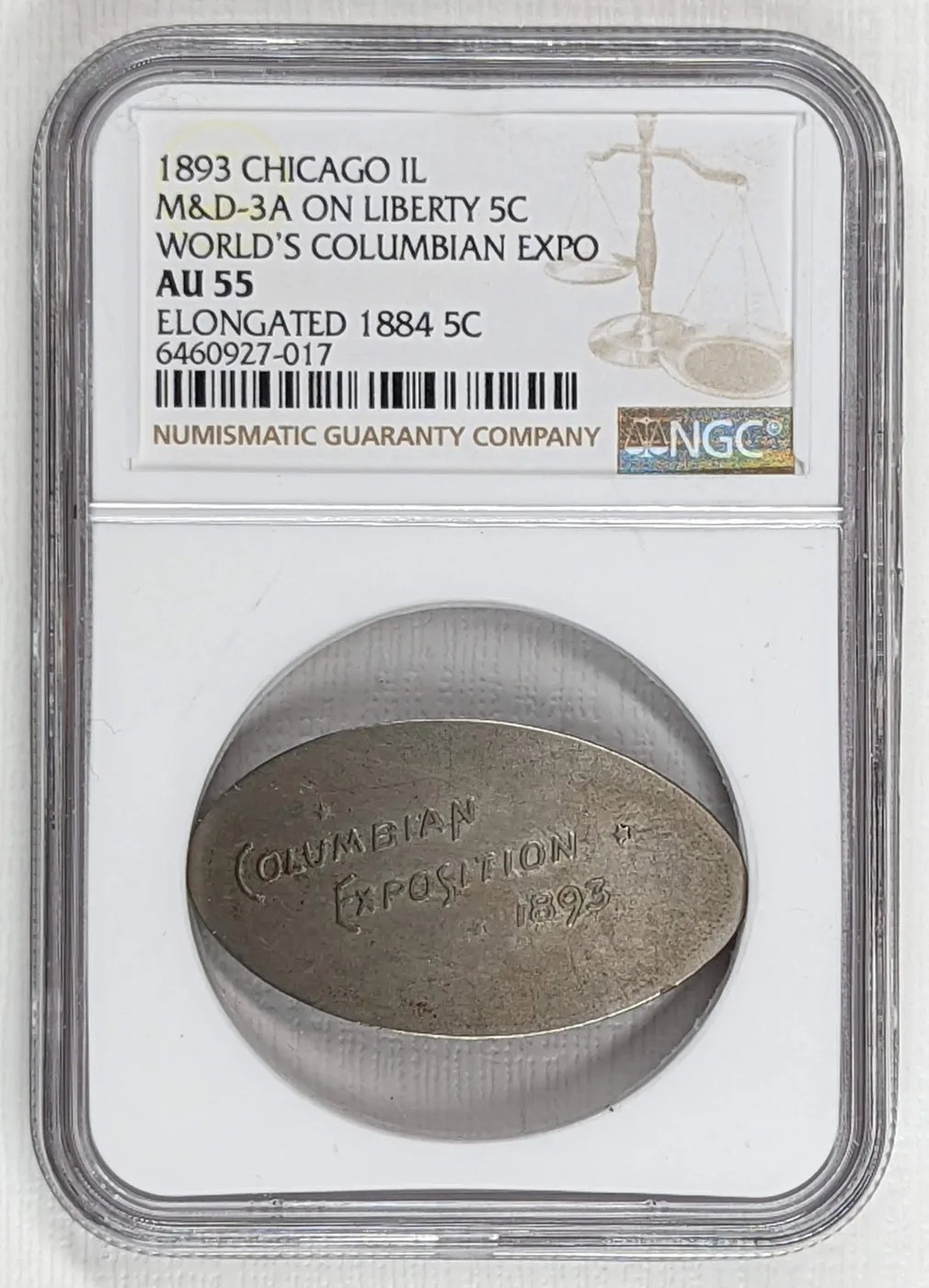
The exposition is generally credited as the birthplace of the American elongated coin: cents and nickels rolled out flat between engraved dies and carried home as souvenirs. They are collected today by their own references and turn up certified, which surprises people who think of them as fairground trinkets.
There were also woven silk ribbons and bookmarks, presentation medals struck for particular exhibits and concessions, and printed material such as dedication ceremony invitations. None of these carry HK numbers, and only some carry Eglit numbers.
What Is a Stevengraph?
A picture woven in silk rather than printed, produced on a Jacquard loom. The name comes from Thomas Stevens of Coventry in England, whose firm made the technique famous in the nineteenth century.
The Columbian Exposition generated woven silk bookmarks and ribbons of exactly this kind, sold as souvenirs on the grounds. They are textile rather than metal, so they sit outside both numbering systems entirely, and they survive in far smaller numbers than the struck pieces because silk does not forgive a century in a drawer.
Condition language for them is different too. You are looking at fading, fraying at the fringe and staining rather than at wear on high points.
The Midway Villages, and a Word About Them
Alongside the exhibition halls, the Midway Plaisance held commercial concessions that included so-called villages, where people from West Africa, the Pacific and elsewhere were put on display for paying visitors. The Dahomey Village was one of them.
Presentation medals and souvenirs survive from these concessions, and they are collected. It is worth being straightforward about what they document. These displays were criticized at the time, including by Frederick Douglass and Ida B. Wells, and they read now as what they were.
A piece from one of them is a historical record rather than a decorative souvenir, and catalog copy that skates over that does the buyer no favors.
What Actually Drives the Price?
Four things, roughly in this order.
Rarity rating first, where the piece carries one: an R-5 and an R-2 of similar appearance are not in the same market. Surface designation second, for the reasons above. Grade third, which matters but matters less than newcomers assume. And provenance or completeness fourth, meaning original cases, award documents and anything that ties the piece to a named exhibitor.
Metal is a smaller factor here than in campaign medals, where the same number in a different metal can be an order of magnitude scarcer. Columbian material was struck largely in white metal, bronze and gilt, and the metal usually tells you which souvenir tier it was sold at rather than how rare it is.
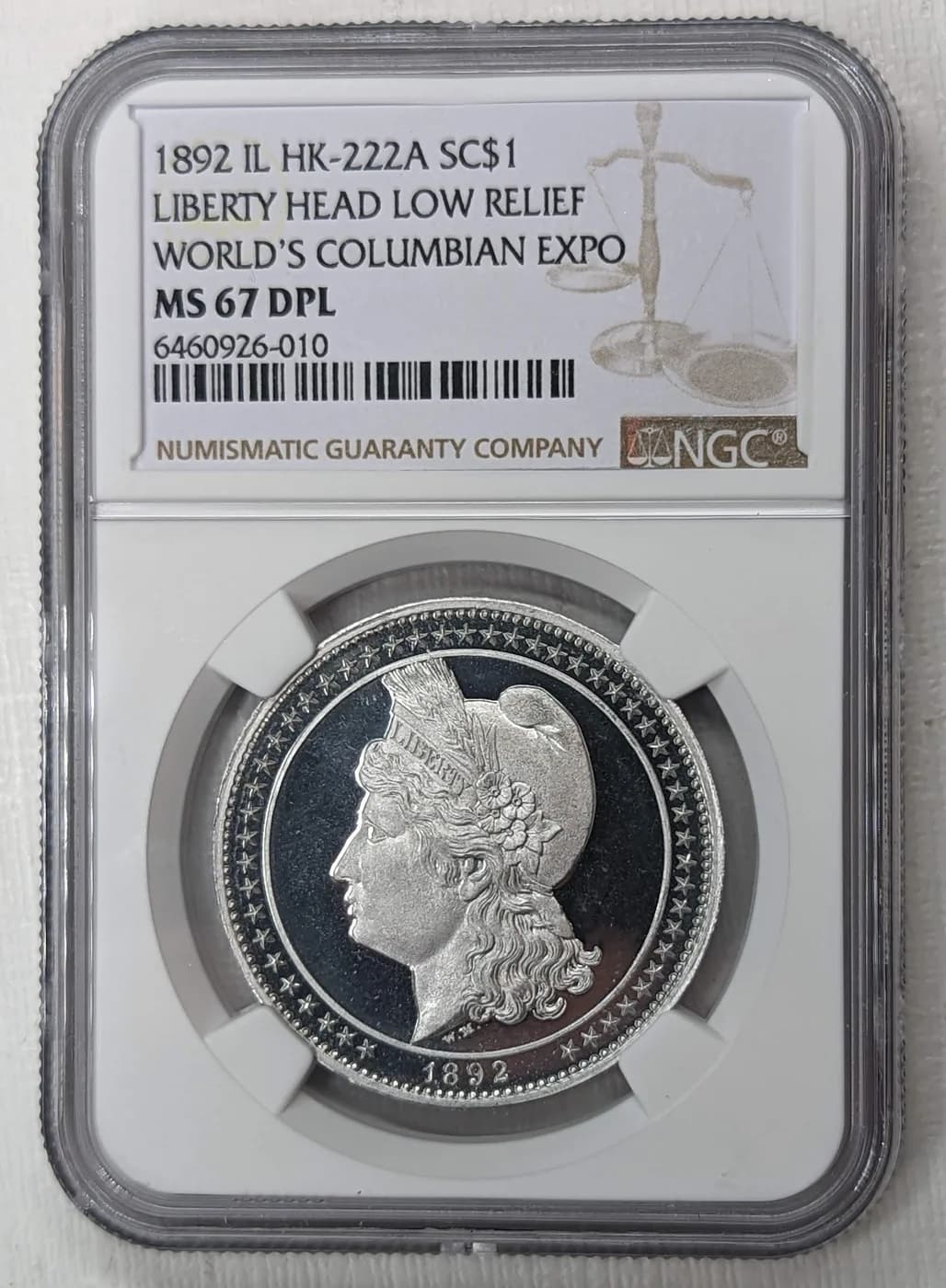
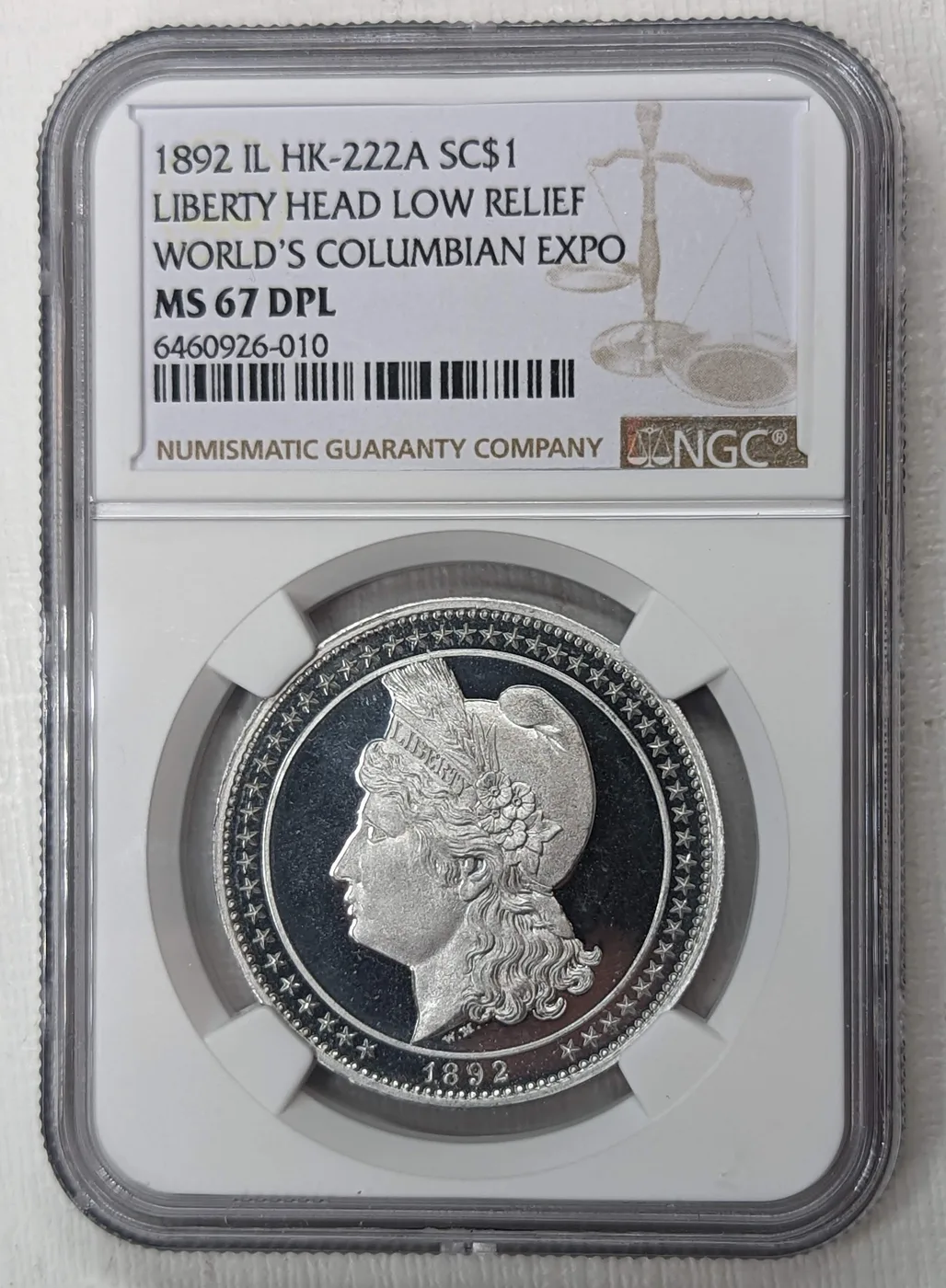
A worked example, from two pieces this catalog handled together. Both were HK-222, the low relief Liberty head, both rated R-5, both certified deep prooflike. One graded MS66 and the other MS67.
On paper the difference is a single point. In practice the pair shows the order above doing its work: rarity rating and surface designation are identical, so grade is the only variable left, and it is the last of the four to move the price. The two sat far closer together than a point of grade would suggest anywhere else in numismatics.
Now reverse it. Leave the MS66 deep prooflike and put the MS67 in a holder with no surface designation at all, and the ranking inverts for most buyers in this series. That is the test worth running in your head before paying a premium for the number on the label: ask which of the four factors actually changed, and whether the one that changed is the one this series pays for.
Where Should a Collector Start?
With one number and its variants, rather than with the fair as a whole. The output was large enough that collecting it broadly means collecting it thinly.
A sensible first target is a single well-struck prooflike so-called dollar in the HK range, bought for the surfaces rather than the grade on the label. From there the natural directions are either depth, chasing the varieties of one design, or breadth across formats, adding an elongated coin, a woven ribbon and a piece of printed ephemera so the collection describes the fair rather than just its metal.
Whichever way you go, buy the piece and not the number. The catalogs are a map of what exists, not a ranking of what is worth owning.
Frequently asked questions
Is a so-called dollar a coin?
No. So-called dollars are medals. They carry no face value and were never legal tender. The name describes the size, roughly that of a silver dollar, and the fact that they were sold and carried like money at the events that produced them.
What is the difference between an HK number and an Eglit number?
HK comes from Hibler and Kappen's So-Called Dollars of 1963 and covers American medals of roughly dollar size across many events. Eglit comes from Nathan N. Eglit's Columbiana of 1965 and covers Columbus and Columbian Exposition material at any size. A dollar-sized Columbian piece can carry both numbers at once.
My medal has an Eglit number but no HK number. Is something wrong?
Almost certainly not. The usual reason is size: the piece falls outside the roughly thirty-three to forty-five millimeter band that Hibler and Kappen catalog. A fifty millimeter Columbian medal is out of scope for HK by definition, which tells you nothing about its scarcity.
Are the Columbian half dollar and Isabella quarter part of this series?
No. Those are United States commemorative coins, struck by the Mint with a face value and legal tender status, and they are collected in the commemorative coin series. The medals described here are private and semi-official souvenirs from the same event.
What does DPL mean on the label?
Deep prooflike: the fields carry strong mirrors from fresh dies, deeper than the PL designation indicates. On Columbian so-called dollars it is a meaningful value driver, often more so than an extra point or two of grade.
What has this material actually sold for?
It runs from modest to serious depending on rarity rating and surfaces. As one datapoint from this catalog, a Saint-Gaudens Columbus medal in its original case sold here for $185. Every piece we handle stays listed with what it brought, so the comparables sit on this site rather than behind a login somewhere else.
Pieces from the collection
Examples handled here, cataloged with photographs and, where the piece was certified, its grading label. Sold pieces stay listed as a reference record.
 Sold
SoldMedals · 1892
1892 World's Columbian Expo HK 222 MS67 DPL Low Relief Liberty Head R5
Sold
 Sold
SoldMedals · 1892
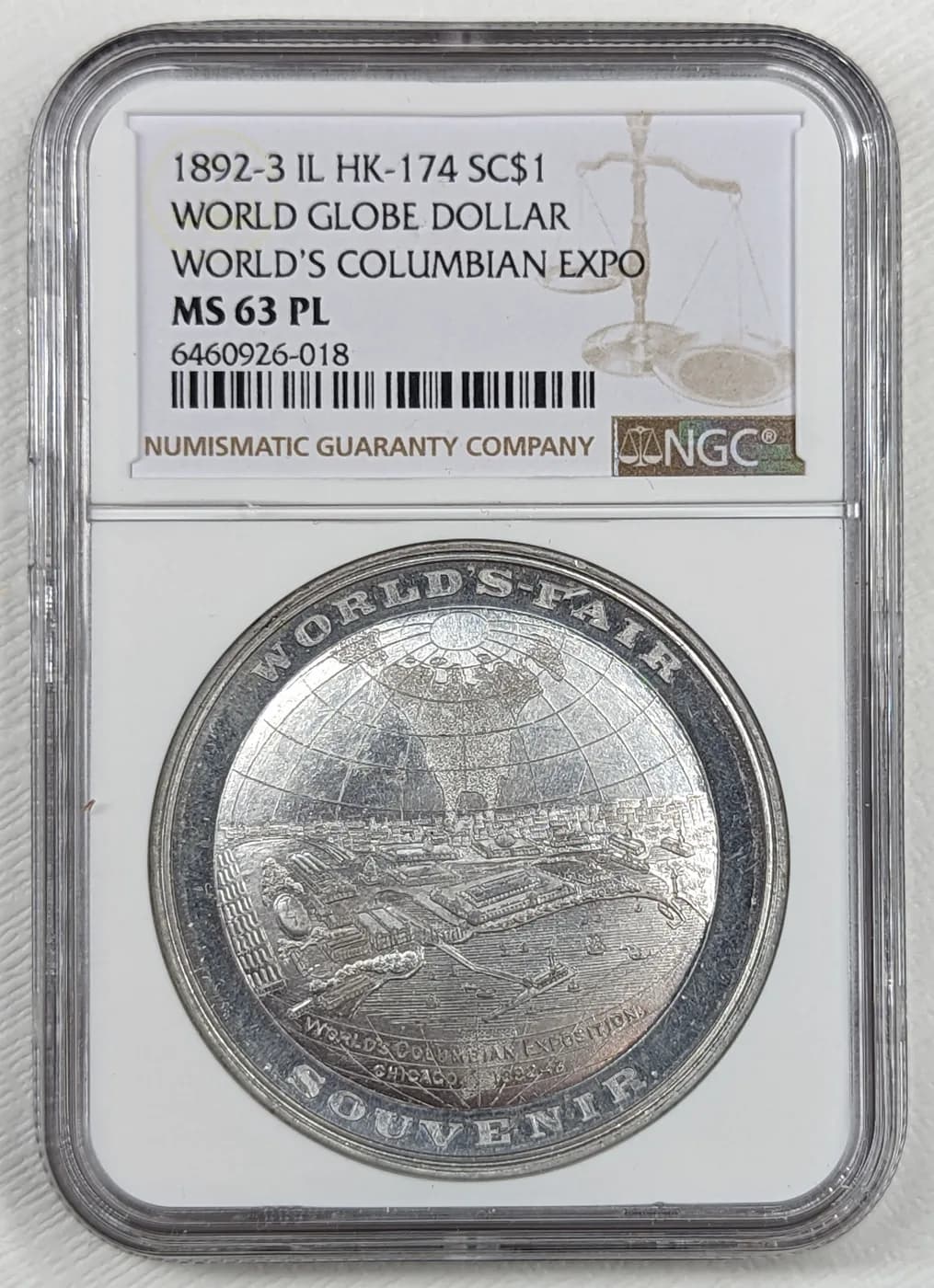
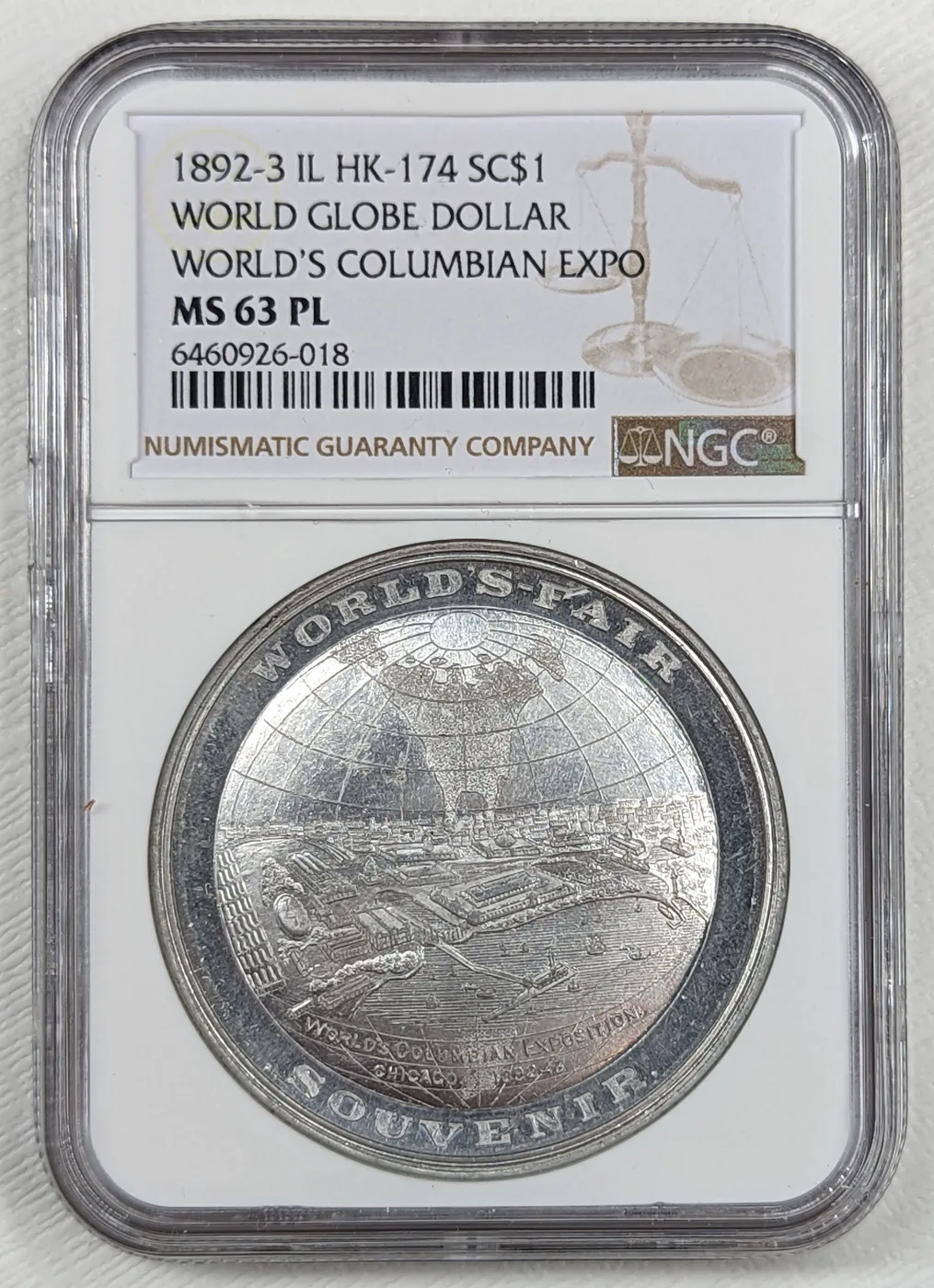
1892 World's Columbian Expo HK 174 MS63 PL NGC Prooflike Globe Dollar
Sold
 Sold
SoldMedals · 1893
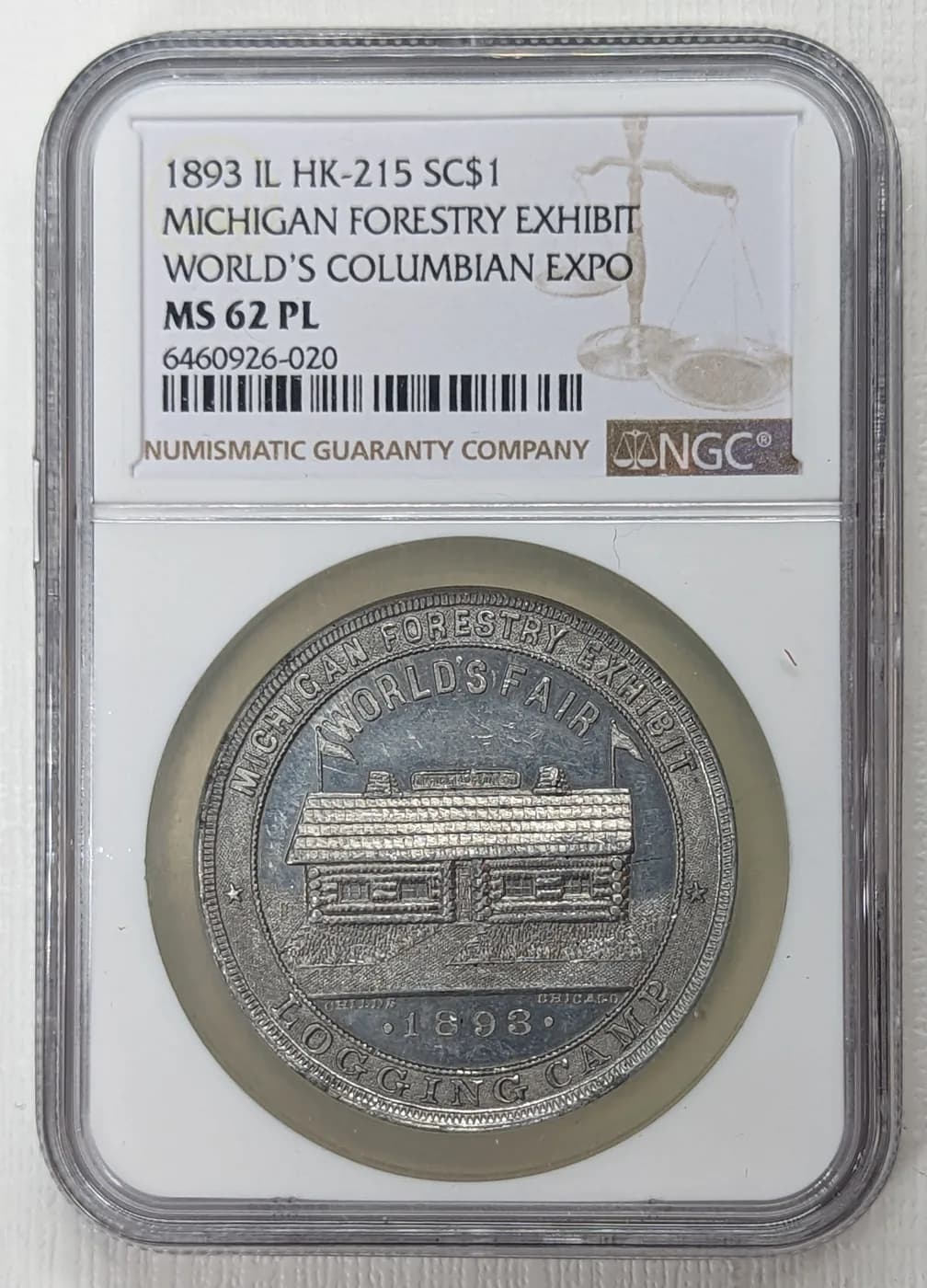
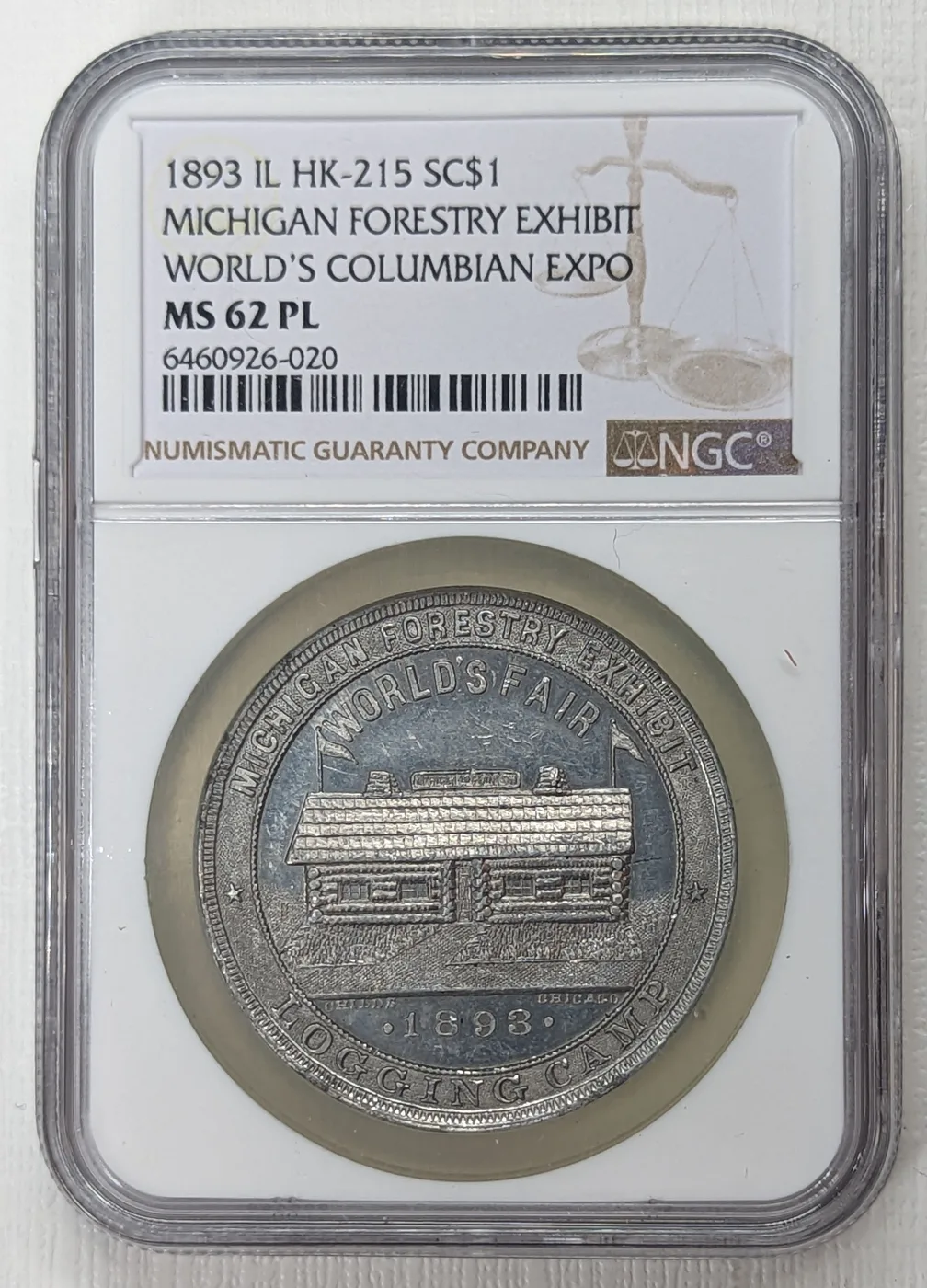
1893 World's Columbian Expo HK 215 MS62 PL NGC Prooflike Michigan Forestry Exhibit
Sold
 Sold
SoldMedals · 1892
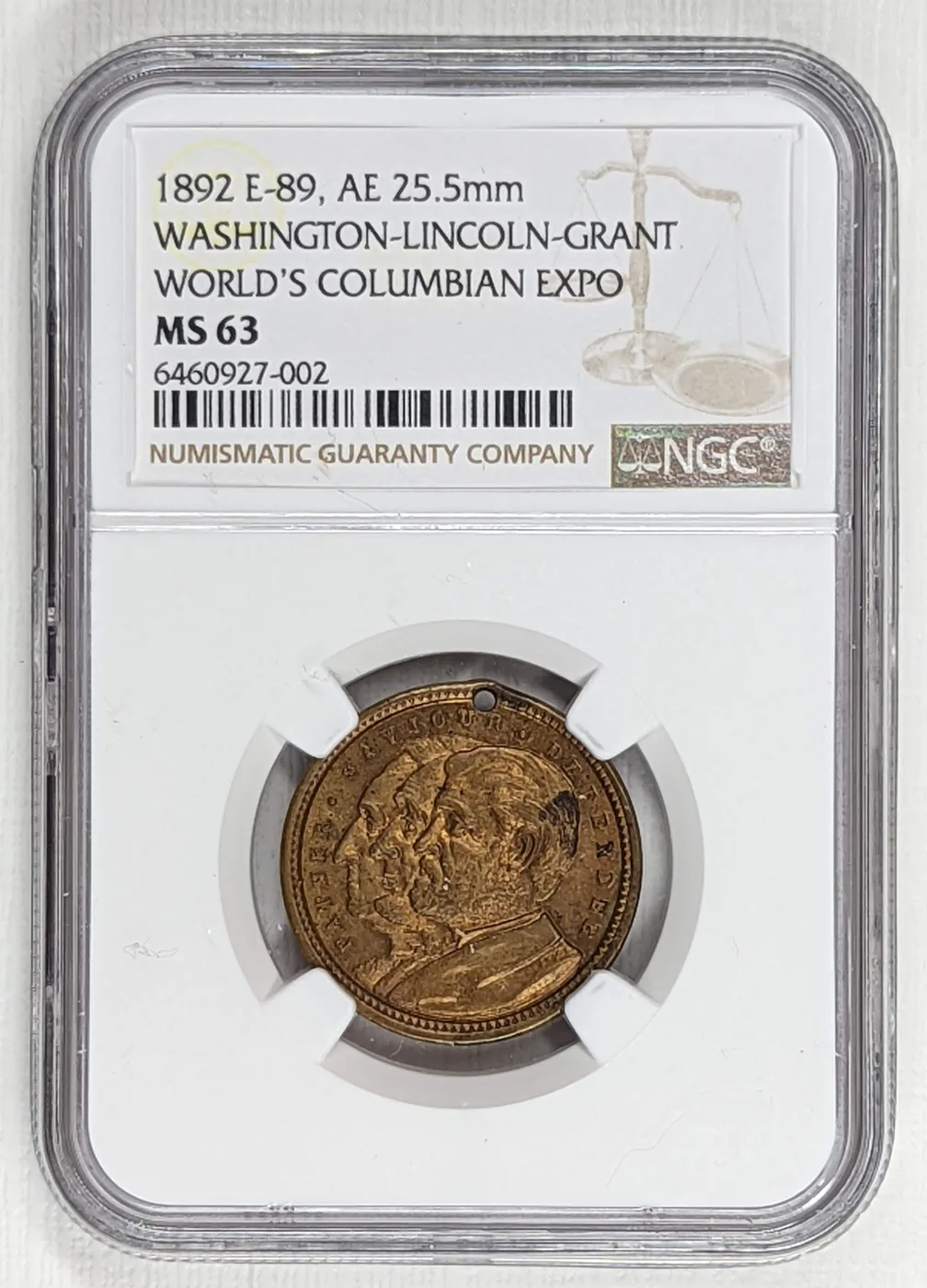
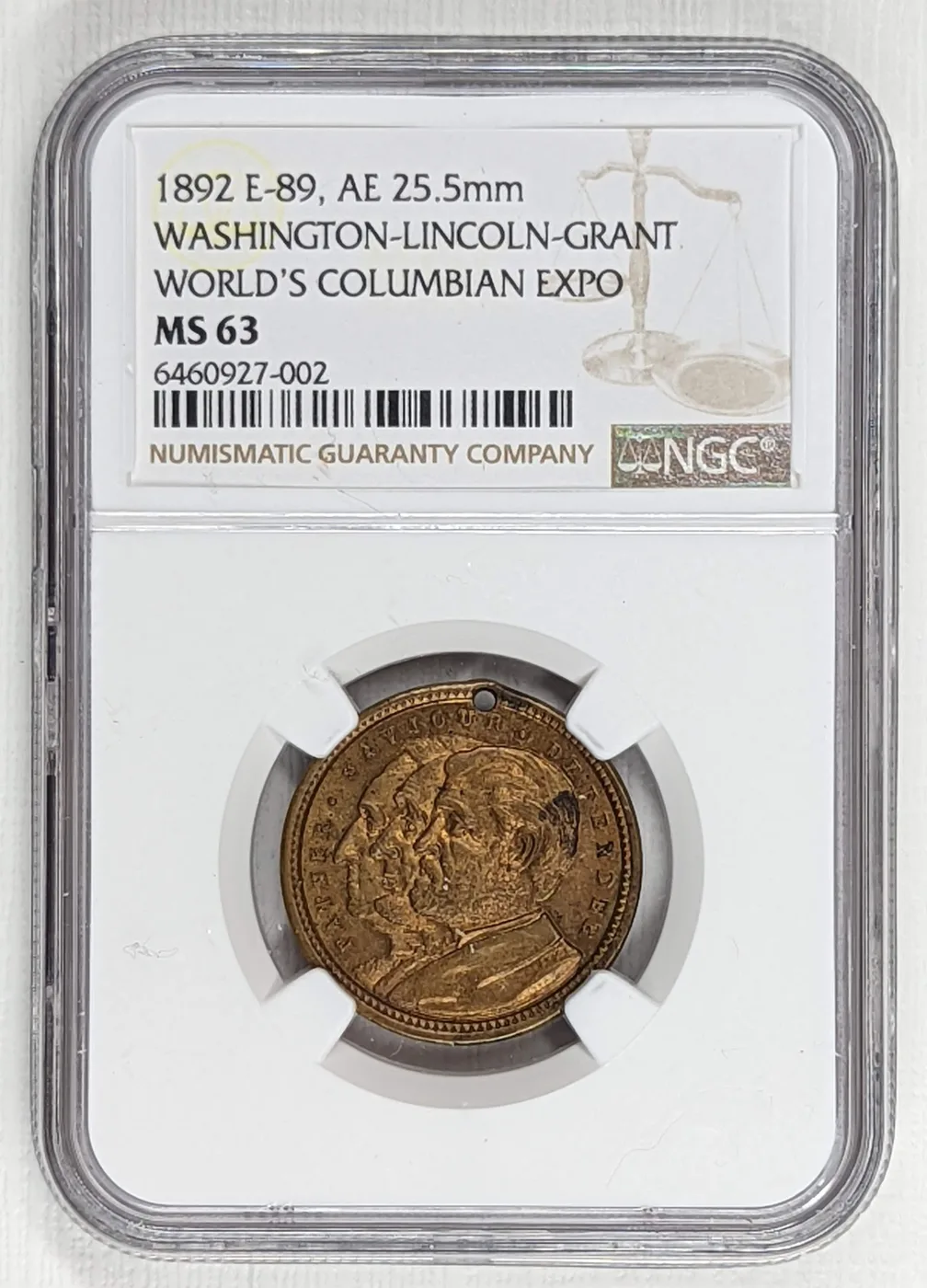
1892 World's Columbian Expo NGC MS63 Eglit 89 Three Presidents Chicago
Sold
More guides
Have one of these?
We buy outright, and we will value a piece for you whether or not you sell. Photographs and whatever paperwork you have are enough to start.