
Exposition Medals
The Saint-Gaudens Columbian Exposition Medal: The Award That Had to Be Redesigned
10 min read
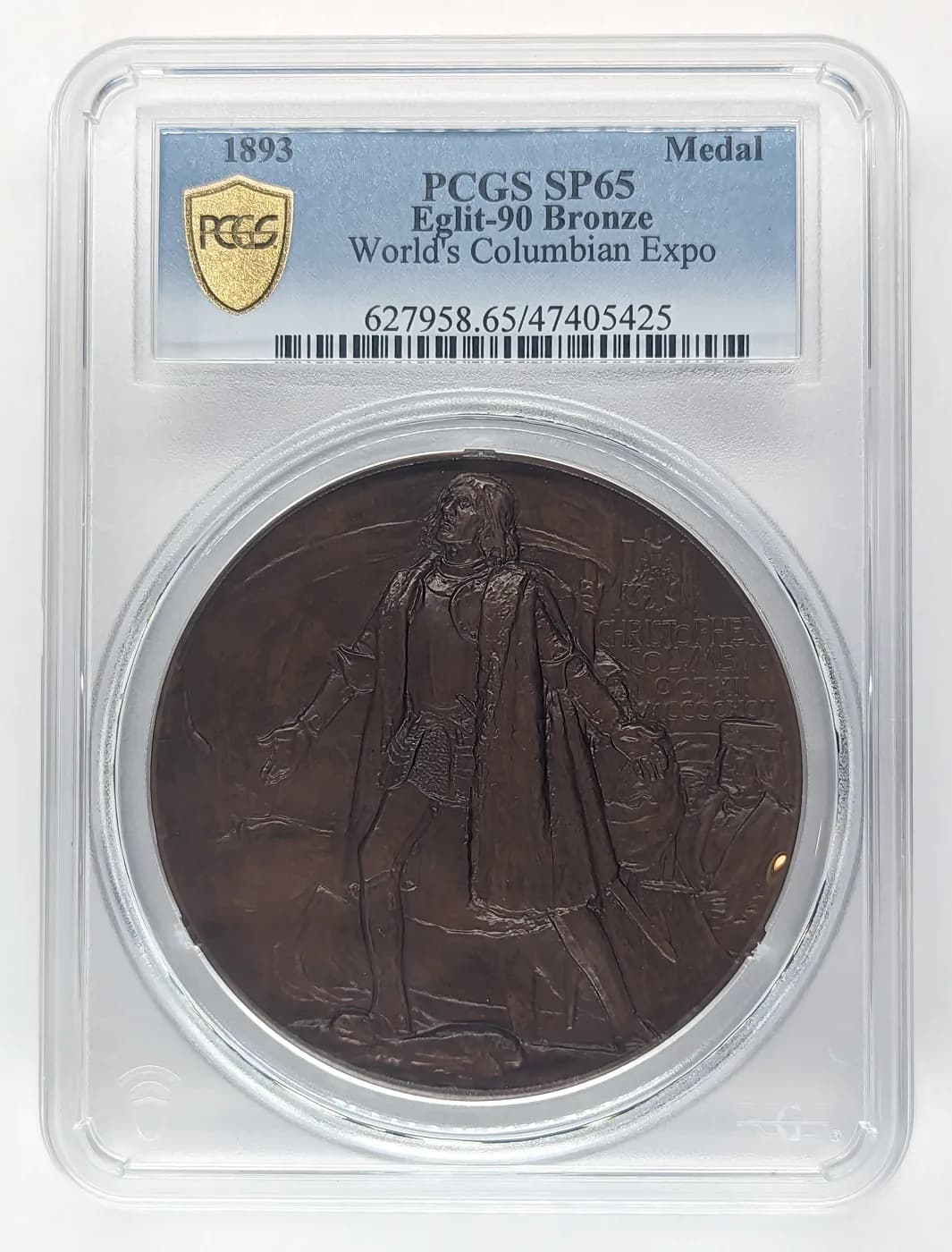
Augustus Saint-Gaudens designed the official award medal for the 1893 World's Columbian Exposition, and his original reverse, featuring a nude youth, was rejected after objections on grounds of propriety. The replacement reverse was cut by Charles E. Barber, Chief Engraver of the US Mint. The result is the most artistically significant American medal of the nineteenth century and a documented case of public taste overruling a major sculptor. Understanding which reverse you are looking at is the first thing to establish on any example.
Who Was Augustus Saint-Gaudens?
The most important American sculptor of his generation, and the figure who dragged American medallic art into serious company.
Born in Dublin in 1848 to a French father and Irish mother, raised in New York, trained in Paris and Rome, he built his reputation on public monuments, the Farragut Memorial, the Shaw Memorial on Boston Common, the Adams Memorial in Washington. His work carried a modelling sophistication that American sculpture had not previously possessed.
He also worked in relief, and it is the relief work that connects him to collectors. Theodore Roosevelt later commissioned him to redesign American gold coinage, which produced the 1907 double eagle, a coin routinely described as the most beautiful the United States has struck, and one whose relief was so high the Mint had to reduce it to make production practical.
The Columbian Exposition medal of 1893 sits fourteen years before that commission, and it is where the collision between artistic ambition and institutional practicality first played out in public.
What Was the Controversy About?
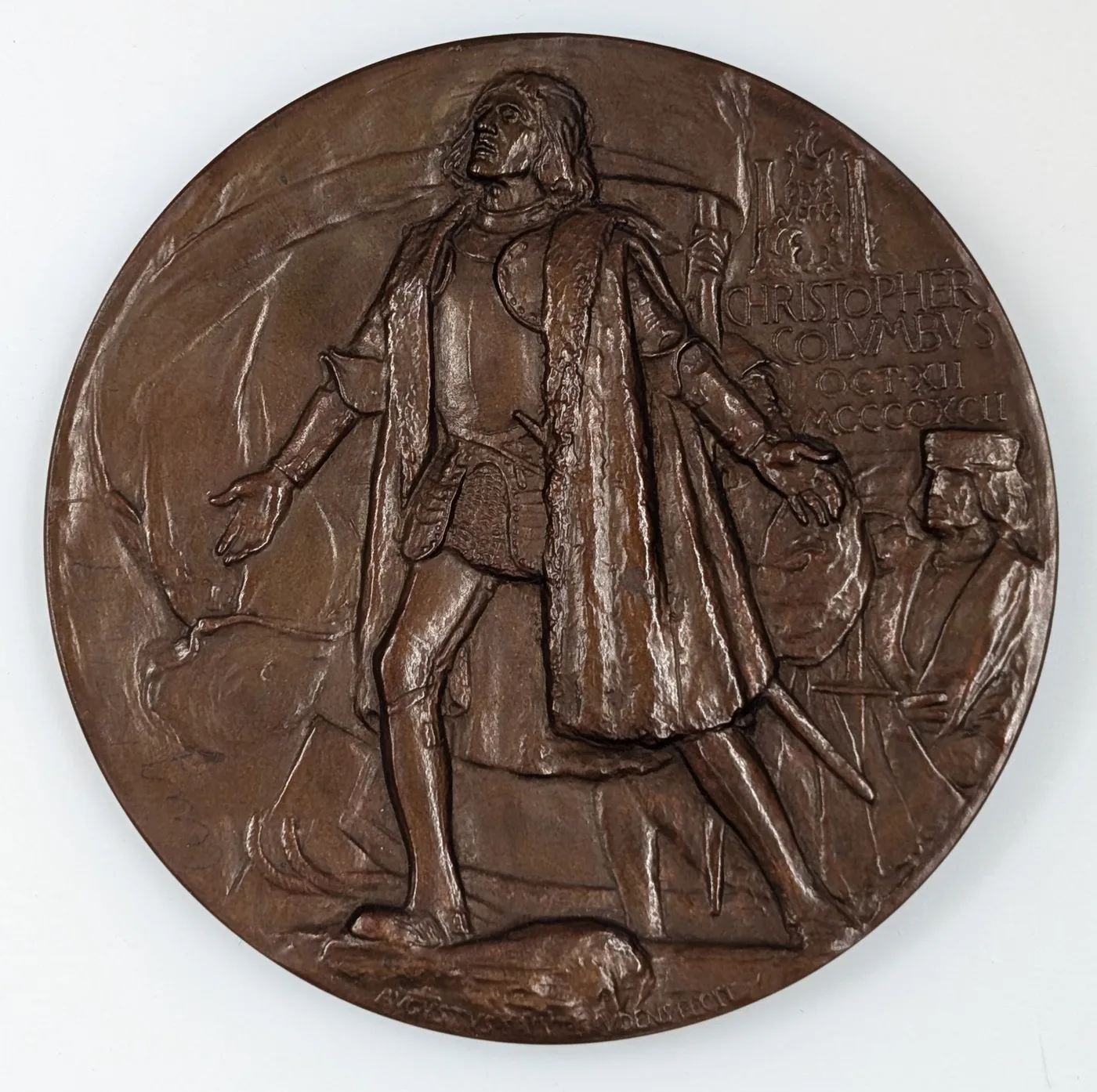
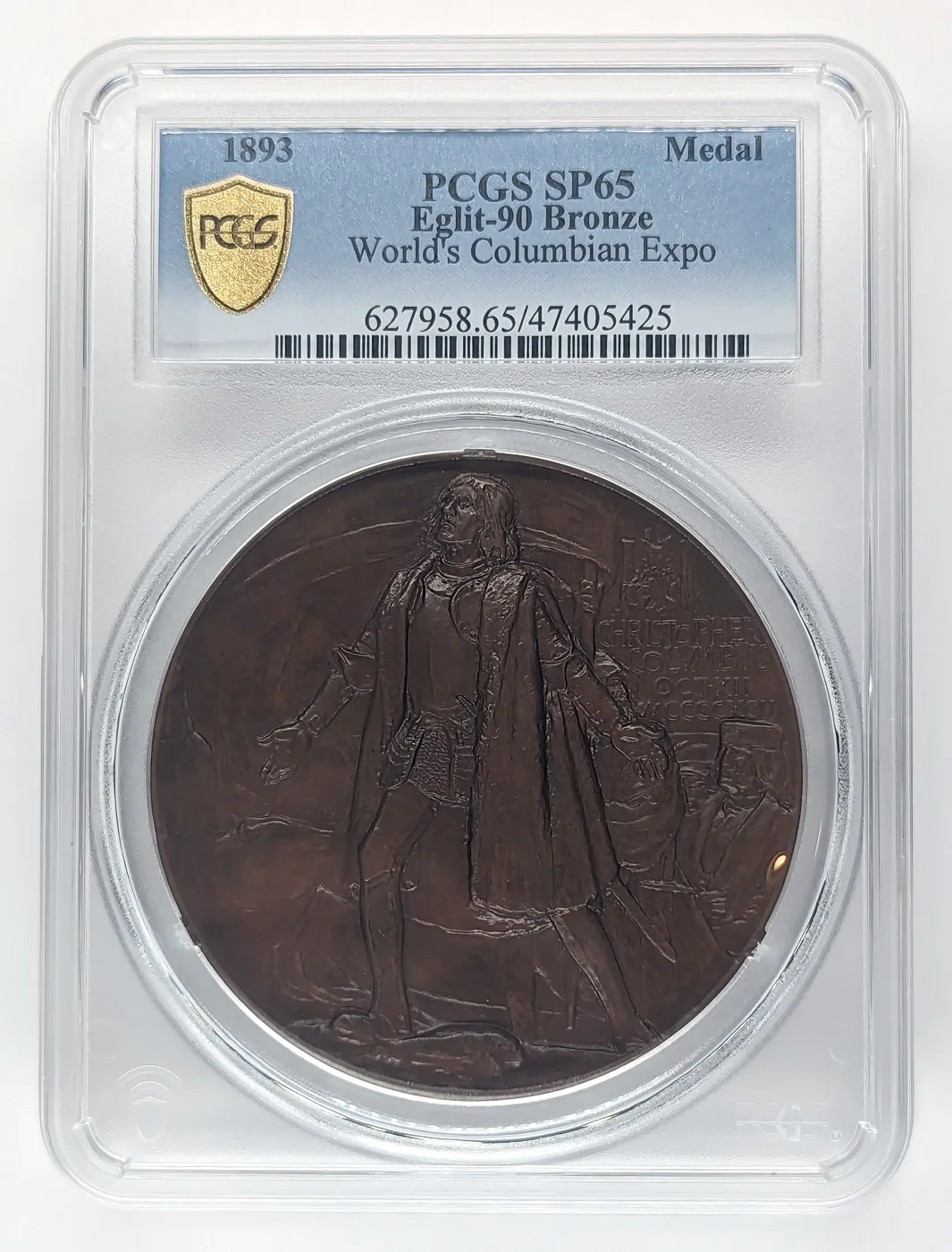
Saint-Gaudens produced designs for both faces of the exposition's official award medal. The obverse, Columbus coming ashore, was accepted without difficulty and is the design on every example.
His reverse was the problem. It featured a nude male youth, in a classical idiom entirely conventional in European academic sculpture and entirely unwelcome to a section of American opinion in 1893. Objections were raised on grounds of propriety, and the design was rejected for the issued medal.
The replacement reverse was cut by Charles E. Barber, Chief Engraver of the United States Mint, a competent, conservative designer whose relationship with outside artists was frequently strained, and who would later resist Saint-Gaudens's coinage designs on similar grounds of practicality and preference.
The upshot: the issued medal is a hybrid. Saint-Gaudens's obverse, Barber's reverse. It is one of the clearest documented instances of American public taste overruling a major artist, and it prefigures the Mint's later friction with the same sculptor over the double eagle.
What Exactly Was the Medal For?
It was an award, presented to exhibitors judged to have merit, not a souvenir sold to visitors.
That distinction governs everything about how examples should be assessed. Award medals were produced in controlled numbers, issued to identifiable recipients, and frequently supplied in fitted cases with accompanying documentation. Souvenirs were made in whatever quantity the market absorbed.
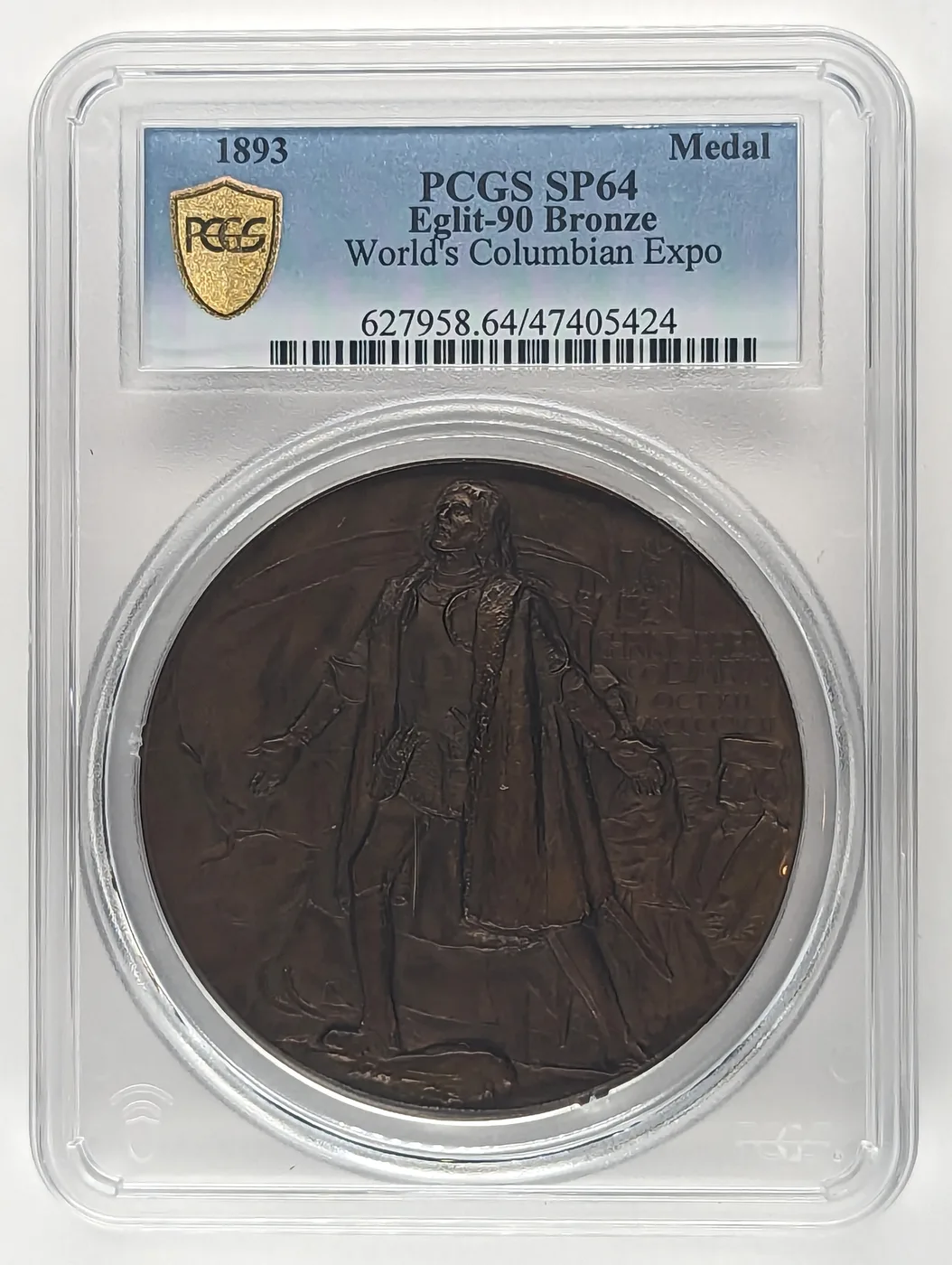
Our archive holds the medal in bronze both with its original case and certified at PCGS MS64 and MS65, which between them cover the two ways collectors usually want this piece: as a complete original artefact, or as a certified example of the design in high grade.
Original cases matter more here than on most medals. They are period objects in their own right, they are frequently lost, and their presence supports the piece's history as an actual award rather than a later acquisition.
| Attribute | What to check | Why |
|---|---|---|
| Obverse | Columbus landing scene | Saint-Gaudens's accepted design |
| Reverse | Barber's replacement design | The Saint-Gaudens nude reverse was not issued |
| Metal | Bronze most commonly encountered | Award tiers existed; metal affects value |
| Case | Original fitted case present? | Frequently lost; materially adds value |
| Grade | MS64, MS65 etc. | Bronze shows handling readily at this size |
How Should You Grade and Buy One?
Bronze medals of this size and period have a characteristic set of problems, and knowing them saves money.
Surface first. Original bronze develops a stable patina over a century and a quarter. A medal that has been cleaned, polished or artificially retoned has lost the single most important thing it had, and no grade compensates. Look for even, undisturbed color.
High points second. The Columbus figure and the ship carry the highest relief and show rub first.
Rim and edge third. Large medals were handled, propped, dropped and displayed. Rim bruises are common and materially affect eye appeal on a piece this size.
Then the case. Period cases suffer from split hinges, crushed silk and detached linings. A poor case is still better than no case, but condition varies enormously and is worth inspecting separately from the medal.
MS64 and MS65 for bronze of this age represent genuinely well-preserved examples. Do not expect the pristine surfaces you would look for on a modern medal.
Who Actually Received One?
Exhibitors, not visitors, and not while the fair was open.
This was an award medal. It went to exhibitors whose displays were judged worthy of recognition, accompanied by a diploma naming the recipient and the award. It was never sold at a souvenir stand, which is the single most common misunderstanding about the piece and the reason so many listings describe it wrongly.
Awards were not presented at the closing ceremony either. The judging, engraving and production ran on well past the fair's close, and recipients waited a considerable time for medals to arrive. That delay is part of why the diplomas and the medals so often became separated: they reached the exhibitor at different times and were kept in different places.
The practical consequence for a buyer is that a medal with its original case, or better still with the associated diploma or any documentation naming the exhibitor, is a materially rarer survival than the medal alone. Our archive has included an example retaining its original case, which is how these were issued and how comparatively few of them have stayed.
What Else From the Fair Belongs Beside It?
Enough to build a coherent group without ever leaving 1892 and 1893.
The fair produced the first United States commemorative coins. The Columbian half dollar was struck dated both 1892 and 1893, and the Isabella quarter of 1893 followed, the only United States quarter issued as a commemorative in the classic series. Both were sold to raise money for the exposition, and both are common enough today to buy in decent grade without difficulty.
Around them sits a large body of so-called dollars and exposition medalets, cataloged in the HK series, running from official issues to pieces struck by exhibiting companies for their own stands. This is where the variety is, and where a collection stops being a shelf of famous names and starts documenting what the fair actually was.
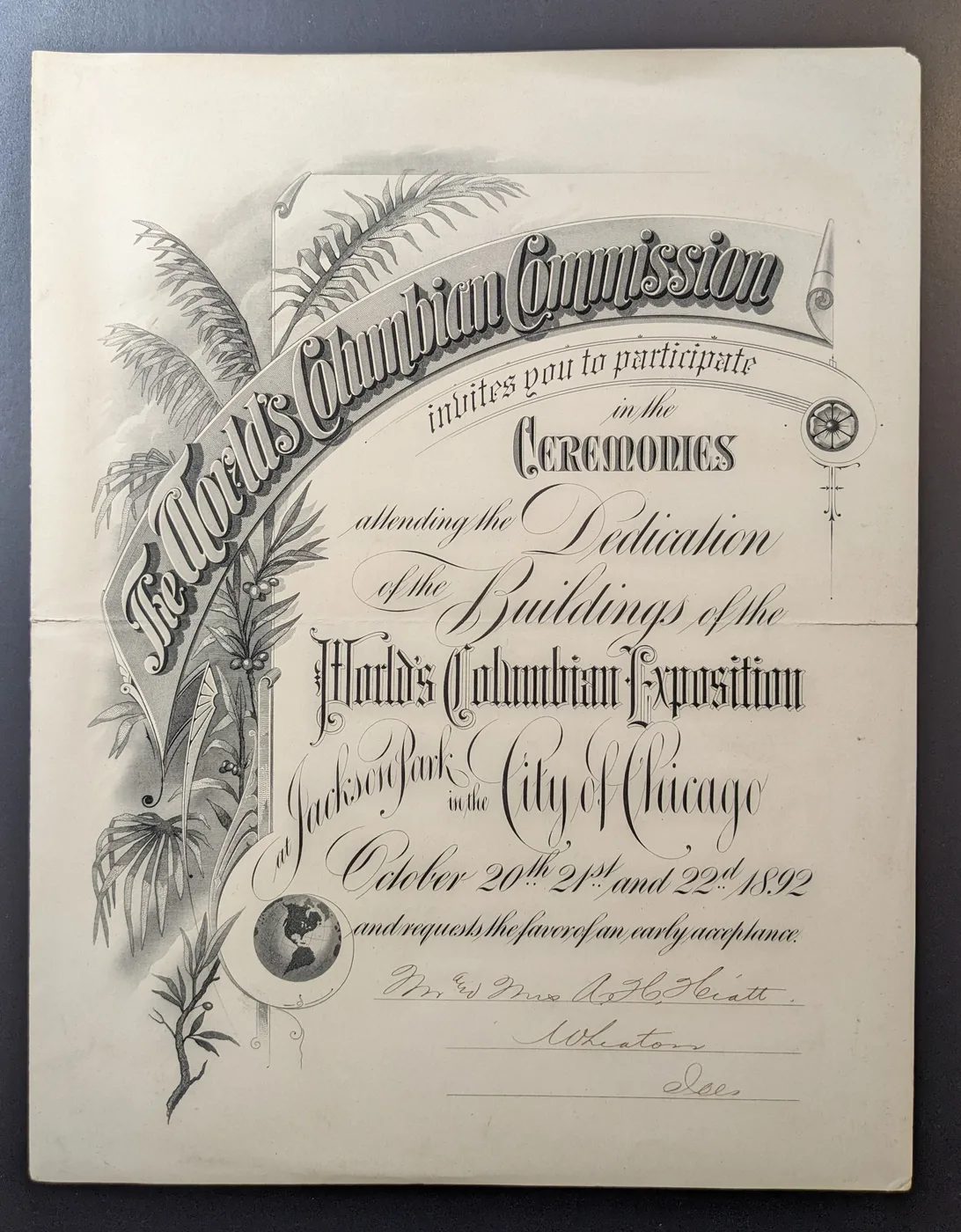
Paper belongs in the group too, and it is routinely overlooked. Tickets, admission passes, exhibitor correspondence and ceremonial invitations survive in reasonable numbers and cost very little. Our original invitation to the 1892 dedication ceremonies is that kind of object: not valuable by the standards of the medal, and far more evocative of the event itself.
How Should a Bronze Medal Be Handled and Stored?
As little as possible, and never with a cleaning cloth.
The brown surface on a nineteenth-century bronze medal is a stable oxide layer built up over a century, and it is the single largest component of the piece's value. Removing it is the work of a minute and cannot be undone. Any product that promises to brighten a medal will strip it, and the bright orange surface underneath will retone unevenly over the following years into something visibly wrong.
Handle by the edges, with clean dry hands or cotton gloves. Fingerprints on bronze are not cosmetic: the salts etch into the surface and appear as permanent dark marks months later, long after the print itself is invisible.
For storage, keep medals away from soft plastics containing PVC, which off-gasses and leaves a green residue on copper alloys. Inert flips, paper envelopes of archival quality, or the original case are all fine. Keep humidity moderate and stable, because damp is what turns a stable patina into active corrosion.
If a medal is already in a grading holder, leave it there. The holder is inert, sealed and does the job better than anything you will assemble at home.
Why Does This Medal Matter Beyond Numismatics?
Because it documents an argument that American art was having with itself.
The 1893 exposition was the moment American civic culture announced its arrival, the White City, the Beaux-Arts architecture, the scale, the ambition. It was also the moment a committee told the country's leading sculptor that his reverse was unacceptable and had a Mint engraver replace it.
Both things are true at once, and the medal carries both. It is simultaneously the most artistically ambitious American medal of its century and a physical record of that ambition being curtailed.
For a collector building around the hands that cut the dies rather than the countries that issued them, this piece is close to essential. It pairs naturally with European medallic coinage of the same generation, the 1908 Austrian jubilee 100 corona by Rudolf Marschall is a useful comparison, a medalist's design that survived into coinage intact, where Saint-Gaudens's did not.
It is also the piece that fixes the medal as an American art form rather than an imported one. Before 1893 the serious medallic work owned by American collectors was overwhelmingly European, and the assumption in the trade was that this was the natural order of things. A commission of this visibility, given to the country's leading sculptor and fought over in public on artistic grounds, changed that assumption permanently.
The generation that followed worked in the space it opened. The named medalists whose output now fills the exonumia catalogs, and the private issues struck for the expositions that came after Chicago, exist in a market that this commission helped create. That is the argument for owning one even if you collect nothing else from the fair: it is the point where American medallic art stopped being derivative, and the object itself is beautiful enough to justify the claim.
Frequently asked questions
Did Saint-Gaudens design both sides of the Columbian Exposition medal?
He designed both, but only the obverse was issued as he intended. His reverse, which featured a nude male youth, was rejected on grounds of propriety and replaced by a design cut by Charles E. Barber of the US Mint.
Can I buy a medal with the original Saint-Gaudens reverse?
The issued award medal carries Barber's reverse. Any piece offered as bearing the Saint-Gaudens reverse requires careful verification of exactly what it is and how it came to exist, and should not be assumed to be an issued award medal.
Was this medal sold to visitors at the fair?
No. It was an official award presented to exhibitors judged to have merit. Souvenir medals for visitors were a separate and much larger category of exposition material.
How much does the original case add?
Materially. Fitted cases are period objects, are frequently lost, and support the medal's history as a genuine award. A cased example and an uncased one are meaningfully different propositions.
Is a cleaned bronze medal still worth buying?
At the right price, as a filler. But cleaning bronze is irreversible and removes the patina that took a century to form, so a cleaned example should cost substantially less than an original-surface piece in a lower technical grade.
What is the connection to the 1907 double eagle?
Theodore Roosevelt commissioned Saint-Gaudens to redesign American gold coinage, producing the 1907 double eagle, widely considered the finest US coin ever struck. The Columbian medal is the earlier episode in the same story of an ambitious sculptor meeting institutional resistance.
Pieces from the collection
Examples handled here, cataloged with photographs and, where the piece was certified, its grading label. Sold pieces stay listed as a reference record.
 Sold
SoldMedals · 1893
1893 Columbus Saint-Gaudens Bronze Medal World's Columbian Exposition with Case
$185
 Sold
SoldMedals · 1893
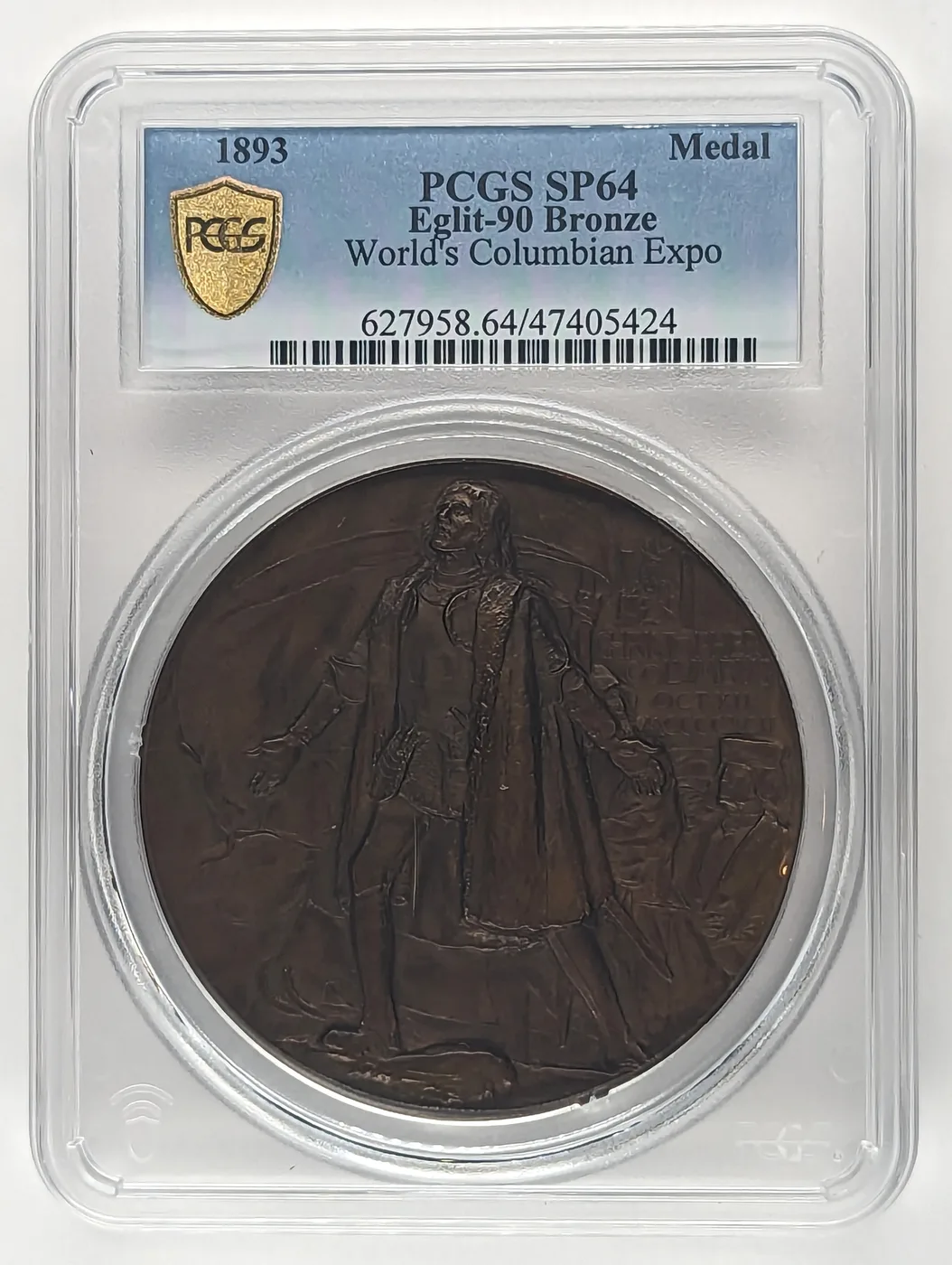
1893 Colubmus Saint Gaudens Bronze Medal PCGS MS64 World's Columbian Exposition
Sold
 Sold
SoldMedals · 1893
1893 Colubmus Saint Gaudens Bronze Medal PCGS MS65 World's Columbian Exposition
Sold
 Sold
SoldMedals · 1892
1892 Columbian Exposition Dedication Ceremonies Invitation Original a H Hiatt
Sold
More guides
Have one of these?
We buy outright, and we will value a piece for you whether or not you sell. Photographs and whatever paperwork you have are enough to start.