
Autographs
Collecting John F. Kennedy Autographs: Letters, Cut Signatures and the Secretarial Problem
11 min read
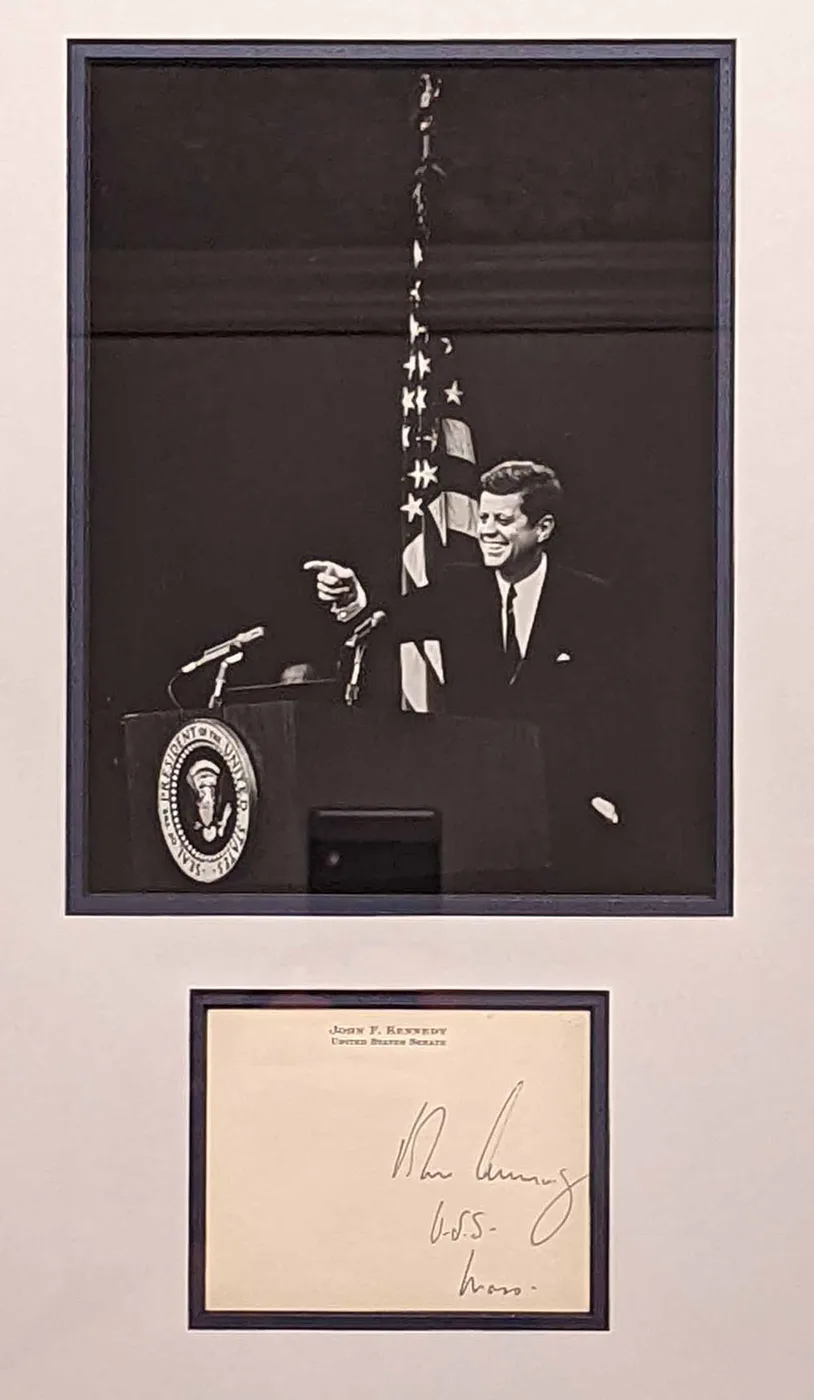
A John F. Kennedy autograph is one of the most forged and most secretarially signed of any twentieth-century American figure, which makes third-party authentication less a nicety than a precondition of the purchase. The material divides sharply by form: a handwritten letter in his own hand sits at the top, a typed letter signed as President below it, and a cut signature or signed card below that. Understanding why those tiers exist, and why a White House-era signature is harder to trust than a Senate-era one, is most of what separates a good buy from an expensive one.
Why Are Kennedy Autographs So Difficult?
Three pressures act on this signature at once, and each of them independently would be enough to make a market difficult.
The first is volume of demand. Kennedy has been among the most collected American political figures since 1963, and sustained demand attracts forgery in a way that obscure figures never do.
The second is secretarial signing. Like most senators and every modern president, Kennedy could not personally sign the correspondence his office generated, and staff signed on his behalf as a matter of routine administration. These are not forgeries in intent, they were produced by his own office, for legitimate reasons, but they are not his hand, and the market values them at a small fraction of an authentic signature.
The third is the compressed timeline of the presidency. He held the office for slightly under three years. The most desirable period is also the shortest, and the period during which he had the least time to sign anything personally.
What Is the Difference Between an ALS, a TLS and a Cut Signature?
These abbreviations are the basic grammar of autograph collecting, and getting them straight is the fastest way to read a listing accurately.
An ALS, autograph letter signed, is written entirely in the subject's own hand and then signed. Every word is his. This is the most desirable form of any autograph, because a secretary cannot produce it and a forger must sustain the hand across an entire document rather than five inches of signature.
A TLS, typed letter signed, is typed by someone else and signed by the subject. The signature is the only autograph content. This is the standard form of official correspondence, and it is where the secretarial problem bites hardest.
A cut signature is a signature removed from a larger document, or signed on a card or album page with no surrounding content. It has the least to authenticate against and the least to say.
| Form | What it is | Why it ranks where it does |
|---|---|---|
| ALS | Letter wholly in his hand, signed | Cannot be secretarial; the volume of handwriting makes forgery far harder |
| TLS as President | Typed letter signed while in office | Highest-status period, but the period of heaviest secretarial signing |
| TLS as Senator | Typed letter signed pre-1961 | Lower status, but a signature more likely to be personally applied |
| Signed photograph | Portrait or press photo, signed | Display value; authentication rests on the signature alone |
| Cut signature / card | Signature with no context | Least information, least premium, easiest to fake |
How Did His Signature Change Over Time?
A collector who knows only one Kennedy signature will reject genuine examples and accept bad ones. The hand moved considerably across roughly two decades of public life.
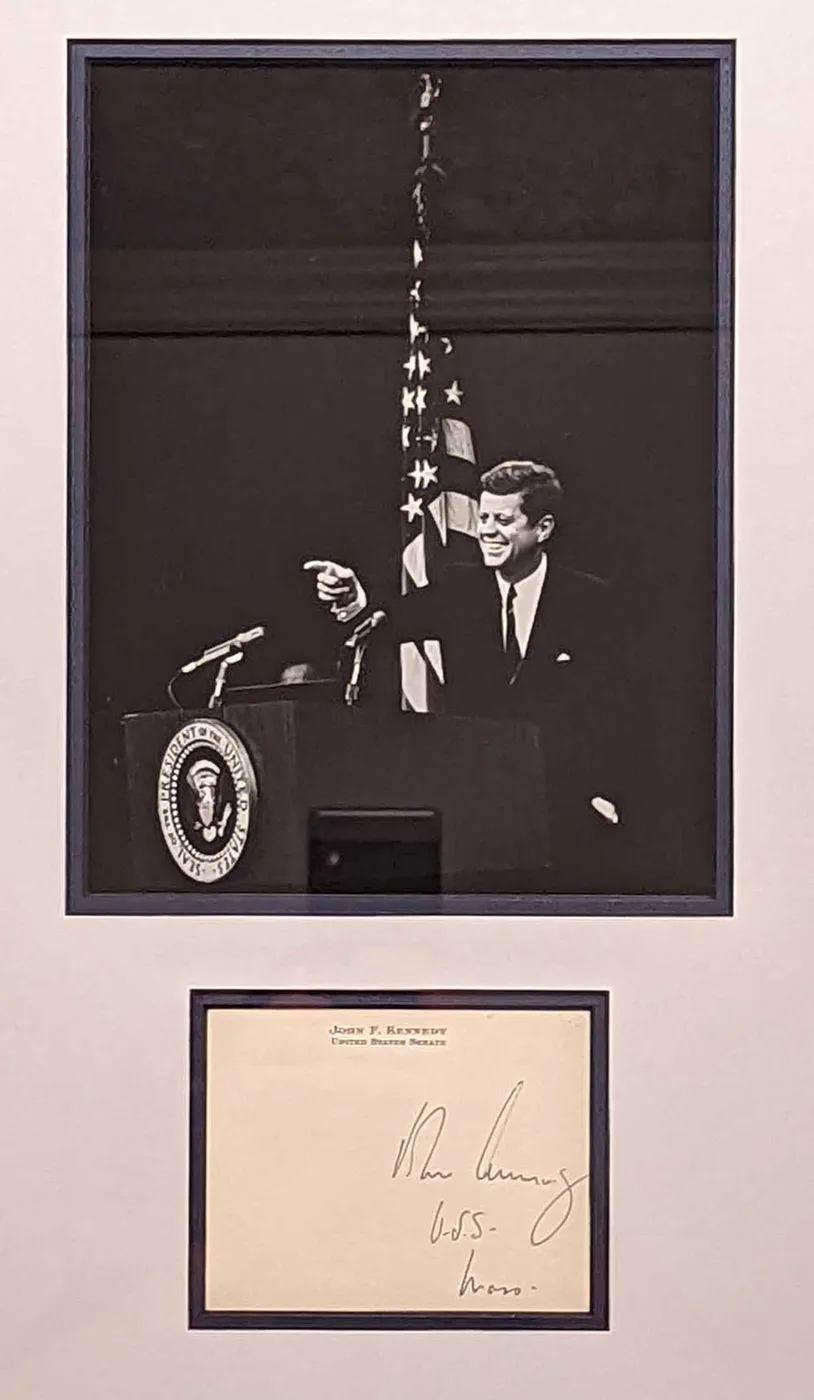
The earlier hand, congressional and Senate years, is generally larger, more deliberate, and more legible, with the individual letters of the surname more fully formed. There was simply more time to sign.
The presidential hand is faster and more abbreviated. Letters collapse into strokes, the surname can reduce to a gesture, and the whole signature tightens. To an eye trained on the Senate signature it can look wrong, and it is not.
This is precisely why authentication is comparative work rather than pattern-matching. An authenticator asks whether a signature is consistent with exemplars from the same period, not with a generalised idea of what a Kennedy signature looks like. The Senate card we cataloged and a presidential-era letter are both genuine and look materially different.
What Does Association Content Add?
Two letters of identical form are not worth the same amount if one of them is about something.
The clearest example in our own archive is the typed letter signed as President concerning the loss of the USS Thresher. The Thresher, a nuclear attack submarine, was lost with all 129 men aboard during deep-diving trials off New England on 10 April 1963, at that point the worst submarine disaster in history, and an event that reshaped US Navy submarine safety practice through the SUBSAFE programme that followed.
A presidential letter touching that event is not simply a Kennedy signature. It is a document connected to a specific, dateable, consequential moment, and it can be researched, contextualised and displayed as history rather than as a name on paper.
Content premium is real but it is not automatic. The event has to be identifiable and the connection has to be genuine. A letter that merely happens to be dated near a famous event carries no premium at all.
How Should You Read a PSA/DNA Certification?
Third-party authentication on autographs works differently from coin grading, and the difference confuses people arriving from numismatics.
An authenticator is answering a binary question first, is this signature genuine, and only then, on some services, assigning a grade. The grade describes the quality of the signature as an artefact: boldness, contrast against the paper, freedom from smudging, placement. A grade of 9 on a ten-point scale describes a strong, clean, well-placed signature. It says nothing further about whether the underlying document is interesting.
So read the two attributes separately. Authentication tells you the thing is real. The grade tells you it presents well. The document's content and form tell you whether it is worth owning.
One practical caution: certification is issued against the item as submitted. If a letter is later trimmed, remounted or separated from its envelope, the certification no longer describes what you are holding. Original envelopes in particular carry postmark evidence that supports the whole package, which is why the handwritten letter retaining its envelope is a stronger artefact than the same letter would be alone.
What Should You Avoid?
Uncertified presidential-era signatures offered cheaply. The combination of high demand and heavy secretarial signing means genuine, personally signed White House material does not turn up underpriced. A bargain here is a warning.
Signatures on modern reproduction photographs. A genuine signature on a photograph printed decades after his death is a real signature applied to the wrong object, which is to say, not genuine at all.
Anything described only as having a certificate of authenticity from the seller. A COA issued by whoever is selling the item is a claim, not an authentication. The value is in the independence, not the paper.
Documents where the signature is the only Kennedy element and the form is not stated. If a listing will not tell you whether a piece is an ALS, a TLS or a cut, assume the least valuable reading.
How Much Does Provenance Add?
More than with almost any other twentieth-century president, because the supply problem and the forgery problem are the same problem.
Kennedy material moves through three broad channels. Some came directly from recipients and their families: the person who was written to, and their descendants. Some came out of the working world of the presidency, through staff, colleagues and the people who handled paper daily. And some has simply circulated in the trade for sixty years, arriving with a certificate and no history at all.
The first two are worth paying for. A letter that can be traced to the person it was addressed to answers the authenticity question from the other end, independent of anybody's opinion about the handwriting, and it usually brings context with it: what the exchange was about, why it happened, what came next. The third is not disqualifying, and most certified material in the market has no documented chain, but it leaves the certificate carrying the entire weight of the claim.
Read provenance claims carefully rather than warmly. A named consignor, an auction record with a date and a lot number, or a letter of transmittal from the recipient's family are checkable facts. A phrase like from a prominent east coast collection is not a provenance, it is a sentence.
How Should a Signed Letter Be Stored and Displayed?
Out of sunlight, out of contact with anything acidic, and with the assumption that display costs condition.
Mid-century paper is not fragile in the way a nineteenth-century document is, but ink fades and paper yellows, and both happen faster than people expect. Ultraviolet light is the main agent. A letter hung on a sunlit wall for a decade will lose contrast in the signature, which is the exact feature the value rests on, and no conservator can put it back.
The practical measures are simple and cheap. Use acid-free, lignin-free mounts and backing rather than ordinary card. Use UV-filtering glazing if the piece is framed, and hang it away from direct sun regardless. Keep it out of basements and attics, where humidity swings drive foxing and cockling. Never trim, never dry-mount, and never use adhesive tape on the object itself.
One point specific to certified material: a slabbed or encapsulated item should stay in its holder. The holder is the certification. Breaking it out to reframe a letter destroys the link between the piece and its certificate, and re-submitting is both a cost and a risk you took on for nothing.
How Does This Sit Alongside Political Medals?
Autographs and campaign medals answer different questions about the same subject, which is why serious collections of political Americana usually contain both.
A signature is personal and singular: this specific person, on this specific day, put a pen to this specific sheet. A campaign medal is the opposite, mass-produced, distributed to strangers, designed to be worn in public by people who would never meet the candidate.
Together they bracket a political career from the inside and the outside. Our own available stock sits firmly on the medal side, running from the 1860 Lincoln campaign medal through the Gilded Age contests, and it is the natural counterweight to a signature collection.
If you are starting out, the medals are also considerably more forgiving. A struck metal object with a cataloge number and a certification label presents far fewer authentication traps than a signature does.
Frequently asked questions
What is the most valuable form of Kennedy autograph?
An autograph letter signed, one written entirely in his own hand and then signed, is the most desirable form, because it cannot have been produced by a secretary and is substantially harder to forge than a signature alone. Presidential-period content raises it further.
How common are secretarial Kennedy signatures?
Common enough that they should be assumed until ruled out, particularly on routine correspondence and especially during the presidency. His office signed on his behalf as normal administrative practice, and those items still circulate.
Does a PSA/DNA grade of 9 mean the letter is rare?
No. The grade describes the physical quality of the signature, boldness, contrast, placement, not the rarity or historical interest of the document. A common letter can grade 9 and a historically important one can grade lower.
Is a signature with its original envelope worth more?
Generally yes. The envelope supplies postmark and addressee evidence that corroborates the letter, and separating the two destroys information that cannot be put back. Authenticators note the envelope as part of the item for exactly this reason.
Why do genuine Kennedy signatures look so different from one another?
Because his hand changed considerably between his congressional years and the presidency, becoming faster and more abbreviated as demands on his time grew. Authentication compares a signature against exemplars from the same period rather than against a single idealised form.
Should I buy an uncertified Kennedy autograph?
Only if you are equipped to authenticate it yourself and are pricing it as though it might not be genuine. For most buyers, on this signature specifically, independent third-party authentication is the minimum sensible precaution.
Pieces from the collection
Examples handled here, cataloged with photographs and, where the piece was certified, its grading label. Sold pieces stay listed as a reference record.
Autographs
JFK John F Kennedy ALS Handwritten Letter with Envelope Signed Autograph PSA/DNA
$5,500
Autographs
JFK John F Kennedy TLS Signed Tresher Letter While President Autograph PSA/DNA Grade 9
$3,150
 Sold
SoldAutographs
JFK John F Kennedy Hand Signed PSA/DNA COA Autograph Senate Card
Sold
More guides
Have one of these?
We buy outright, and we will value a piece for you whether or not you sell. Photographs and whatever paperwork you have are enough to start.