
Campaign Medals
The 1860 Election in Campaign Medals: Lincoln, Douglas and a Country Splitting
8 min read
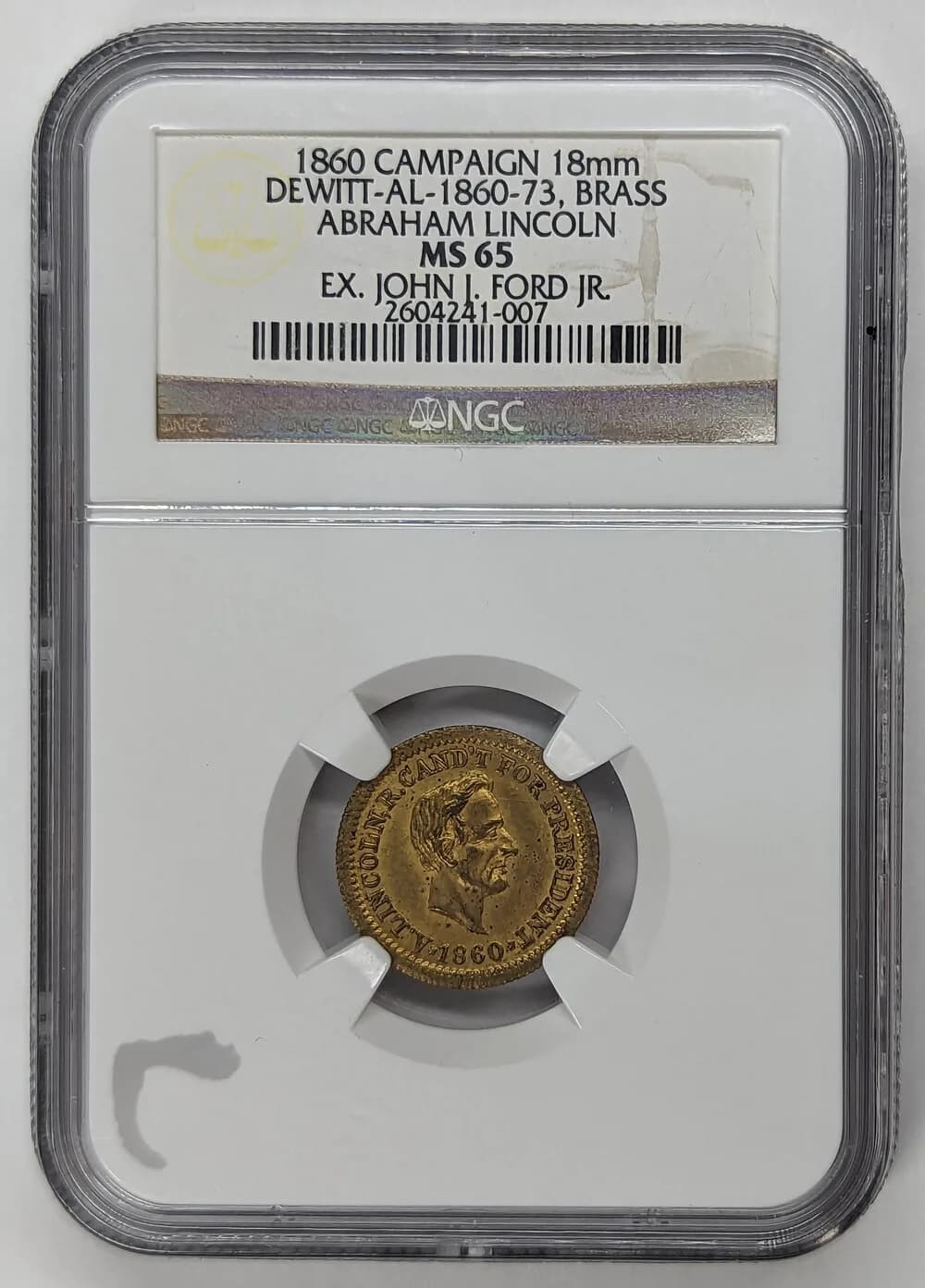
The 1860 presidential election produced the richest body of campaign medals in American history, because four tickets were competing at once and the stakes were the survival of the union. Lincoln's medalets, cataloged under DeWitt AL 1860 numbers, and Douglas's under SD 1860, are the two northern series a collector is most likely to encounter. They were struck in white metal, brass, copper and occasionally lead, worn on coats and carried in pockets, and they are the closest thing surviving to the physical texture of that campaign.
Why Was the 1860 Election So Unusual?
Because the party system collapsed in the middle of it.
The Democratic party could not agree a single candidate. Northern Democrats nominated Stephen A. Douglas of Illinois; Southern Democrats broke away and nominated John C. Breckinridge. The remnants of the old Whig coalition formed the Constitutional Union party behind John Bell. The Republicans, a party barely six years old, nominated Abraham Lincoln.
Lincoln won with under forty per cent of the popular vote and carried no southern state. South Carolina seceded in December, weeks after the result. By the following April the country was at war.
For collectors this means 1860 material is not simply early, it is the last political ephemera of the pre-war republic, produced by people who did not yet know what was coming.
How Do DeWitt Numbers Work for 1860?
J. Doyle DeWitt's descriptive cataloge organises campaign material by candidate initials and year. AL 1860 designates Lincoln's 1860 campaign; SD 1860 designates Douglas's. The number following identifies the design.
Two things about that are easy to get wrong.
First, a DeWitt number describes a design, not an individual piece. The same number can exist in several metals and several states of preservation, and each is a distinct collectible object. We cover that in detail in why one campaign medal exists in several metals.
Second, the number is not a rarity rating. A low number is not scarcer than a high one; the sequence reflects DeWitt's organisation of the designs he cataloged, not their availability.
Where a certification label also reads *Ex DeWitt*, that is a provenance statement about the specific piece having been in his collection, a separate matter, covered in what 'Ex DeWitt' means.
What Did These Medals Do?
They were worn and carried, which is why so many are holed.
A nineteenth-century campaign medalet was a piece of visible partisanship. Pierced at the top and hung from a ribbon or a coat, or simply carried loose in a pocket, it declared an allegiance in a period before the celluloid pinback button existed. The button did not arrive until the 1890s; before that, partisanship was struck in metal.
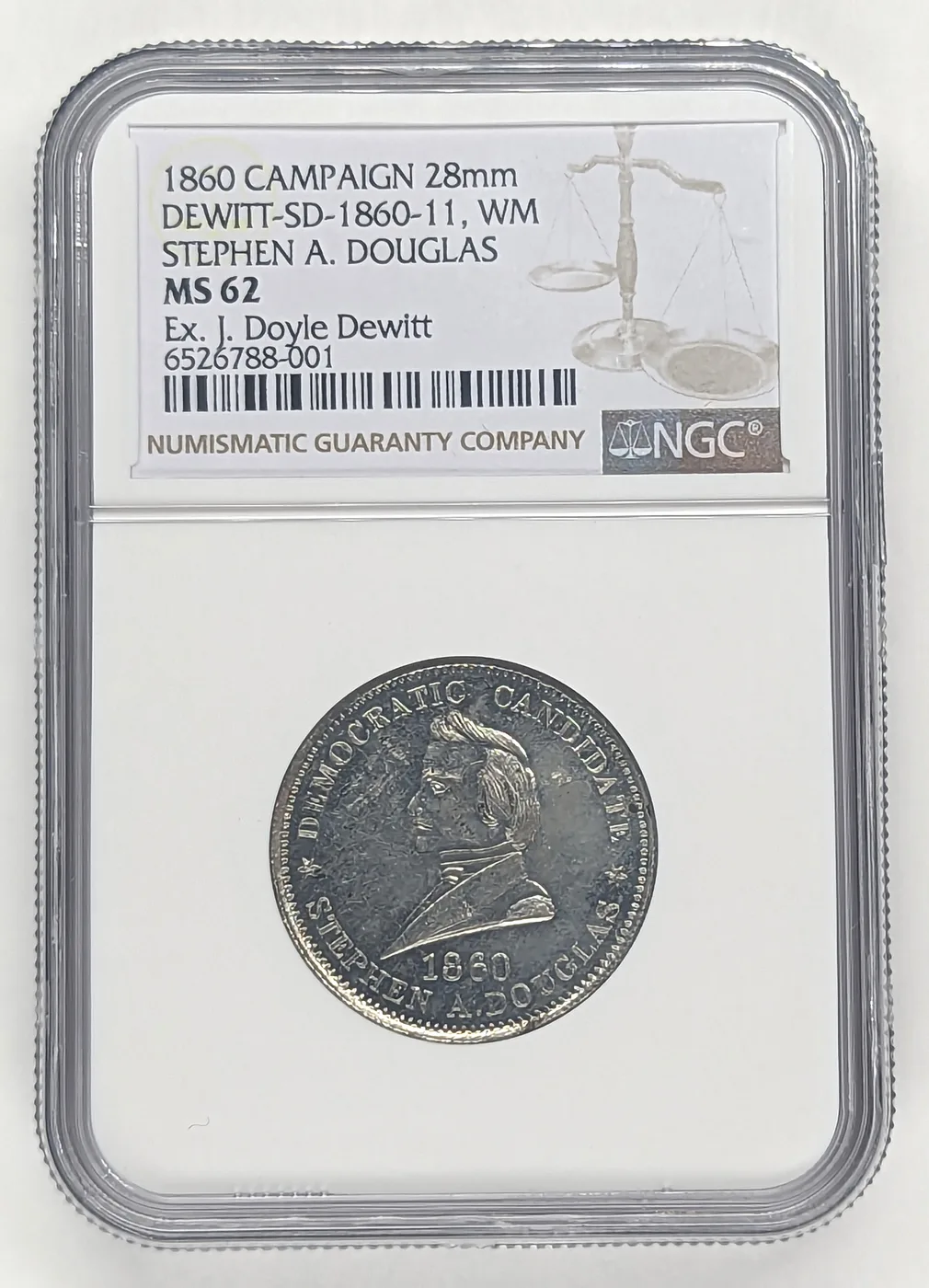
That use explains the condition profile of the surviving population. Holed examples are the norm. Rims are often bruised, high points are worn, and surfaces are frequently cleaned. An unholed, undamaged example survived by not being used for its intended purpose, and prices reflect that.
It also explains why grading services apply *Details* grades so often to this material. A holed medalet is not damaged goods in any meaningful historical sense, it is a medalet that did its job, but it will not receive a straight numerical grade. We treat that distinction in what a 'Details' grade means on a campaign medal.
| Candidate | Party | DeWitt prefix | Result |
|---|---|---|---|
| Abraham Lincoln | Republican | AL 1860 | Elected; 180 electoral votes |
| Stephen A. Douglas | Northern Democrat | SD 1860 | Second in popular vote, 12 electoral votes |
| John C. Breckinridge | Southern Democrat | JCB 1860 | 72 electoral votes, all southern |
| John Bell | Constitutional Union | JB 1860 | 39 electoral votes |
What Should You Buy?
For a first 1860 piece, prioritise in this order.
A legible portrait. These are small objects and the portrait is the point. A worn or weakly struck head undermines everything else.
Original surface over technical grade. Cleaned white metal takes on a characteristic dull, slightly grey flatness that never recovers. An honest circulated piece with original surface is a better object than a brighter cleaned one.
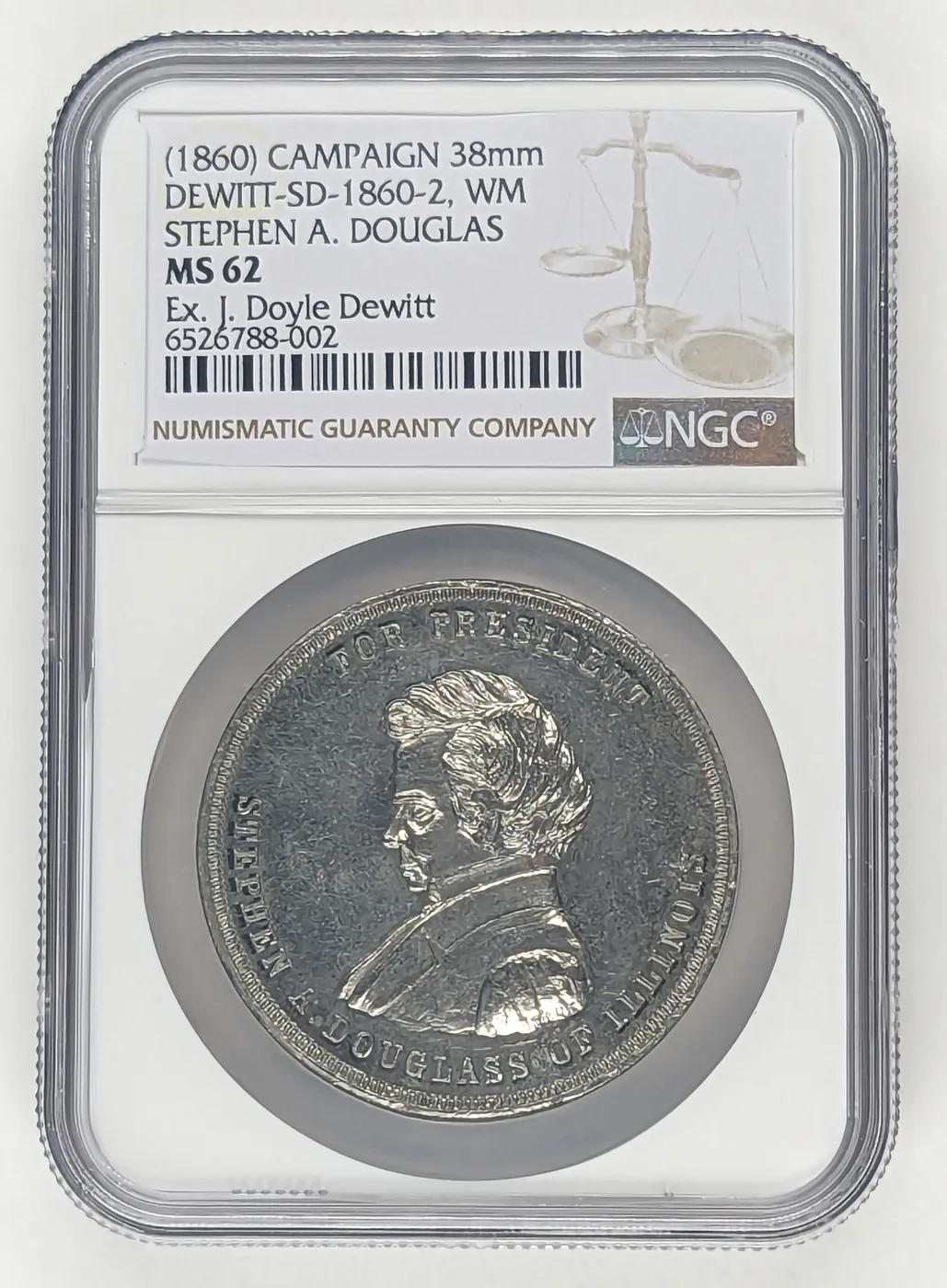
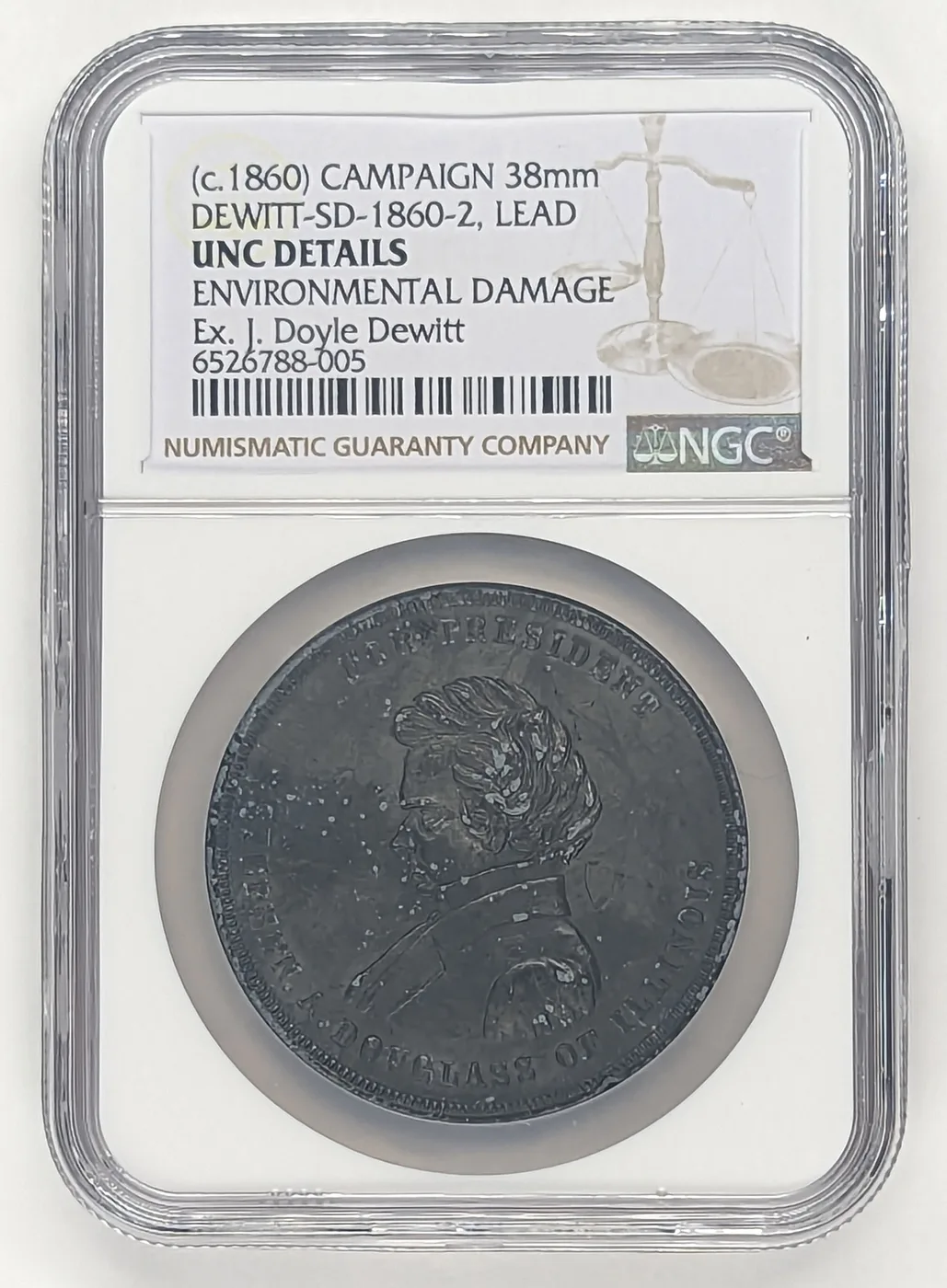
Metal you understand. White metal is the most commonly encountered for 1860; brass and copper are less so; lead strikings such as our Douglas SD 1860-2 in lead are genuinely unusual and worth understanding before you pay a premium for one.
Certification on anything expensive. NGC encapsulation of political medalets is now common, and for 1860 material, the most valuable and therefore most reproduced nineteenth-century campaign year, it is worth having.
How Do the Four Candidates Compare in Surviving Material?
Very unevenly, and not in proportion to the votes they took.
Lincoln and Douglas between them account for the overwhelming majority of surviving 1860 medalets. Both ran national organizations in the populous north, where the printing, striking and marching culture of American campaigning was concentrated, and both had constituencies willing to spend money on the paraphernalia of a campaign.
John C. Breckinridge, the southern Democratic candidate, and John Bell of the Constitutional Union party are a different matter. Their material exists, and it is collected, but it turns up far less often. Part of that is simply that fewer pieces were made. Part of it is what happened next: the war fell hardest on precisely the regions where their supporters lived, and objects made of soft white metal do not survive attics, moves and four years of catastrophe in the same proportions everywhere.
The practical effect is that a collector assembling a set of the 1860 field will find the two familiar names quickly and then wait, sometimes for years, on the other two. It also means the price gap between a common Lincoln medalet and a scarce Bell piece is much narrower than their relative fame suggests. If you want the harder half of the field, buy it when you see it rather than when you need it.
How Does Douglas Material Compare to Lincoln's?
Lincoln material carries a substantial premium, and the reason is not subtle: he won, he was assassinated, and he became the most collected figure in American history.
Douglas material is consequently better value for a collector interested in the campaign rather than the man. He was the most significant northern Democrat of his generation, the architect of popular sovereignty, and Lincoln's opponent in the debates that made Lincoln nationally famous. His medalets are scarcer in absolute terms than Lincoln's in several designs, and they cost less.
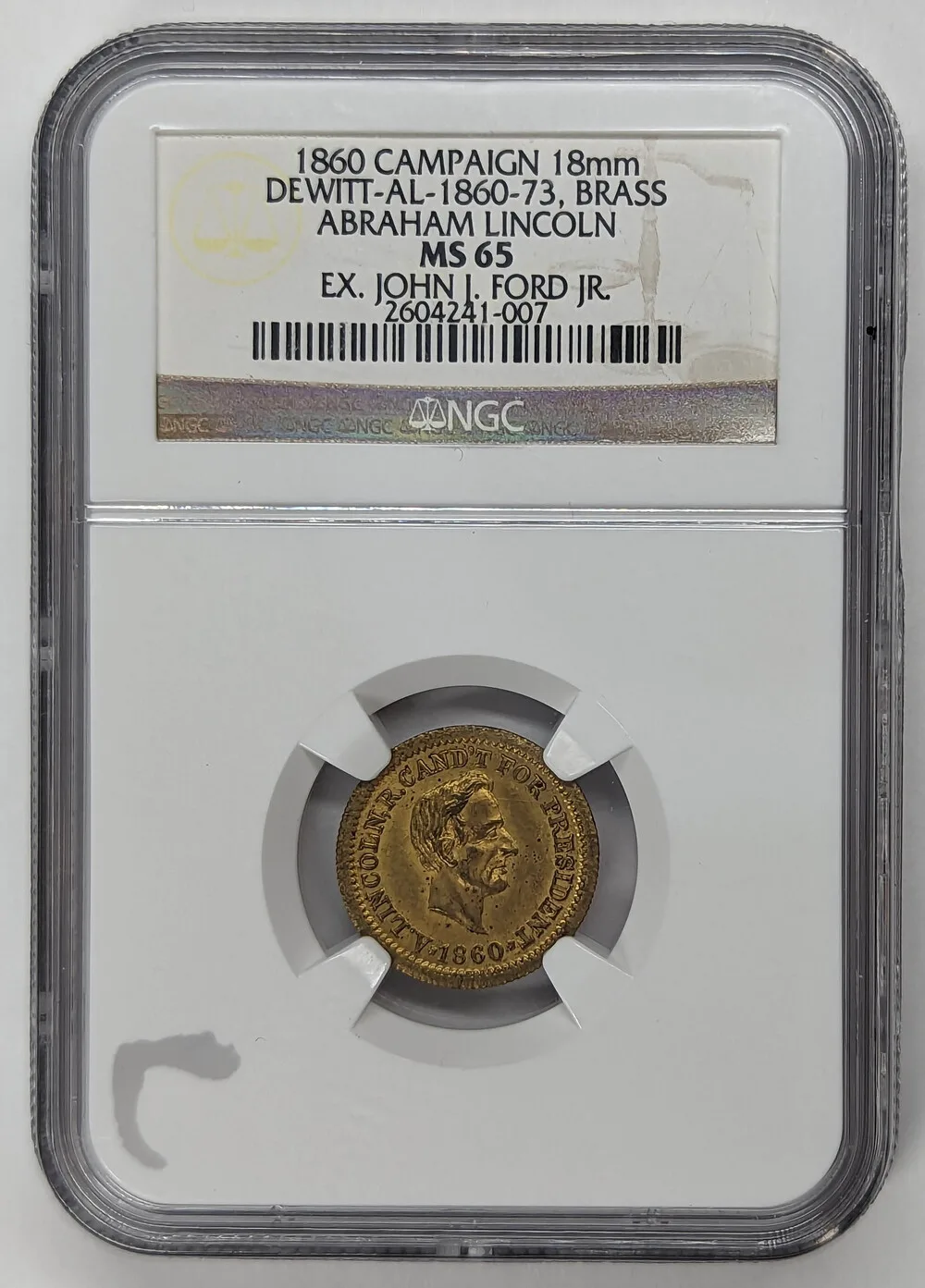
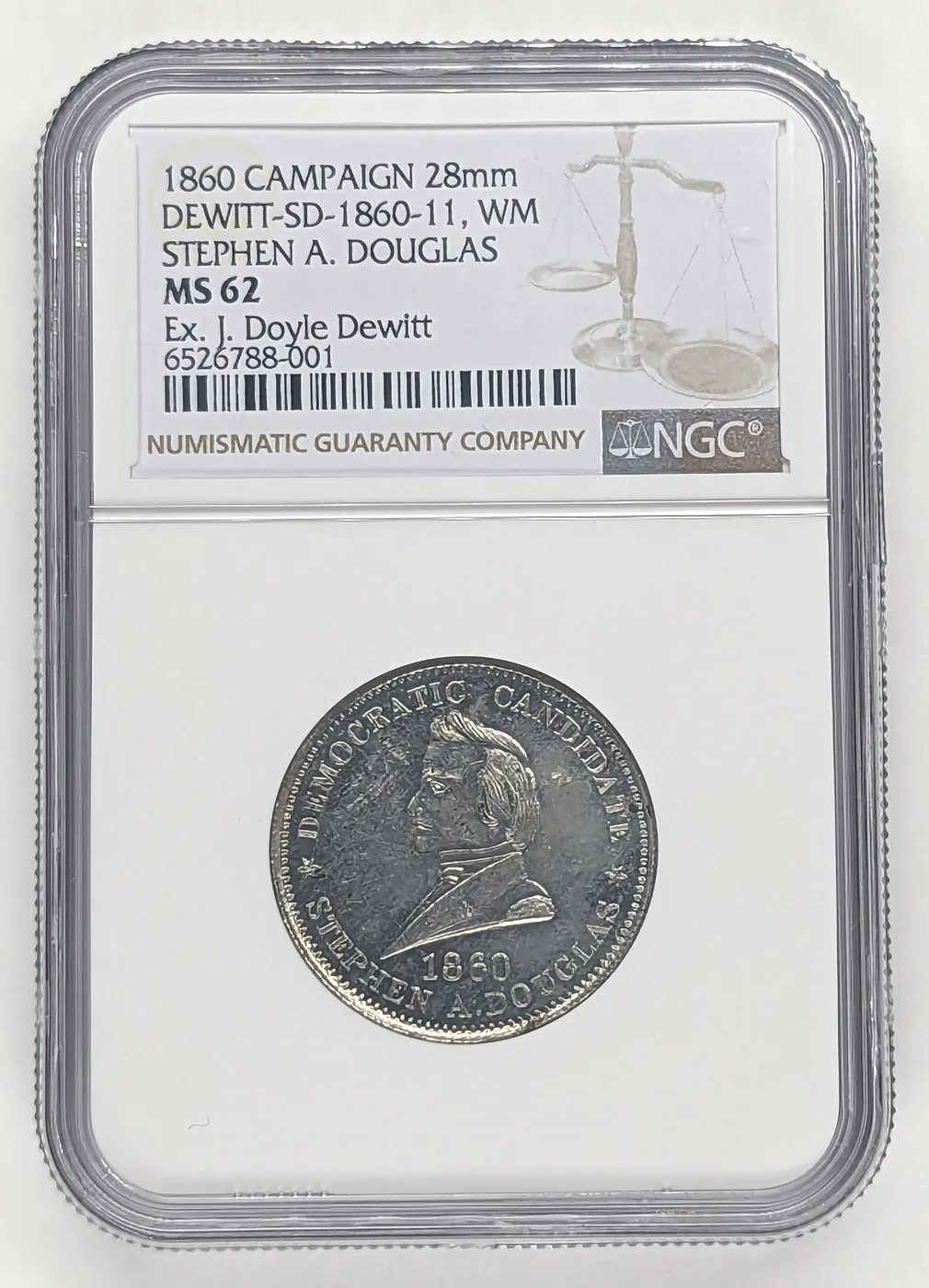
A collection containing both, our archive has Douglas in white metal at NGC MS62 and Lincoln AL 1860-73, represents the northern half of the 1860 contest as voters actually experienced it, with two rosettes competing for the same coat.
Frequently asked questions
Why are so many 1860 campaign medals holed?
Because they were meant to be worn. Pierced at the top and suspended from a ribbon or pinned to a coat, they were the pre-button method of declaring allegiance. An unholed example is scarcer precisely because it was never used as intended.
Does a low DeWitt number mean a rarer medal?
No. The number identifies a design within DeWitt's cataloge organisation. It carries no information about rarity, and the same number can exist in several metals of very different scarcity.
Is Lincoln 1860 material a good investment compared to Douglas?
Lincoln commands a large premium for reasons of fame rather than scarcity. Douglas designs are often genuinely scarcer and cost considerably less, which makes them better value for collectors interested in the campaign itself.
What metals were 1860 campaign medalets struck in?
Most commonly white metal, with brass and copper also frequent and lead encountered occasionally. The same design often exists across several, and each striking is a separate collectible with its own scarcity.
Why did four candidates run in 1860?
The Democratic party split over slavery, nominating Douglas in the north and Breckinridge in the south. The Constitutional Union party formed from former Whigs behind John Bell, and the Republicans nominated Lincoln. He won with under forty per cent of the popular vote.
Should I buy 1860 medals raw or certified?
For inexpensive examples, raw is reasonable if you can assess original surface. For anything costly, certification is worth having, 1860 is the most valuable nineteenth-century campaign year and therefore the most attractive to reproduce.
Pieces from the collection
Examples handled here, cataloged with photographs and, where the piece was certified, its grading label. Sold pieces stay listed as a reference record.
 Sold
SoldMedals · 1860
1860 Abraham Lincoln Campaign Medal DeWitt AL 1860-73
Sold
 Sold
SoldMedals · 1860
1860 Stephen A. Douglas Campaign Medal DeWitt SD 1860-2 White Metal
Sold
 Sold
SoldMedals · 1860
1860 Stephen A. Douglas Campaign Medal DeWitt SD 1860-2 Lead
Sold
 Sold
SoldMedals · 1860
1860 Stephen A. Douglas Campaign Medal DeWitt SD 1860-11 White Metal
Sold
More guides
Have one of these?
We buy outright, and we will value a piece for you whether or not you sell. Photographs and whatever paperwork you have are enough to start.