
Campaign Medals
Ulysses S. Grant Campaign Medals: From General to Candidate, 1864 to 1868
7 min read
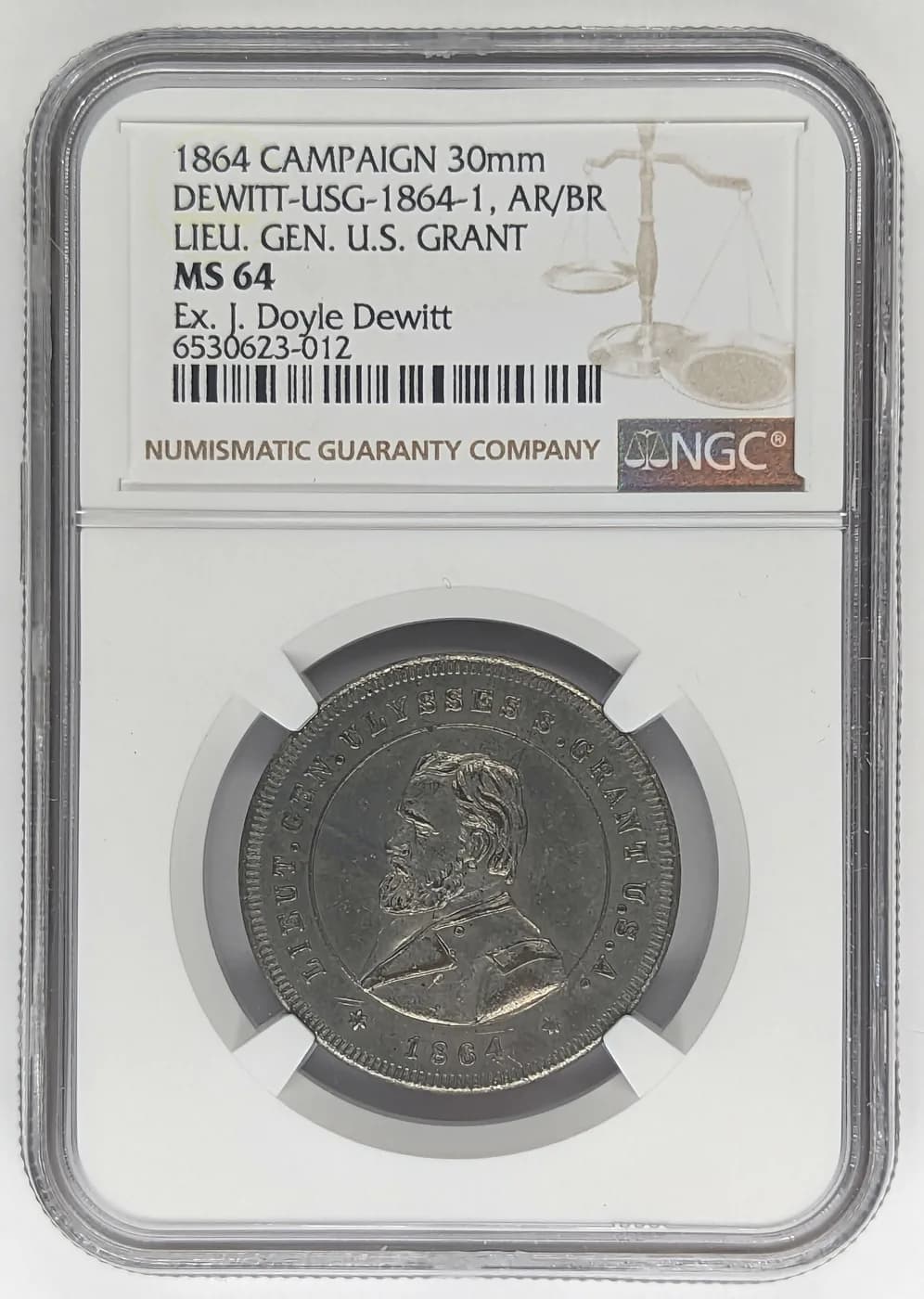
Grant is unusual among nineteenth-century candidates because medals bearing his portrait were being struck while he was still a serving general, before he was a candidate for anything. That gives the DeWitt USG series an unusual shape: 1864 pieces that are as much wartime commemoratives as campaign advertising, and 1868 pieces produced for the presidential run that followed. Understanding which is which changes how you read the cataloge and what you should expect to pay.
Why Do Grant Medals Exist Before He Ran for Anything?
Because by 1864 he was the most famous soldier in the country, and fame sold struck metal.
Grant took Vicksburg in July 1863, splitting the Confederacy along the Mississippi. He was promoted to lieutenant general in March 1864, the first officer to hold that rank substantively since Washington, and given command of all Union armies. For the remainder of the war he was the public face of Union victory.
Portrait medalets of popular generals were a normal commercial product of the period, sold to a public that wanted an image of the man in the newspapers. They were not campaign advertising, because there was no campaign.
This is why our 1864 Grant piece in silver, DeWitt USG 1864-1 sits slightly awkwardly under the word *campaign*. The cataloge includes it in the Grant sequence, but what it commemorates is a general at the height of his reputation, eighteen months before anyone nominated him for office.
What Happened in the 1868 Campaign?
Grant ran as the Republican nominee against Horatio Seymour, the former Democratic governor of New York, in the first presidential election after the Civil War and the first in which large numbers of freedmen voted in the reconstructed south.
Grant's campaign slogan, *Let us have peace*, came from his letter accepting the nomination, and it captured the appeal of a soldier as a stabilising figure after a decade of catastrophe. He won comfortably in the electoral college.
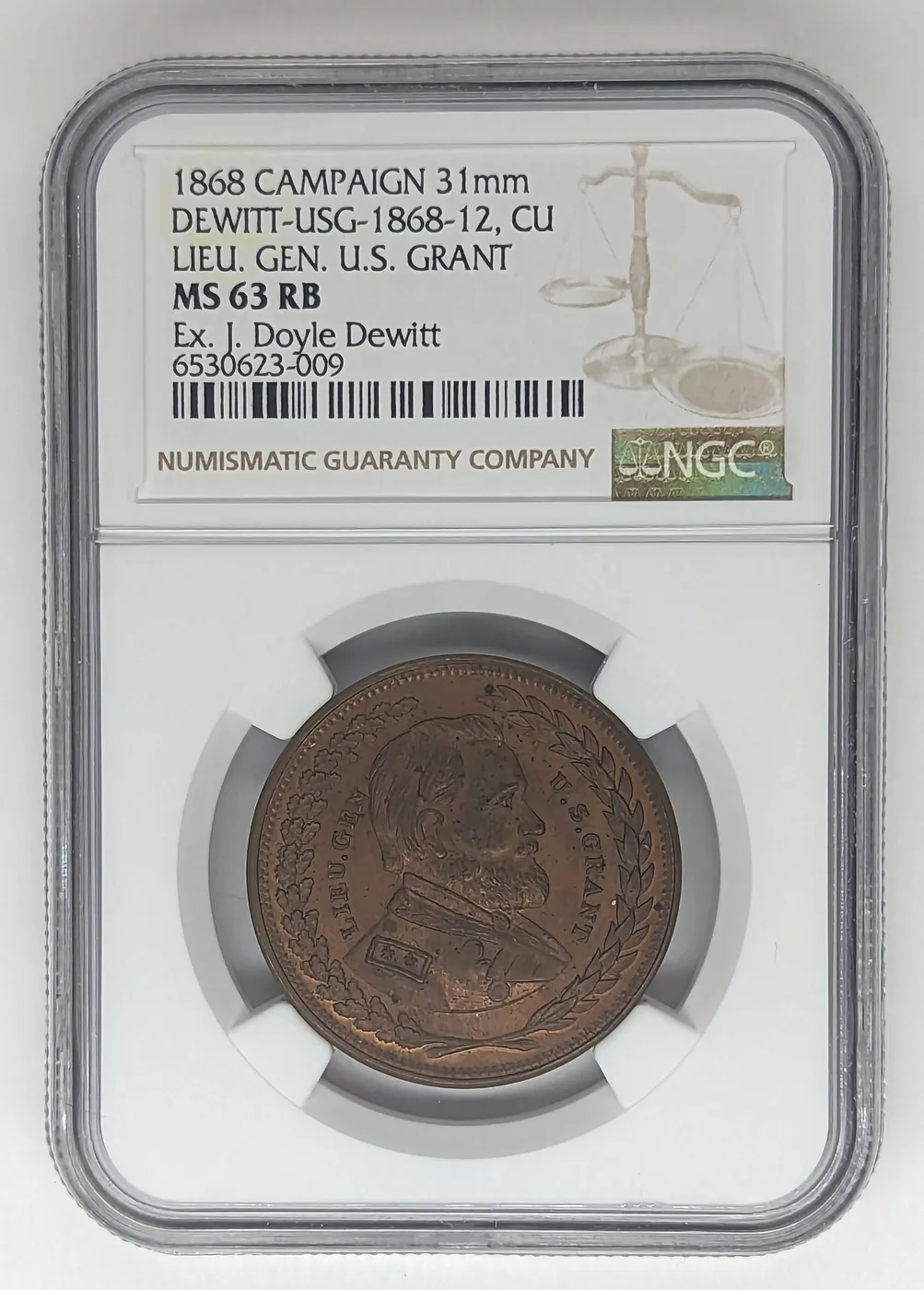
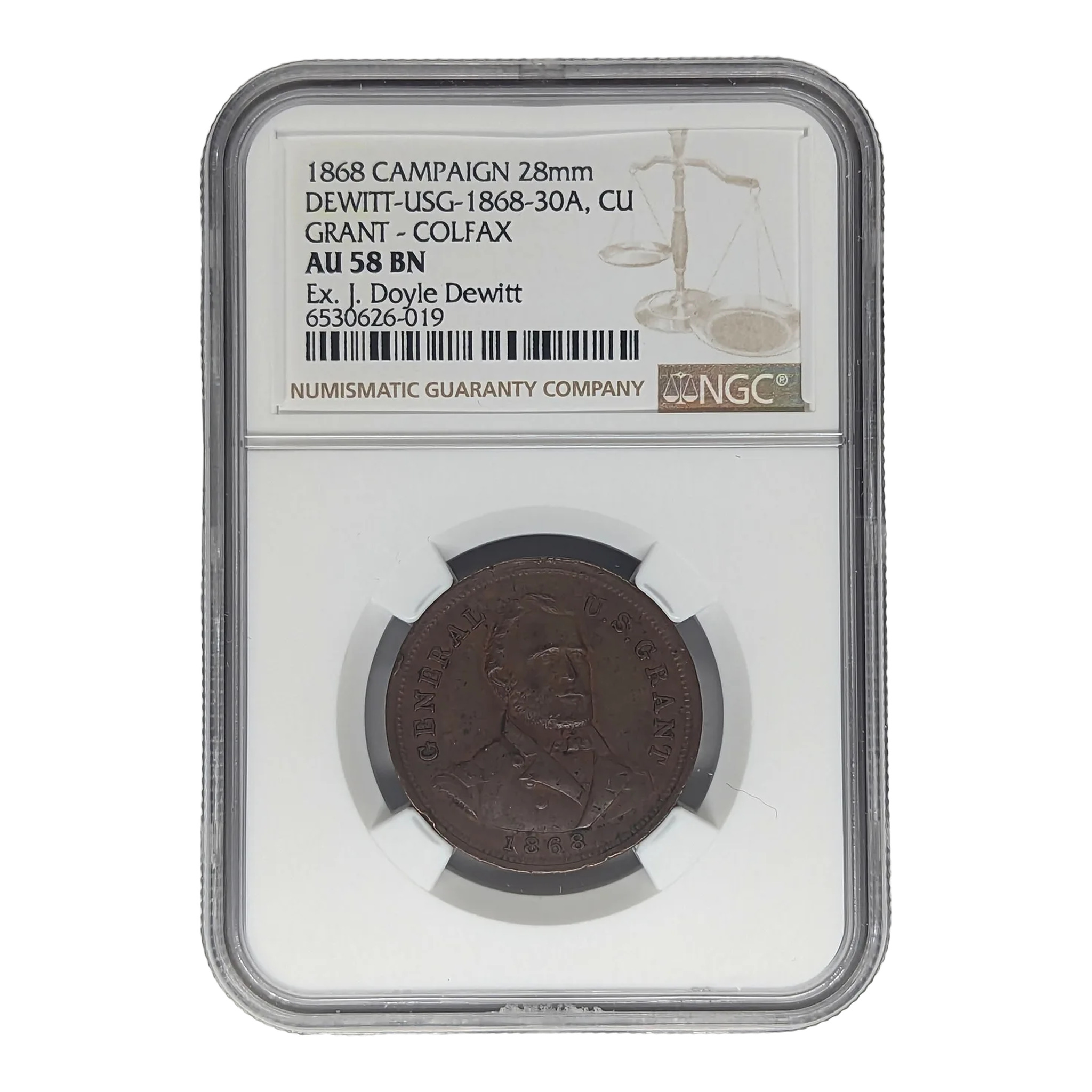
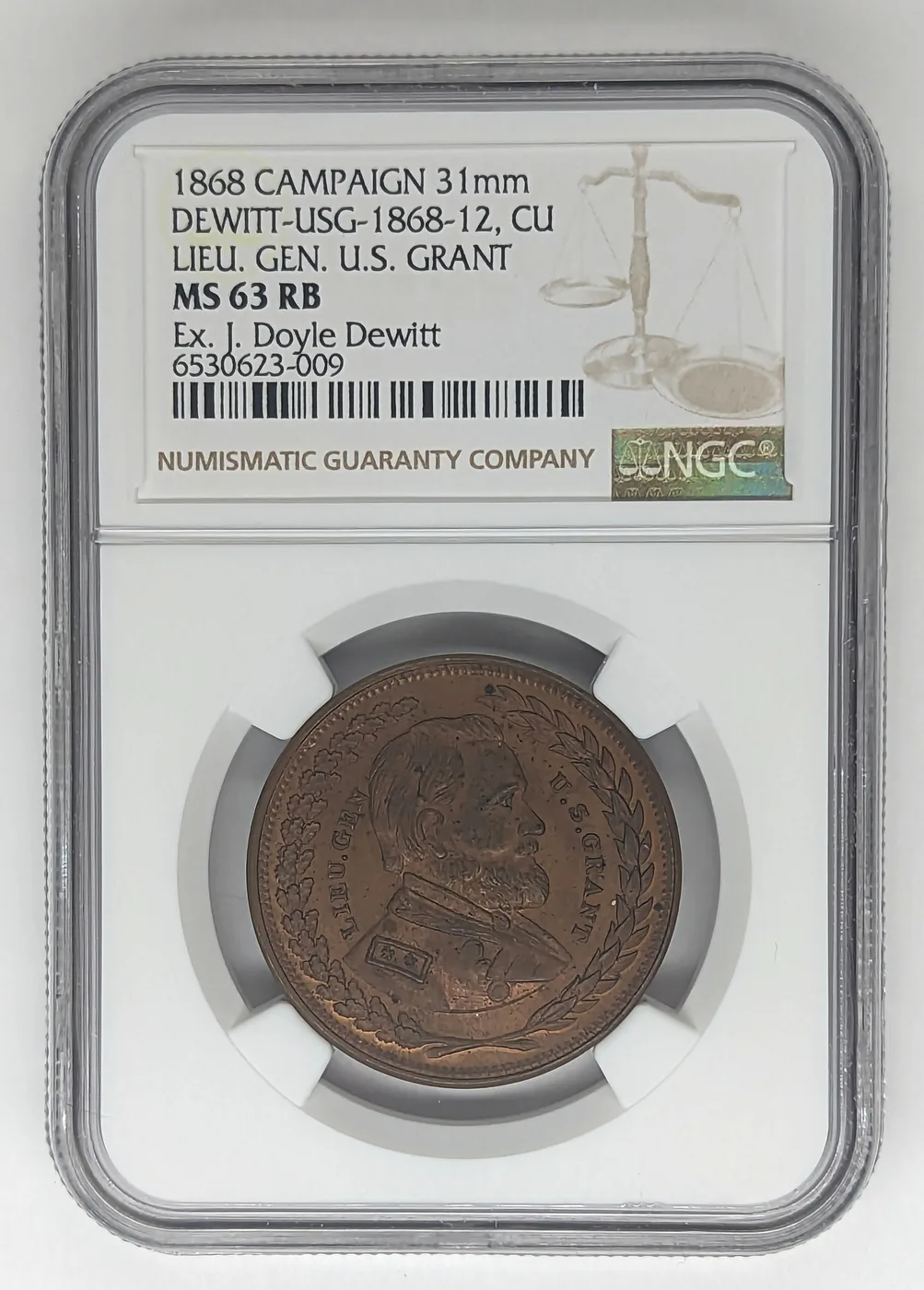
The 1868 campaign produced a large body of medalets on both sides, and it is the year in which the Grant series becomes genuinely a campaign series. Our stock runs across several designs, including USG 1868-8, USG 1868-11 in copper, USG 1868-14, USG 1868-28 and USG 1868-30.
| Year | Grant's status | What the medals are | Typical collector interest |
|---|---|---|---|
| 1864 | Lieutenant General, not a candidate | Commercial portrait commemoratives | Civil War collectors as much as political |
| 1868 | Republican nominee vs Seymour | True campaign medalets | Political Americana collectors |
| 1872 | Incumbent seeking re-election | Campaign medalets, second term | Less collected than 1868 |
How Should You Read the Opposed Pair?
One of the most satisfying ways to collect nineteenth-century campaign material is in opposed pairs: the two candidates of a single contest, held side by side.
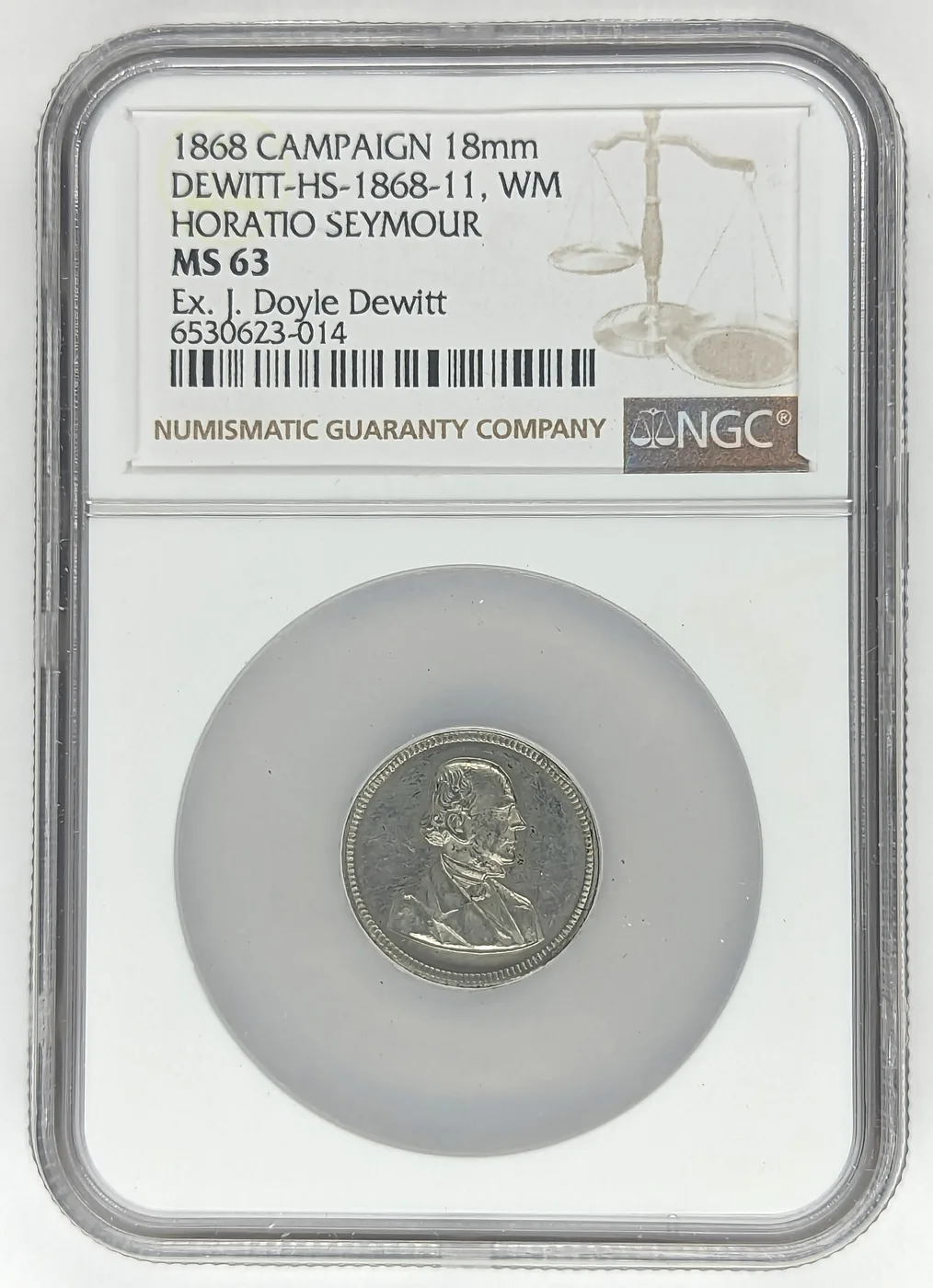
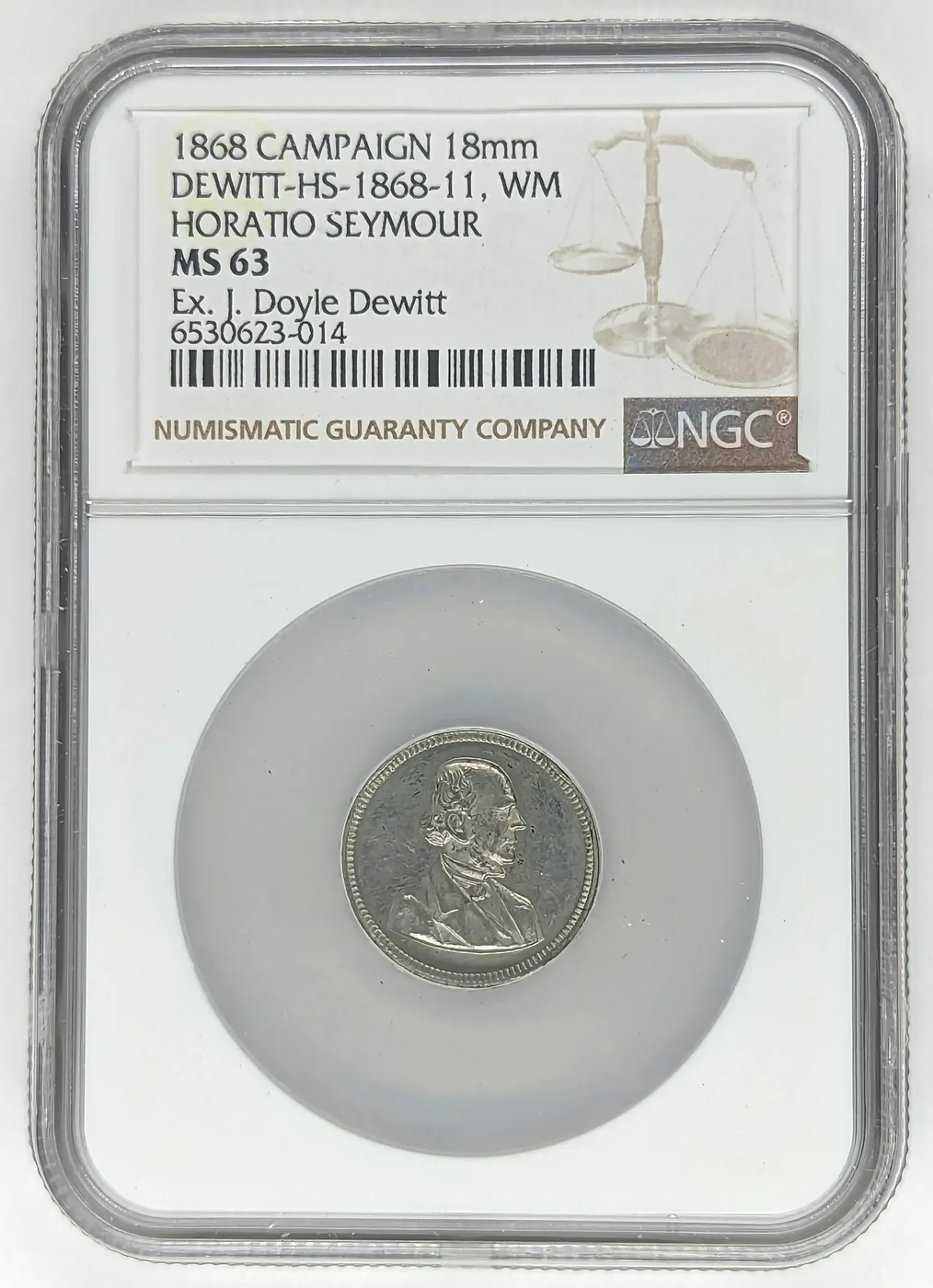
1868 supports this well because both series survive. Our archive carries Seymour in three metals from the same design, HS 1868-11 in white metal, in copper and in brass, which is a compact demonstration of the multi-metal principle within one cataloge number.
A Grant and a Seymour on the same shelf is the 1868 election as a voter met it: two coats, two rosettes, one argument about what the war had been for.
How Did These Medals Actually Reach Voters?
By hand, at events, and usually with a hole in them.
A campaign medalet was not a keepsake bought in a shop. It was distributed at rallies, club meetings and the torchlight processions that were the centerpiece of nineteenth-century campaigning, and it was meant to be worn where other people could see it. Most were struck with an integral loop above the portrait, or holed afterwards so a ribbon or a pin could be threaded through.
That history is written on the pieces themselves. A holed example is not damaged goods in the way a holed coin is: it is a medal that did the job it was made for. Collectors price unholed survivors higher because they are scarcer and photograph better, but an original suspension loop, intact and unbroken, is usually the more interesting object.
It also explains the wear you see. These pieces were carried in pockets and rubbed against coats for a season, then put in a drawer. Even a piece that never circulated as money often shows the soft, even rub of a few months of wear on the high points of the portrait, which is why grading services assign so many nineteenth-century medalets to the About Uncirculated range rather than to Mint State.
What About 1872?
Grant ran again in 1872 and won by a wider margin than in 1868, but the campaign left a thinner medallic record.
His opponent was Horace Greeley, the newspaper editor, nominated by the Liberal Republicans who had broken with Grant over Reconstruction and civil service reform, and then endorsed by the Democrats. It was an unusual coalition and an unhappy one. Greeley was heavily caricatured, lost decisively, and died within weeks of the election, before the electoral votes were counted.
For a collector, the practical consequences are simple. There is 1872 Grant material, and there is Greeley material, and both are legitimately part of the series. But the volume is lower than 1868, the designs repeat earlier types more often, and the whole campaign sits in the shadow of the two elections on either side of it. Prices reflect that: 1872 pieces are frequently the cheapest way into a Grant collection, and the Greeley material is the harder and more interesting half.
If you are assembling Grant by campaign rather than by design, 1872 is the year most collections are missing, and it is missing because nobody went looking rather than because the pieces are rare.
What Should You Look For?
Portrait quality first. Grant's likeness, the beard, the set of the jaw, is the object. Dies varied in quality across producers, and some 1868 portraits are considerably better than others. Buy the die you like.
Metal and its condition characteristics. White metal is bright when original and turns a flat grey when cleaned or when it has begun to oxidise. Copper should show either original red-brown or honest even brown; a copper medalet that has been brightened is easy to spot and hard to sell on. Silver examples such as the 1864 piece are the scarcest and warrant the closest inspection.
Holing and mounting. As with all campaign material of the period, expect it. Priced correctly, a holed medalet is an honest artefact rather than a compromised one.
Cataloge agreement. Check that the DeWitt number, the metal and the described design agree. Mismatches usually indicate a listing assembled from a reference rather than from the piece.
Frequently asked questions
Why are there Grant medals from 1864 if he did not run until 1868?
Because he was the most famous general in the country. Commercial portrait medalets of popular military figures were a normal product of the period, sold to a public that wanted an image of the man in the news. They are commemoratives rather than campaign advertising.
Who did Grant run against in 1868?
Horatio Seymour, the former Democratic governor of New York, in the first presidential election after the Civil War. Grant's slogan, Let us have peace, came from his letter accepting the nomination.
Are silver Grant medalets much scarcer than white metal?
Yes, substantially. Silver strikings were made in small numbers for presentation or collectors rather than for general distribution, so the same design can be readily available in white metal and genuinely scarce in silver.
Does a DeWitt USG number tell me whether a piece is 1864 or 1868?
The year is part of the designation, USG 1864-1 versus USG 1868-8, so yes, provided the full number is quoted. A bare design number without the year is ambiguous and should be clarified before purchase.
What is an opposed pair?
Two medals from the same election representing the opposing candidates, collected and displayed together. For 1868 that means Grant and Seymour, and it presents the contest as voters actually encountered it rather than as history recorded the winner.
Is 1872 Grant material worth collecting?
It is generally less collected than 1868, being a re-election campaign against a fractured opposition rather than the landmark first post-war contest. That can make it better value for a collector building the full Grant sequence.
Pieces from the collection
Examples handled here, cataloged with photographs and, where the piece was certified, its grading label. Sold pieces stay listed as a reference record.
 Sold
SoldMedals · 1864
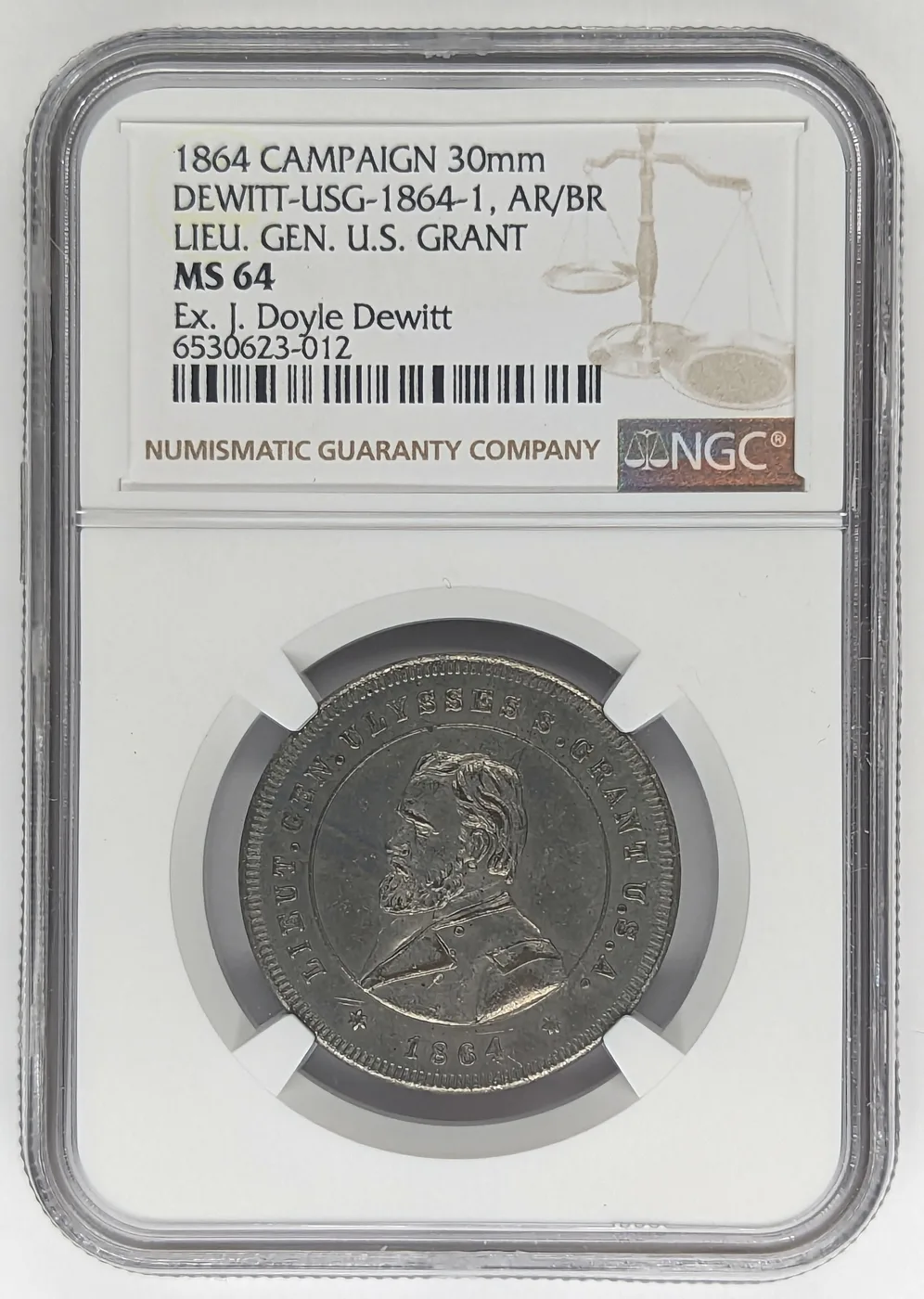
1864 Ulysses S. Grant Campaign Medal DeWitt USG 1864-1 Silver
Sold
 Sold
SoldMedals · 1868
1868 Ulysses S. Grant Campaign Medal DeWitt USG 1868-30
Sold
 Sold
SoldMedals · 1868
1868 Ulysses S. Grant Campaign Medal DeWitt USG 1868-11 Copper
Sold
 Sold
SoldMedals · 1868
1868 Horatio Seymour Campaign Medal DeWitt HS 1868-11 White Metal
Sold
More guides
Have one of these?
We buy outright, and we will value a piece for you whether or not you sell. Photographs and whatever paperwork you have are enough to start.