Autographs
Collecting Theodore Roosevelt Autographs: The Most Written President
10 min read
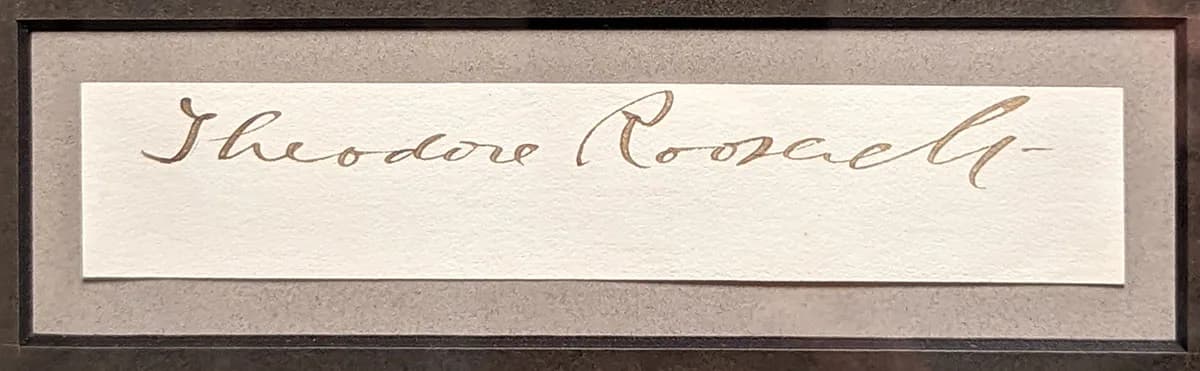
Theodore Roosevelt wrote more than any other American president, around forty books and an estimated correspondence running to six figures of letters, which makes his autograph unusually obtainable for a figure of his stature. He signed Theodore Roosevelt or T. Roosevelt, never Teddy, a nickname he disliked and never used himself. That single fact disqualifies a certain class of fake immediately. The collecting decisions that matter are period, form, and whether a piece connects to the presidency, the Bull Moose campaign of 1912, or the writing life that ran alongside both.
How Did Theodore Roosevelt Actually Sign His Name?
He signed Theodore Roosevelt in full, or T. Roosevelt in more informal or space-constrained contexts. Both are normal and both are genuine.
He did not sign Teddy. The nickname attached to him publicly, and produced the teddy bear, after the widely reported 1902 hunting trip on which he refused to shoot a captive bear, but Roosevelt himself disliked it and did not use it. Family and close friends called him Theodore or Ted.
This is the single most useful piece of knowledge a new collector of Roosevelt material can hold. A signature reading Teddy Roosevelt is wrong. It is not a variant, a casual form or an early style; it is a signature produced by someone who knew the nickname from popular culture and not the man from documents.
The hand itself is generally firm, angular and quickly written, with a strong forward slant. He wrote a great deal and wrote fast.
Why Is There So Much Roosevelt Material?
Because he wrote constantly, for his entire adult life, in a way no other president has matched.
His published output ran to roughly forty books across an implausible range, naval history, ranching, natural history, big-game hunting, biography, political essays and autobiography. *The Naval War of 1812* was published when he was twenty-three.
His private and official correspondence was vast. He maintained active written relationships with naturalists, politicians, soldiers, writers and family across decades, and the surviving letters run into very large numbers.
The practical consequence for collectors is unusual for a president of his rank: you can own a genuine Theodore Roosevelt letter without extraordinary expense. The scarcity premium that inflates Lincoln or Washington material does not apply in the same way.
Which Period Should You Collect?
Roosevelt had at least five publicly distinct careers, and material from each reads differently.
As Assistant Secretary of the Navy and Rough Rider (1897–1898), material connects to the Spanish-American War and to the volunteer cavalry regiment that made his national reputation.
As Governor of New York (1899–1900) and Vice President (1901), material is scarcer and often overlooked, a short window before the presidency.
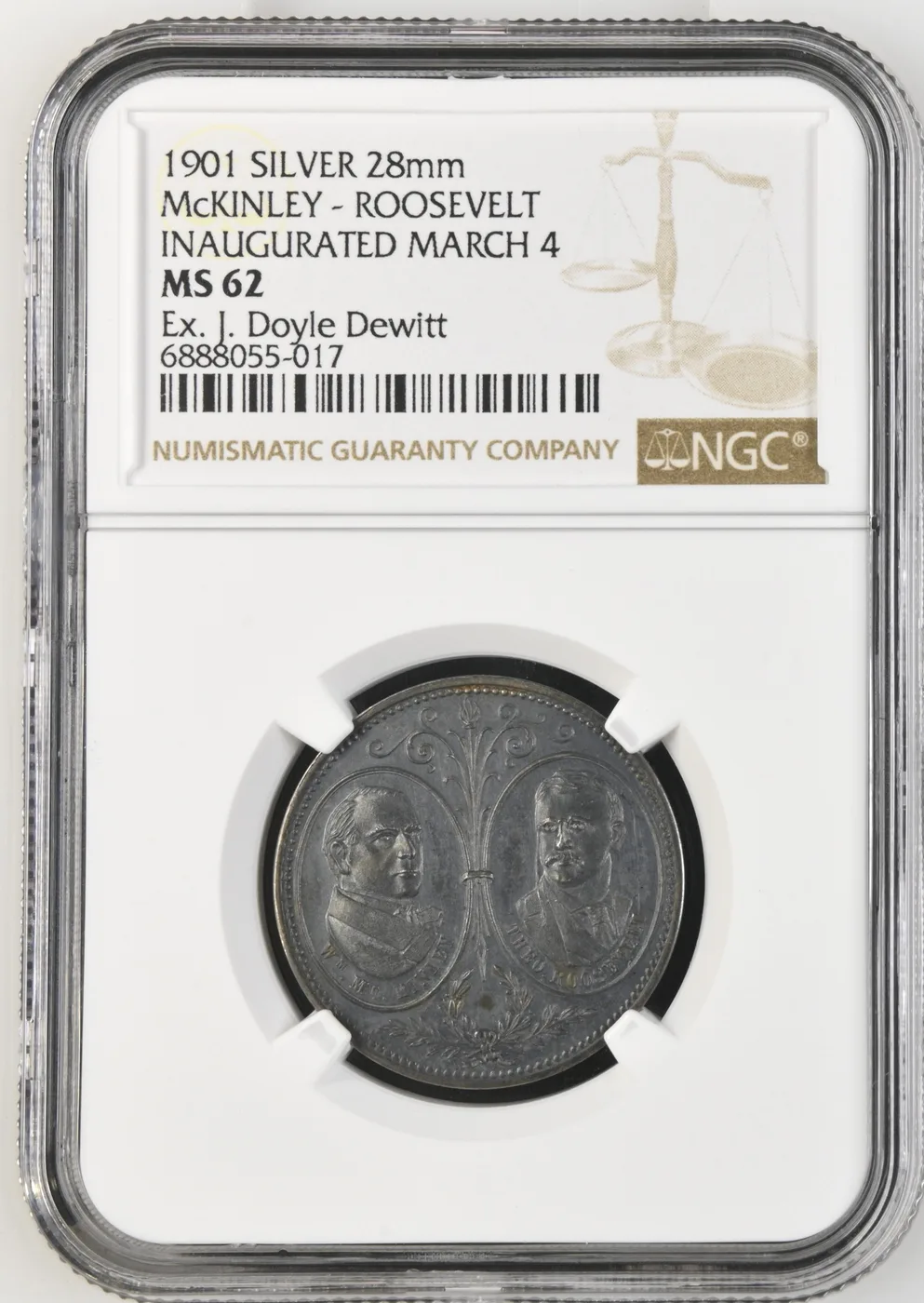
As President (1901–1909) he arrived through McKinley's assassination in Buffalo in September 1901, an event our archive touches through the 1901 Roosevelt–McKinley inaugural medal in silver at NGC MS62, struck for the March 1901 inauguration months before McKinley was shot.
As ex-President (1909–1912) he hunted in Africa and travelled, generating a distinctive body of correspondence.
As Progressive candidate (1912) he split the Republican party and ran under the Bull Moose banner, the most collectible phase for non-autograph material.
| Period | Years | What defines the material |
|---|---|---|
| Rough Rider | 1897–1898 | Spanish-American War, San Juan Heights, military correspondence |
| Governor / VP | 1899–1901 | Scarce, short window, state politics |
| President | 1901–1909 | Conservation, trust-busting, Panama, Nobel Peace Prize |
| Ex-President | 1909–1912 | African expedition, travel, writing |
| Bull Moose | 1912 | Progressive Party split; richest non-autograph material |
What Makes 1912 Bull Moose Material Special?
The 1912 campaign is the most visually distinctive episode in Roosevelt collecting, and it produced objects that a signature cannot match for character.
Having failed to take the Republican nomination from Taft, Roosevelt ran on the newly formed Progressive Party ticket. The Bull Moose name came from his own remark that he felt as fit as one, and the animal became the campaign's emblem. The election split the Republican vote and delivered the presidency to Woodrow Wilson.
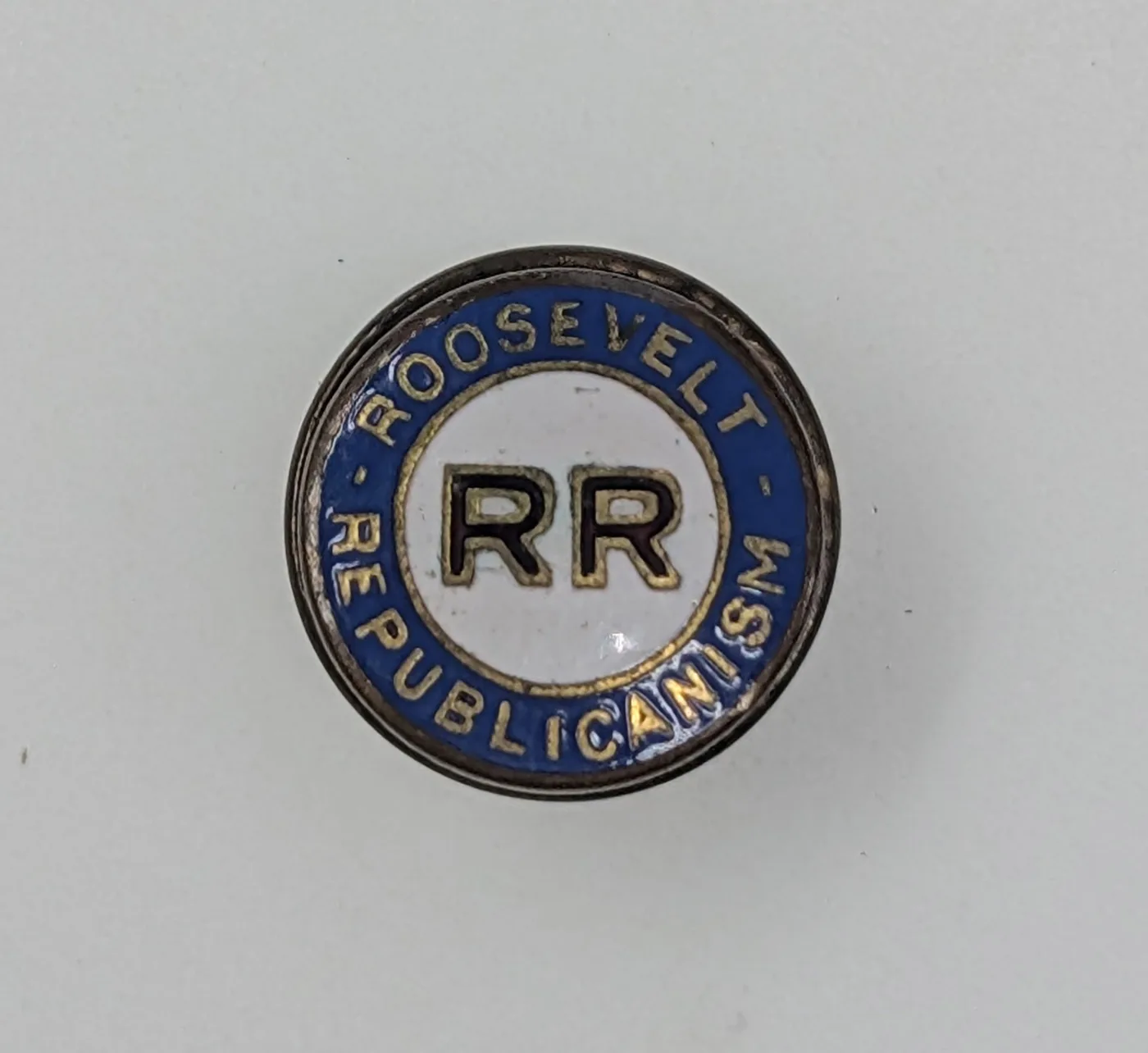
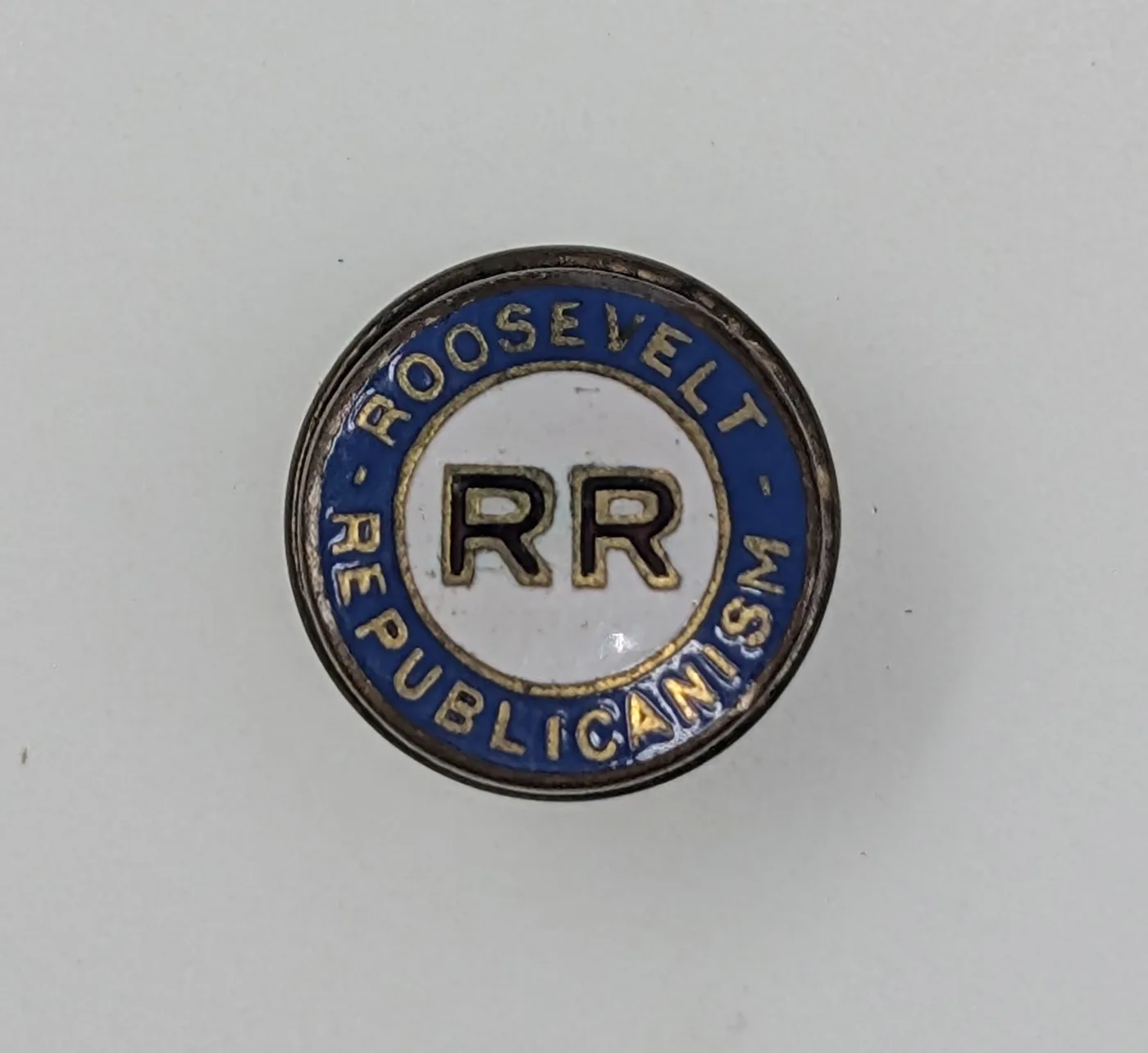
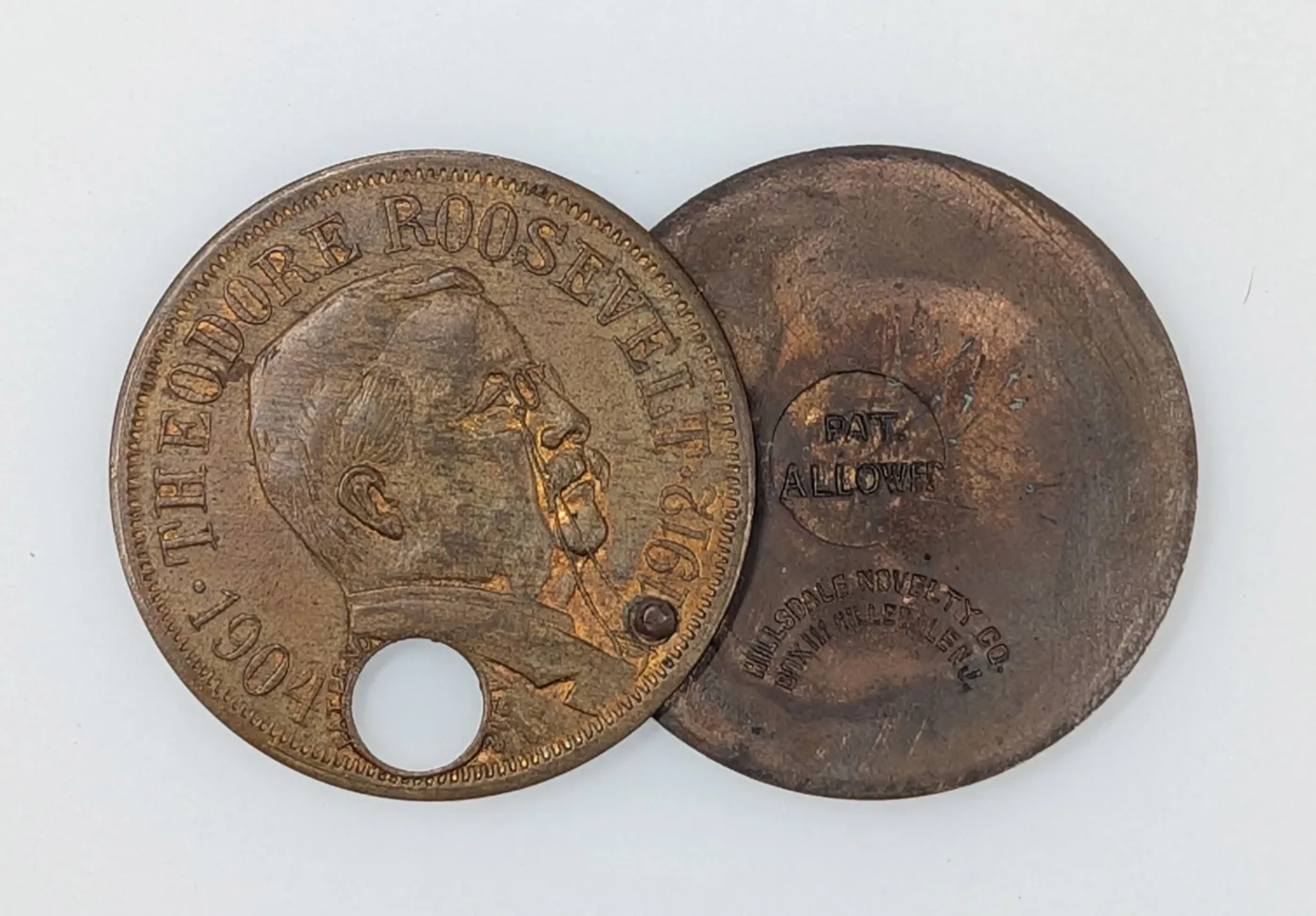
The material culture of that campaign was inventive. Our archive holds the 1912 Progressive lapel stud reading RR, Roosevelt Republicanism, a Roosevelt Club of Massachusetts stud, and a brass Bull Moose cigar cutter, a functional pocket object carrying campaign branding, which is exactly the sort of thing that survives in small numbers because it was used rather than saved.
A signature tells you Roosevelt existed. A campaign cigar cutter tells you what his supporters carried in their pockets.
How Do You Authenticate a Roosevelt Signature?
The same discipline applies as to any president, with one Roosevelt-specific advantage and one specific trap.
The advantage is abundance of exemplars. Because he wrote so much, and because so much is held in public institutions and published collections, there is a deep comparative base. An authenticator has a great deal to work from.
The trap is the secretarial hand during the presidency, which is a live issue here as everywhere. Volume forced delegation.
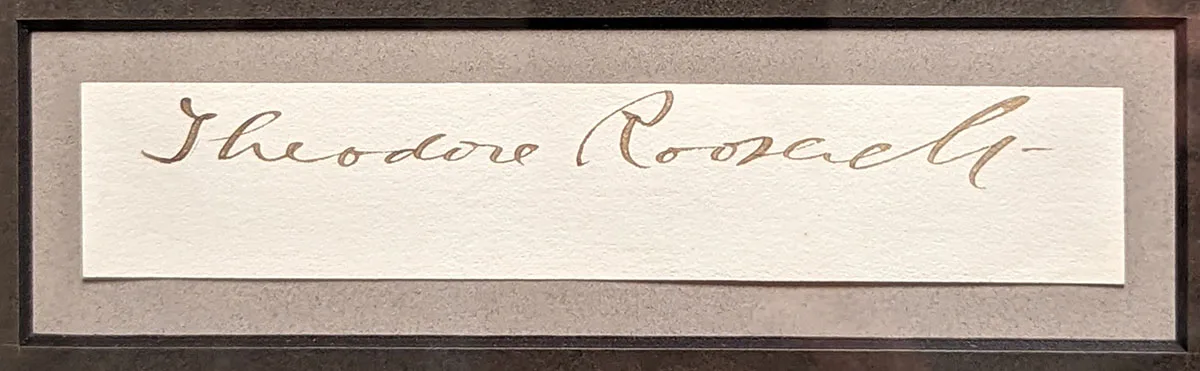
Practical checks: confirm the signature form is Theodore Roosevelt or T. Roosevelt and never Teddy; confirm the letterhead and addressee are consistent with the claimed period; and prefer material with content over cut signatures. Our own PSA/DNA-certified cut signature illustrates the form, clean and certified, but with the least contextual information of any autograph type, which is why cuts sit at the bottom of the value ladder.
As always, independent authentication is the floor, not the ceiling, of due diligence.
What Is the Post-Presidency Material?
The most interesting decade of his life on paper, and the phase collectors reach for last.
Roosevelt left office in March 1909 and went almost immediately to Africa on a collecting expedition for the Smithsonian, returning in 1910. He broke with his successor, ran in 1912, was shot before a speech in Milwaukee and finished it, and lost. In 1913 and 1914 he went down an uncharted tributary of the Amazon on the Roosevelt-Rondon expedition and came back with an infection and a fever that permanently damaged his health. He spent the war years arguing loudly for American intervention and against the administration. His youngest son Quentin, an aviator, was killed in France in July 1918. Roosevelt died the following January, aged sixty.
That decade produced letters of a kind the presidency did not. He was writing as a private citizen with nothing to lose, at length, often furiously, and frequently to people he considered equals rather than constituents.
It is also where the value sits for anyone who cares about content rather than the name. A routine White House note carries a presidential letterhead and very little else. A 1917 letter about the war, or an 1914 letter written while recovering from the Amazon, is a document with something in it.
Are Signed Books Worth Collecting?
Yes, and they are the most undervalued Roosevelt format.
He published roughly forty books, and they were not vanity projects: naval history, biography, ranching, hunting, natural history and politics, several of which remain in print. Copies signed or inscribed by him turn up regularly, because he signed for friends, colleagues, constituents and admirers over four decades.
The value hierarchy runs on association rather than on the book. A signature on a flyleaf is pleasant. An inscription naming a recipient, dated, in a title that connects to the recipient, is a document. An inscribed copy of *The Naval War of 1812* to a naval officer is worth several times a bare signature in a common later title.
Two cautions. Bookplates and later owner inscriptions are not provenance and are frequently mistaken for it. And condition rules are the book trade's, not numismatics': a rebacked spine, a trimmed edge or a supplied endpaper cuts value hard, and an inscription on a supplied leaf is a serious problem rather than a cosmetic one.
How Should You Read a Typed Letter From His Office?
As a genuine document with a signature that needs checking on its own terms.
Roosevelt dictated heavily, and the volume of correspondence leaving his office was industrial. A typed letter signed is therefore the commonest surviving form, and there is nothing second-rate about it: the text is his, the decision to send it was his, and the signature at the bottom is frequently his.
What varies is that last part. Offices of this period routinely used secretaries to sign routine acknowledgments, and the practice was neither hidden nor considered dishonest. The tell is usually consistency: a secretarial hand reproduces the same shapes at the same size letter after letter, while his own signature varies in speed, pressure and size with the circumstances of the day.
Read the letter, too, not only the signature. A dictated three-line acknowledgment of a gift is worth what it is. A typed letter with a handwritten postscript, a correction in his hand, or content that shows he actually engaged with what he was answering is a materially better object, and the market prices that difference less efficiently than it should.
How Should a Roosevelt Collection Be Built?
The most satisfying Roosevelt collections are thematic rather than exhaustive, because the man's range defeats completeness.
One approach is the writing life: signed books, letters about books, correspondence with naturalists and historians. It plays directly to what made him unusual.
Another is the 1912 rupture: the studs, badges, novelties and printed material of the Progressive campaign, anchored by one good signature from the same year.
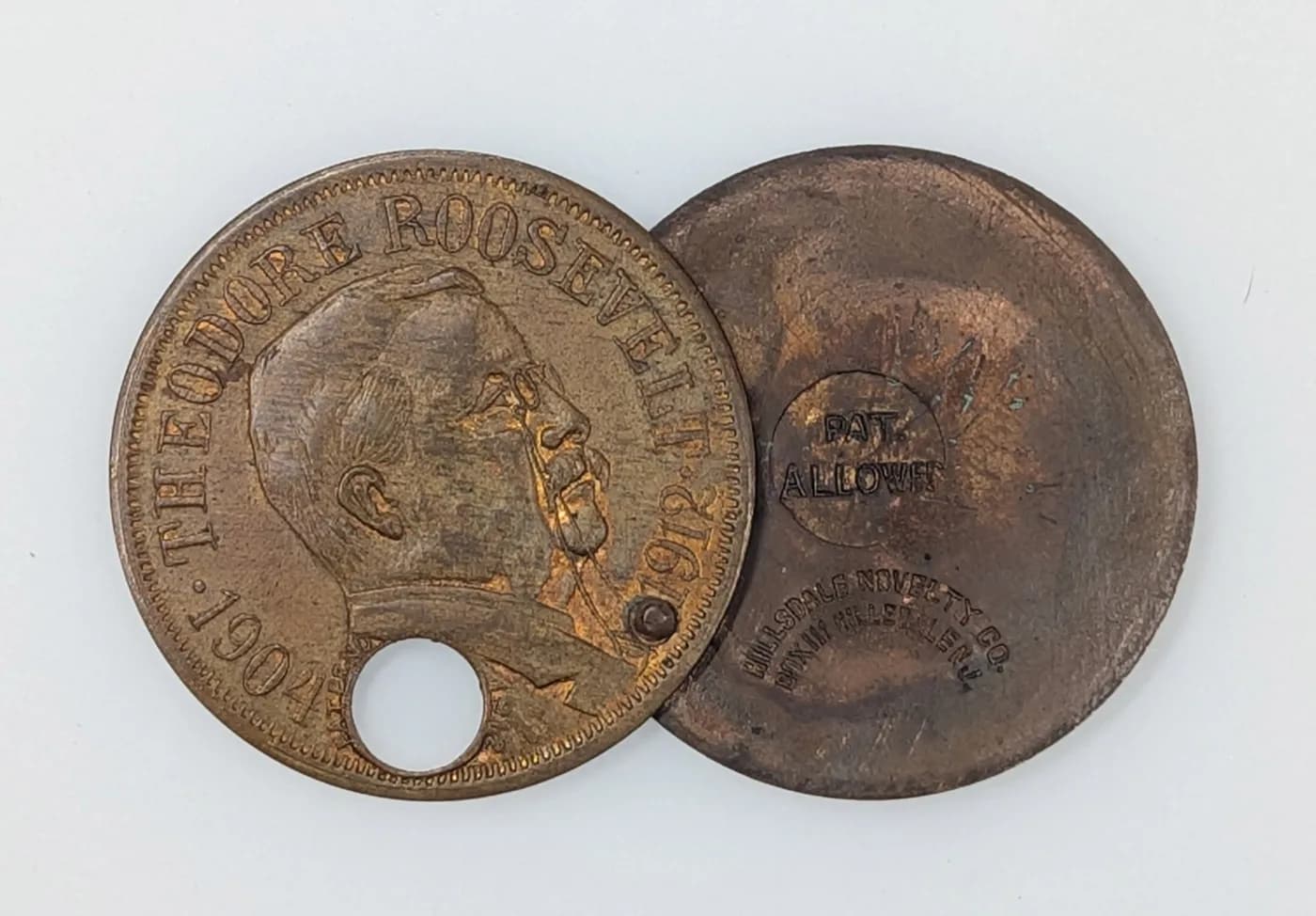
A third is the presidency in medals, which sidesteps autograph risk entirely and connects to the broader nineteenth-century political medal tradition, the ground our available stock occupies, from the 1868 Grant campaign medals through the 1892 Harrison issues.
Roosevelt sits at the hinge between the nineteenth-century medal tradition and the twentieth-century button-and-badge era, which makes him an unusually good organising figure for a collection that wants to span both.
Frequently asked questions
Did Theodore Roosevelt ever sign his name as Teddy?
No. He disliked the nickname and did not use it. He signed Theodore Roosevelt in full or T. Roosevelt informally. A signature reading Teddy Roosevelt should be treated as a decisive warning sign.
Are Theodore Roosevelt autographs expensive?
Less so than most presidents of comparable stature, because he was an exceptionally prolific writer and a large body of genuine material survives. Content and period drive price far more than the signature itself.
What is Bull Moose material?
Campaign items from Roosevelt's 1912 run on the Progressive Party ticket, after he failed to take the Republican nomination from Taft. The nickname came from his own comment that he felt fit as a bull moose, and the animal became the party's emblem.
Is a cut signature worth collecting?
It is the least valuable autograph form, because it carries no content, no date and no context, only the signature. It is a reasonable way to acquire a name inexpensively, but a letter with substance will always be the better object.
Why does the 1901 inaugural medal name both Roosevelt and McKinley?
Because they were inaugurated together in March 1901 as President and Vice President. McKinley was shot in Buffalo that September and died days later, which made Roosevelt president, so the medal shows the ticket months before the event that transformed it.
How many books did Theodore Roosevelt write?
Around forty, across naval history, natural history, ranching, hunting, biography, political essays and autobiography. He published his first, a history of the naval War of 1812, at twenty-three.
Pieces from the collection
Examples handled here, cataloged with photographs and, where the piece was certified, its grading label. Sold pieces stay listed as a reference record.
 Sold
SoldAutographs
Theodore Roosevelt Hand Signed PSA/DNA COA Autographed Cut
Sold
 Sold
SoldCampaign Items · 1912
1912 Theodore Roosevelt Progressive Lapel Stud RR Roosevelt Republicanism
$100
 Sold
SoldEphemera · 1912
Theodore Roosevelt 1912 Bull Moose Cigar Cutter Brass
$129
 Sold
SoldMedals · 1901
Rare Silver 1901 Roosevelt McKinley NGC MS62 Inaugural Medal March 4 1901
$1,095
More guides
Have one of these?
We buy outright, and we will value a piece for you whether or not you sell. Photographs and whatever paperwork you have are enough to start.