
Autographs
Collecting Franklin D. Roosevelt Autographs: Twelve Years, Four Terms and a Signature That Aged
10 min read
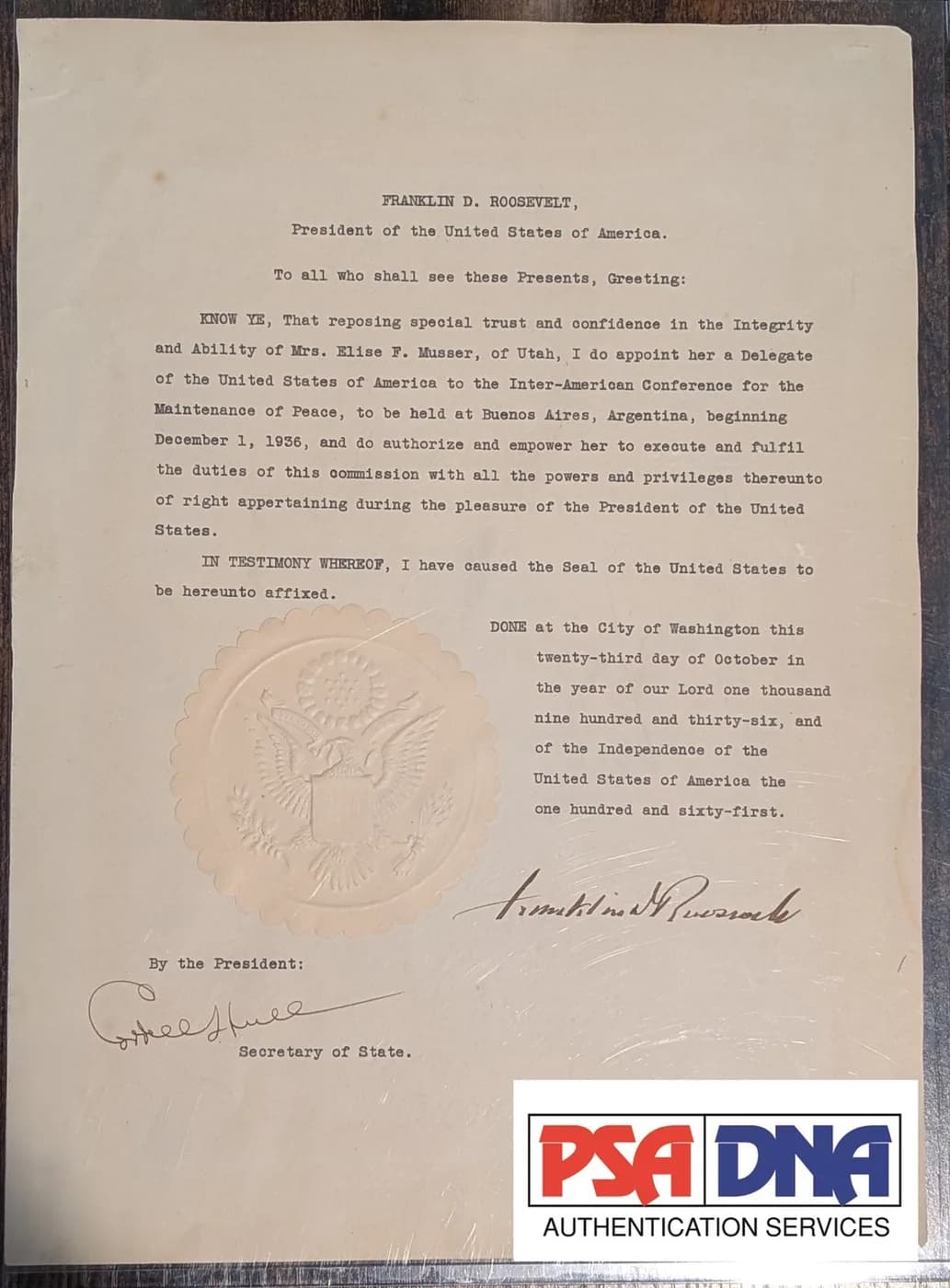
Franklin D. Roosevelt signed more official paper than any president before him, twelve years in office across four elected terms, spanning the Depression and the Second World War. That volume cuts both ways for collectors: genuine Roosevelt signatures are more available and more affordable than Kennedy's, but the same volume forced heavy use of secretarial signers and mechanical aids. His hand also visibly deteriorated in the final years as his health failed, which is both an authentication tool and a dating tool if you know how to read it.
Why Is FDR Material More Available Than Other Presidents'?
The arithmetic is straightforward. Roosevelt was elected president four times and served from March 1933 until his death in April 1945, twelve years and one month, against the two-term maximum every president since has faced under the Twenty-Second Amendment, which his tenure directly prompted.
Twelve years of correspondence, commissions, appointments, photographs and presentation pieces is a very large quantity of signed paper. It entered the market steadily through the twentieth century and continues to.
For a collector this is good news with a caveat. Availability lowers price but does not lower risk. The same volume that makes genuine material obtainable also made personal signing impossible at scale, which is why the secretarial question is as live here as with any president.
How Did His Signature Change Across the Terms?
The Roosevelt signature is unusually useful for dating, because it moved in a consistent direction over the presidency.
The early hand, the governorship and first term, is firm, fluent and comparatively large, with a confident, sweeping capital F and R and good baseline control. This is a man signing quickly but in full command of the pen.
Through the middle terms the hand compresses and speeds up, as it does for most presidents under volume pressure.
The final period is the distinctive one. From roughly 1944, as his cardiovascular health collapsed, the signature loses control: the line grows shaky, letters become irregular, and the whole signature can appear noticeably diminished. This is genuine and it is important. Inexperienced buyers reject late Roosevelt signatures as forgeries precisely because they look weak, and dishonest sellers occasionally exploit the confusion in the other direction.
| Period | Characteristics | Collector note |
|---|---|---|
| Pre-1933 | Firm, large, fluent; full letterforms | Governor and campaign material; less status, often better hand |
| 1933–1940 | Confident but faster; some compression | Depression-era policy content is the draw |
| 1941–1943 | Tighter, more abbreviated | Wartime content commands premiums |
| 1944–1945 | Shaky line, irregular letters, weaker pressure | Genuine but often wrongly doubted; the last months are historically significant |
What Is the Secretarial and Mechanical Signing Problem?
Two separate issues get collapsed into one and they are worth separating.
Secretarial signing means a member of staff signed the president's name by hand. These are skilled imitations produced with authority, and the better ones are genuinely difficult. They are not rare on routine Roosevelt correspondence.
Mechanical signing means a device reproduced a signature, either by stamp or by a pen-holding machine. A mechanical signature is identical to other examples from the same pattern, which is the tell: two signatures that superimpose exactly cannot both be hand-produced, because no human signs the same way twice.
That superimposition test is the most practical check available to a private buyer. If you can compare a candidate signature against known examples and they match too well, that is not confirmation, it is the opposite.
What Content Is Worth Paying For?
Roosevelt's presidency covers two of the largest subjects in modern history, and content premiums follow them.
Wartime and diplomatic material is the strongest category. Anything touching the conduct of the war, alliance relations, or the wartime conferences carries a premium over domestic routine. The peace conference autograph in our archive sits in this territory.
New Deal policy content is the second tier, letters connected to specific programmes, agencies or appointments that can be researched and placed.
Routine acknowledgements and thanks carry no content premium at all, and are the items most likely to have been signed by staff.
The general rule holds across all presidential autographs: pay for the document, not for the name. A name on an empty page is the most forgeable and least interesting thing in the field.
Are Inauguration Medals a Better Entry Point?
For a great many collectors, yes, and it is worth saying plainly rather than burying.
An official inauguration medal is struck metal with a documented issuing authority, a fixed design, a cataloge identity and, when certified, an independent grade. It cannot be secretarially signed, it cannot be autopenned, and its authentication problem is close to nil compared with a signature.
Roosevelt's four inaugurations produced official medals across the series. Our archive includes the 1933 first inauguration medal in bronze at NGC MS64 and the 1937 second inauguration medal at MS67, the latter an exceptional grade for a medal of that period.
A collector assembling all four inaugurations has a defined, completable project with a clear finish line. A collector assembling Roosevelt signatures has an open-ended pursuit with an authentication tax on every purchase. Both are legitimate; they are not equally suited to everyone.
Why Are There Four Inauguration Medals?
Because there were four inaugurations, which has happened to no other president and cannot happen again.
Roosevelt was inaugurated in March 1933, January 1937, January 1941 and January 1945. The move from March to January came with the Twentieth Amendment, ratified in 1933, so his first term is the last to begin in the old month. The Twenty-Second Amendment, ratified in 1951, made the two-term limit law, which is why the set stops at four permanently.
Each inauguration produced an official medal, and they are not equally easy to find. The 1933 and 1937 issues came at moments of enormous public attention and were produced accordingly. The 1945 ceremony was a wartime austerity affair held on the South Portico of the White House rather than at the Capitol, lasting a matter of minutes, and Roosevelt was dead within three months.
For a collector this is an unusually satisfying run: four objects, a fixed and complete series, each one dated and officially issued, spanning the Depression, the New Deal and the war. Our archive has included both the 1933 first inauguration medal in bronze and the 1937 second inauguration medal, the latter in an exceptional grade for a piece of this size.
Where Does Eleanor Roosevelt Material Fit?
Alongside his, and it is consistently underpriced relative to its historical weight.
Eleanor Roosevelt wrote and signed prolifically for four decades. Her newspaper column ran six days a week from 1935 into the early 1960s, she answered correspondence in enormous volume, and after his death she chaired the commission that drafted the Universal Declaration of Human Rights, adopted in 1948. She is not a supporting figure with a famous surname; she is a principal in her own right.
Because she signed so much, her material is affordable. A genuine Eleanor Roosevelt signed letter frequently costs a fraction of a comparable Franklin item, and the content is often better, because she wrote personally and at length where he dictated briefly.
The same authentication cautions apply. Her office also used secretarial signers, and volume plus low prices is exactly the combination that discourages careful checking. Buy certified where the price justifies it, and read the hand for the same consistency of construction and pressure you would look for on his.
How Does FDR Compare With Other Presidents to Collect?
He sits in the comfortable middle, which is the whole argument for starting here.
The early presidents are a different market. Washington and Lincoln material is scarce, heavily forged and expensive enough that a single acquisition is a considered decision rather than a purchase. Nineteenth-century figures below that tier vary enormously, and much of what survives is routine official paper signed in a hand that changed little across a career.
Roosevelt's twelve years in office, his volume of correspondence and the survival rate of mid-century paper mean genuine, certified, interesting material is continuously available at prices that do not require a specialist budget. The signature also changes visibly across the terms, which gives a collector something to study rather than simply to own.
The counterweight is the secretarial and mechanical signing problem discussed above, which is worse for him than for most. Availability and risk arrive together. The honest summary is that FDR is an excellent president to learn on precisely because the material is plentiful enough that you can afford to be fussy, and you should be.
What Should a First Purchase Be?
A certified, dated item with content, bought from a seller who will take it back.
The temptation with a president this available is to buy the cheapest genuine signature and call the box ticked. It is a poor first purchase, because a bare signature teaches you nothing about the hand and gives you nothing to compare later acquisitions against. A signed letter with a date on it, even a routine one, anchors a collection: you can see where it falls in the progression of the signature, and you have a reference point in your own hands.
Buy certified for the first piece regardless of price. Learning to read the hand is what the second and third purchases are for, and paying a modest premium to remove the authentication question from the first one is a reasonable trade.
Set a budget that leaves room to be wrong. The most useful thing a first purchase does is show you what you actually want to collect, and that answer is frequently not the one you started with.
How Do You Verify Before You Buy?
Work through this in order, and stop at the first failure.
Is it independently authenticated? PSA/DNA and comparable services are the baseline for presidential signatures. A seller-issued certificate is not an answer to this question.
Does the hand match the claimed date? A firm, sweeping 1944 signature is a problem. A shaky 1934 signature is a different problem. The period must agree with the ink.
Does the document make sense? Letterhead, addressee, subject matter and date should form a coherent whole. Forgers reproduce signatures far more competently than they reproduce administrative context.
Has it been altered since certification? Compare the item in front of you to what the certificate describes. Trimming, remounting and separation from envelopes are common and material.
If all four hold, you are buying on evidence rather than on hope.
Frequently asked questions
Why is my FDR signature so shaky, is it fake?
Not necessarily. Roosevelt's health declined sharply from 1944, and his signature weakened visibly in the final year of his life. A shaky signature on a late-dated document is consistent with the period; a shaky signature on an early-dated one is a genuine warning sign.
Are FDR autographs a good first presidential autograph?
They are among the more accessible, because twelve years in office produced a large body of signed material. But accessibility is about price, not safety, the secretarial and mechanical signing problems still require independent authentication.
How do I spot a mechanically produced signature?
Compare it against other examples. A device reproduces the same pattern every time, so two mechanical signatures will superimpose almost exactly. No human signature matches another that precisely.
What FDR content carries the biggest premium?
Wartime and diplomatic material, particularly anything connected to the conduct of the Second World War or to the wartime conferences. New Deal policy content is the next tier; routine correspondence carries no content premium.
Why are there four Roosevelt inauguration medals?
Because he was elected president four times, in 1932, 1936, 1940 and 1944, and each inauguration produced an official medal. No president since has had the opportunity, as the Twenty-Second Amendment now limits presidents to two elected terms.
Is an inauguration medal a substitute for an autograph?
Not a substitute, but a complement, and a far lower-risk one. A struck, cataloged and certified medal removes the authentication burden almost entirely, which makes the four-medal inauguration set a clean project for collectors who want Roosevelt material without signature risk.
Pieces from the collection
Examples handled here, cataloged with photographs and, where the piece was certified, its grading label. Sold pieces stay listed as a reference record.
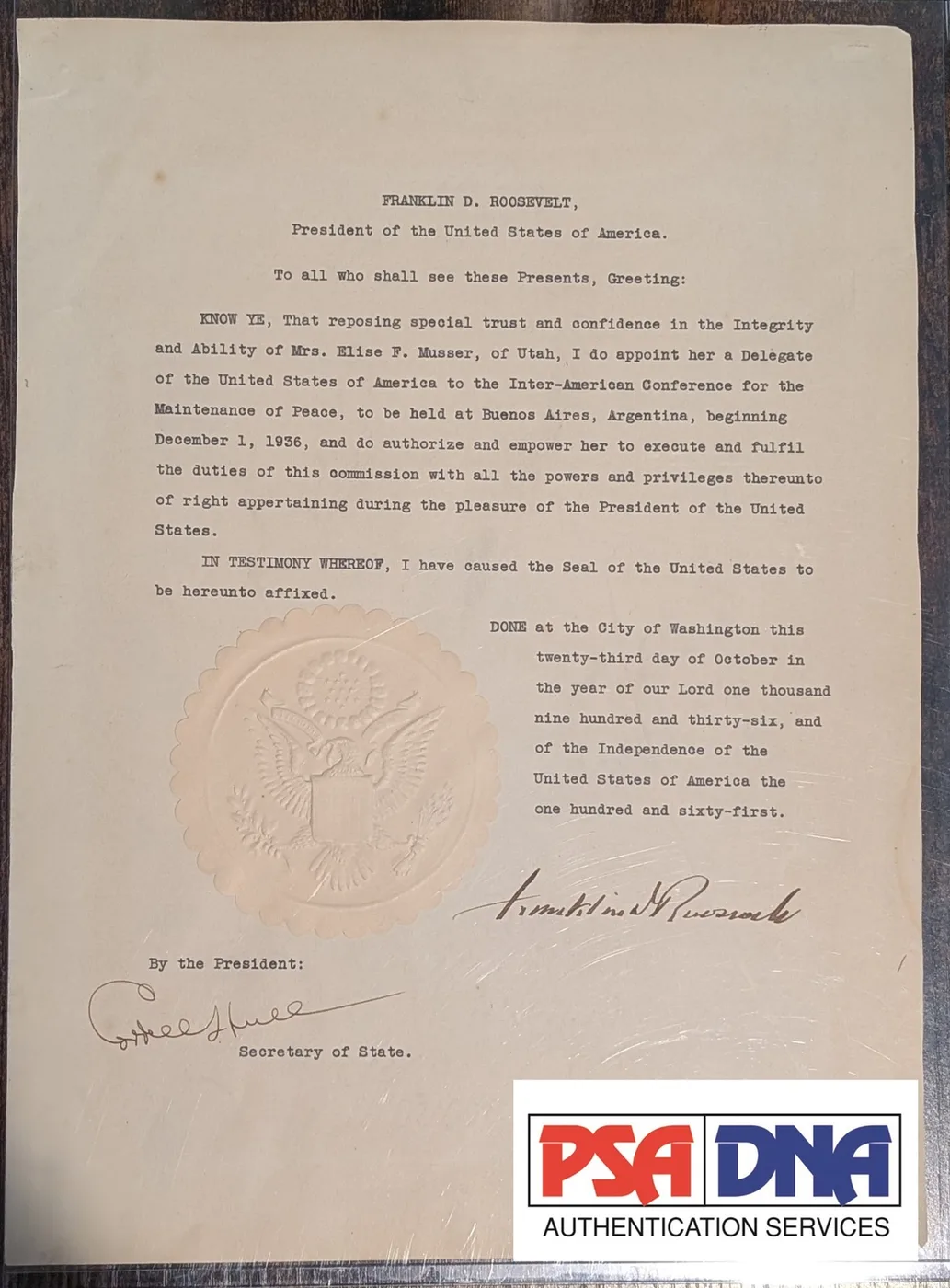 Sold
SoldAutographs
FDR Franklin Delano Roosevelt Peace Conference Signed Autograph Psa/dna
$650
Medals · 1933
1933 Franklin Roosevelt MS64 NGC Bronze 1st Inauguration Official Medal
Sold
Medals · 1937
1937 Franklin Roosevelt MS67 NGC Bronze 2nd Official Inauguration Medal
Sold
More guides
Have one of these?
We buy outright, and we will value a piece for you whether or not you sell. Photographs and whatever paperwork you have are enough to start.